
Mahindra BE 6 SPORTEQ BaaS Explained
Mahindra's dual loan BaaS scheme for the BE 6 SPORTEQ splits the car and battery into two loans with different tenures. Here's the actual math, and why a single loan of the same amount works out Rs 69,341 cheaper over the full tenure.


Category:
Tag:
- Mahindra BE 6 SPORTEQ
- Battery as a Service
We covered how 'Battery as a Service' or BaaS works in a previous article. We received multiple queries to explain the BaaS cost when the Mahindra BE 6 SPORTEQ was launched.
As explained earlier, the BaaS scheme is a dual loan option and not a per kilometer running cost. The user takes 2 loans — one for the car and another for the battery from the same lender which primarily is a partnered Non Banking Financial Corporation (NBFC) of the OEM.
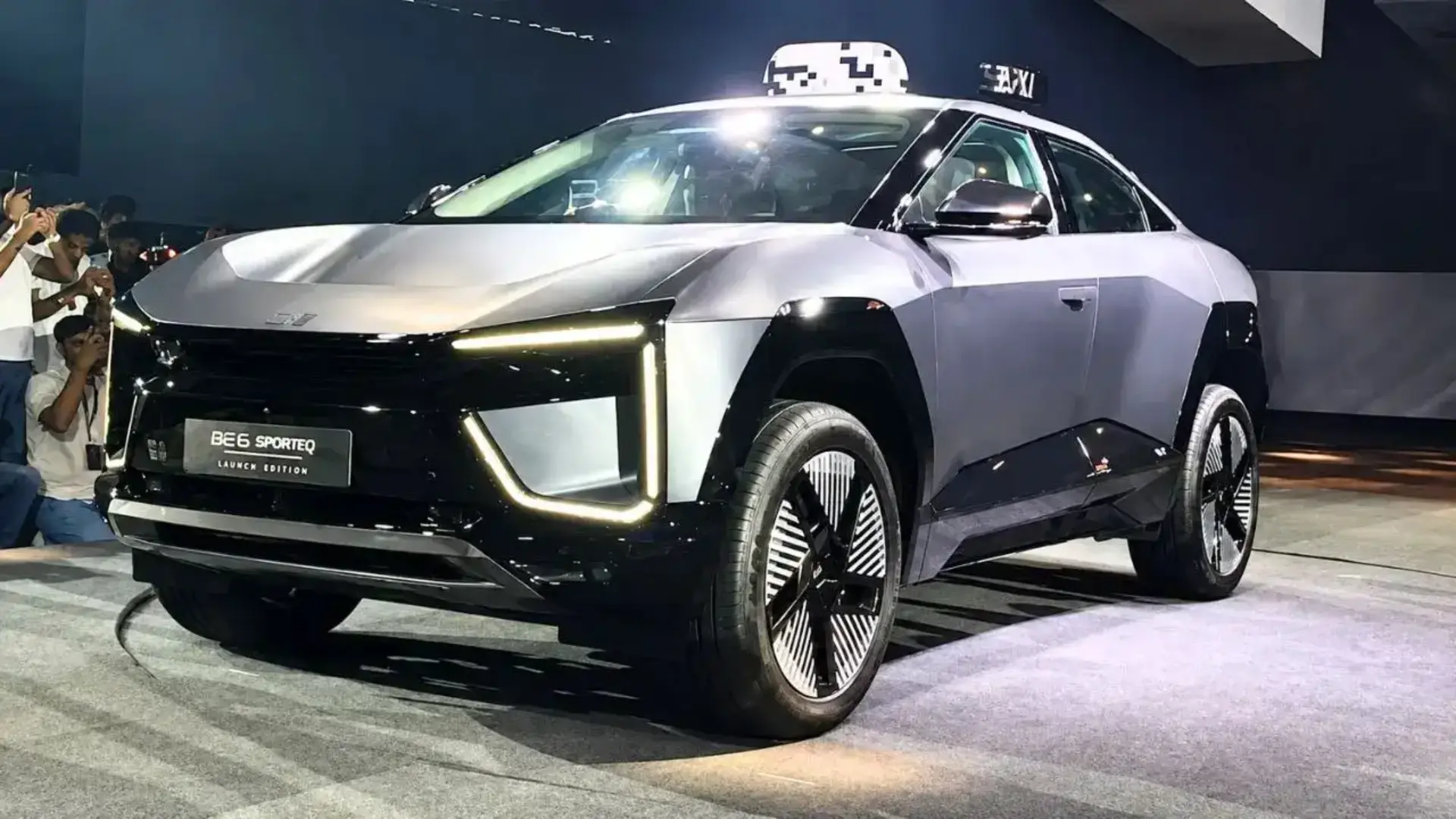
The BaaS scheme is offered in 2 variants of the BE 6 SPORTEQ — SPORTEQ One and SPORTEQ Two. Taking the former as example, the ex-showroom price of the car is ₹19.45 Lakh but under the dual loan finance the car costs ₹11.45 Lakh ex-showroom and a separate ₹8 Lakh for the battery.
In a best case scenario, the lender gives 100% loan-to-value (LTV) for the car and ~62% for the battery. This means a car loan of ₹11.45 Lakh and a battery loan of ₹4,93,397. A down payment of ₹3,06,603 needs to be made. The tenure of these 2 loans differ. The car loan is for 5 years whereas the loan for the battery is for 8 years.
Calculations
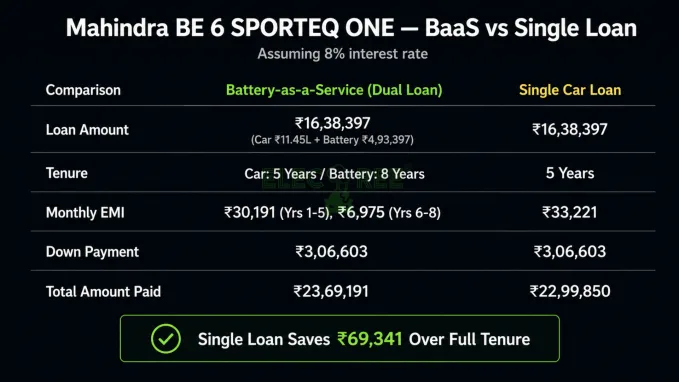
Assuming the rate of interest to be 8%, the car loan will entail an EMI of ₹23,216 and for the battery the installment will be ₹6,975. This means a total EMI of ₹30,191 for the first 5 years and ₹6,975 for the additional 3 years of the battery's loan.
At the end of 8 years, the customer pays ₹20,62,588 for the total loan taken. Adding the down payment — the total amount paid is ₹23,69,191.
If the user takes a single car loan of the same amount which in this case is ₹16,38,397 for 5 years at the same 8% rate of interest — the EMI will be ₹33,221 and total amount paid after the loan ends is ₹19,93,247. Including the down payment the amount equals ₹22,99,850.
A single loan therefore leads to a saving of ₹69,341.
Mahindra advertises this as ₹3.75 per km, which stems from the assumption that user will have a monthly running of 1860 kms. As 6975 ÷ 1860 equals 3.75.
Answering some FAQs
Due to the confusing nature of the dual loan scheme there are a few questions which we would like to address.
- Can I take just the battery loan while paying the amount for the car in full?
Ans: No. Under Battery as a Service, the user needs to take 2 loans. If a single loan is opted for then it is just like a single car loan with lower principal amount. - The amount saved by not paying for the battery upfront can be invested in Fixed Deposits for better returns. Will this not be beneficial?
Ans: Since the final loan amount in single loan case scenario and BaaS will be the same — the upfront cost saved will be the same and thus in both cases equal amount can be invested in other saving schemes. But with a single loan the total amount saved will be higher at the end of the tenure. - Is BaaS interest free?
Ans: No BaaS is not interest free. - What if I want to sell my EV after 5 years of usage?
Ans: The loan on the battery is typically non-transferable unlike a car loan which can be transferred. The customers needs to pay the remaining amount plus any closing charges in full before selling the car. Consult the respective lender for their terms. - What if I ride over the assumed monthly kilometer number?
Ans: The number of kilometers traveled do not make a difference. Since it is a loan, the customer needs to pay an EMI irrespective of monthly running. The per km cost is a marketed number.
To comment and participate in discussion Click Here
Trending Articles