Charging Up: Maruti’s Journey - SUVs, Strong Hybrids, and the electric future
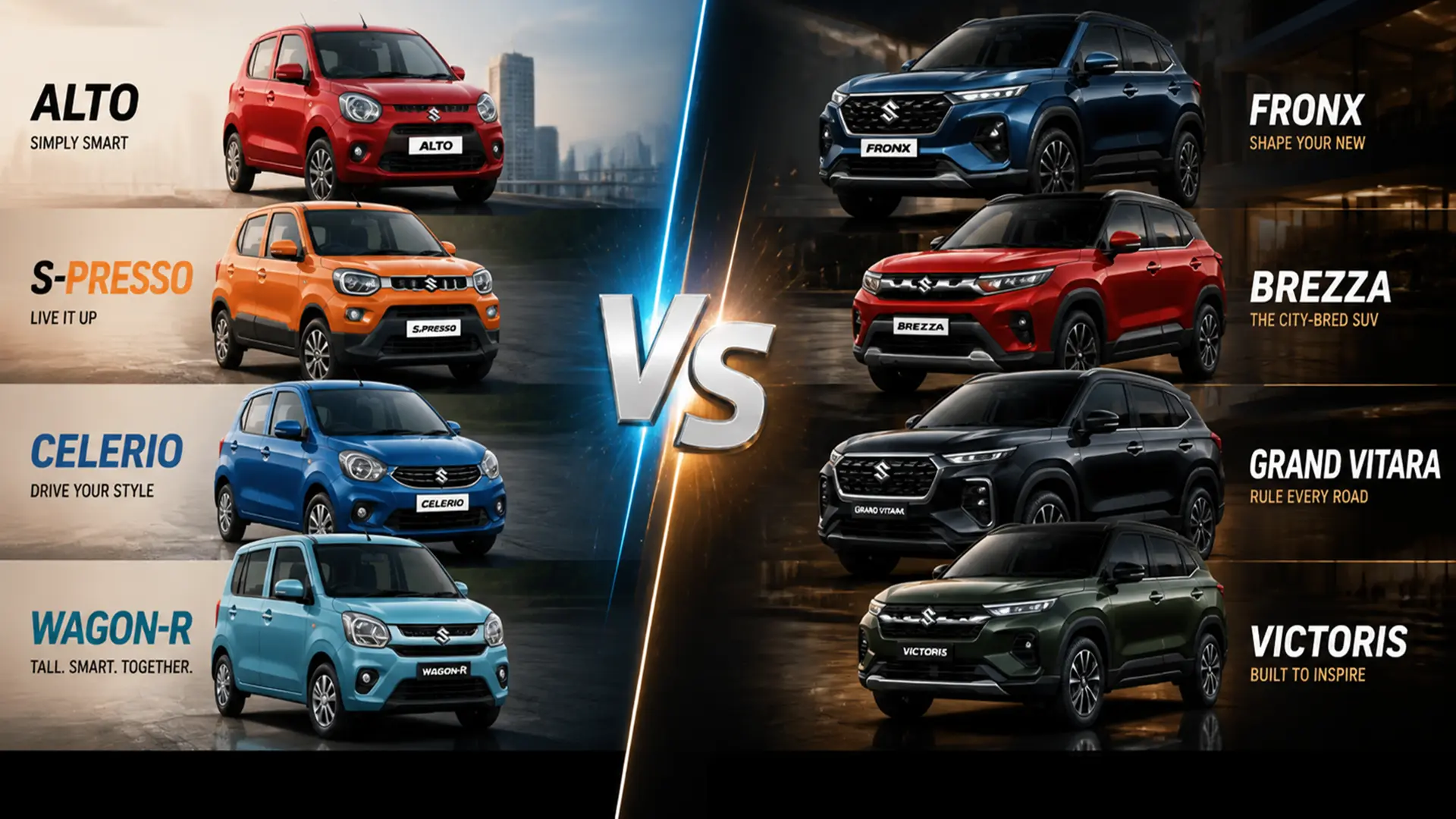
Maruti Suzuki’s 2021–2025 data shows a structural shift from budget hatchbacks to premium SUVs and alternative fuels. Despite an 11% drop in entry-level market share, volume surged 61% to 1.79M units. This growth is fueled by hit SUVs like Fronx, Brezza, and Grand Vitara, plus a dominant CNG strategy in fleet models like Dzire and Ertiga. Now, all eyes are on their EV foray for the next growth phase.


Category:
Tag:
- Maruti Suzuki
- Automotive industry analysis
- Maruti sales analysis
Recently, Autocar India reported “Small car market revival 'inevitable', says Maruti chairman” - "Maruti Suzuki chairman RC Bhargava stated that a revival of India's small-car segment is "inevitable" over the next few years, even as the market continues to shift toward SUVs. Speaking at the company's annual results, Bhargava noted, "In the last six years, the share of small cars has been declining. Now, with new GST rates, it is inevitable that what was lost will gradually come back," pointing to improving affordability as a key driver."
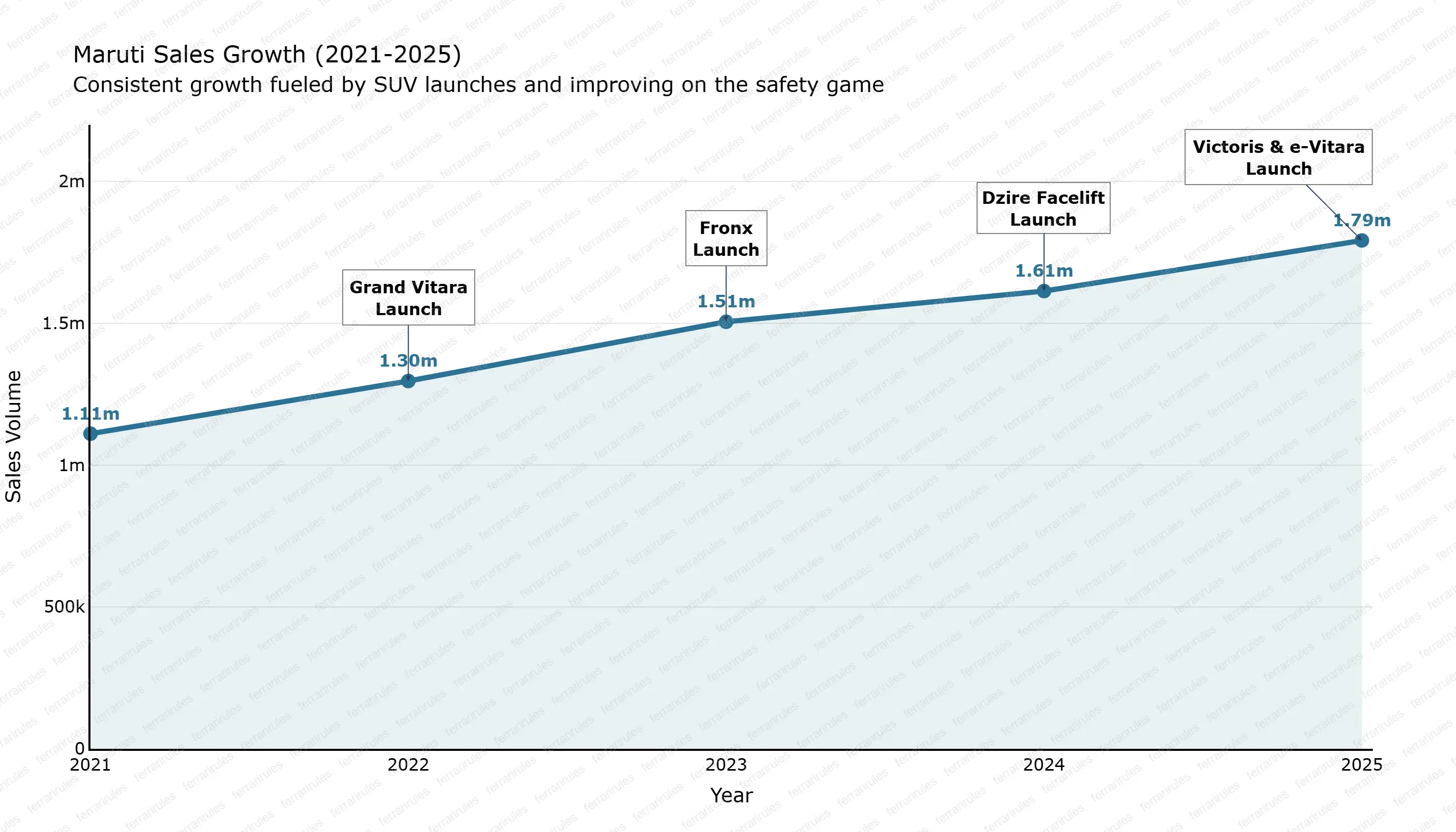
We took a deep dive into Maruti's sales data from 2021 to 2025 to see how this shift has been panning out. During this period, total sales volume scaled from 1.11 million to 1.79 million units—a robust 61% expansion. Despite a declining entry-level market, Maruti successfully captured the C1, C2, and MPV segments through aggressive SUV launches and a comprehensive "CNG-as-the-new-diesel" strategy.
The key takeaway from the analysis is not just the volume, but the shift in consumer ideology. Maruti achieved a 10% overall CAGR during a period when its historical core—Segment A—contracted at a -7% CAGR. This indicates that the "Big Story" isn't merely about selling more cars; it is a total transformation of what those cars are and how they are powered. The Indian consumer has definitively moved from entry-level hatchbacks to C1 and C2 SUVs.
Segment Analysis: The Upward Migration
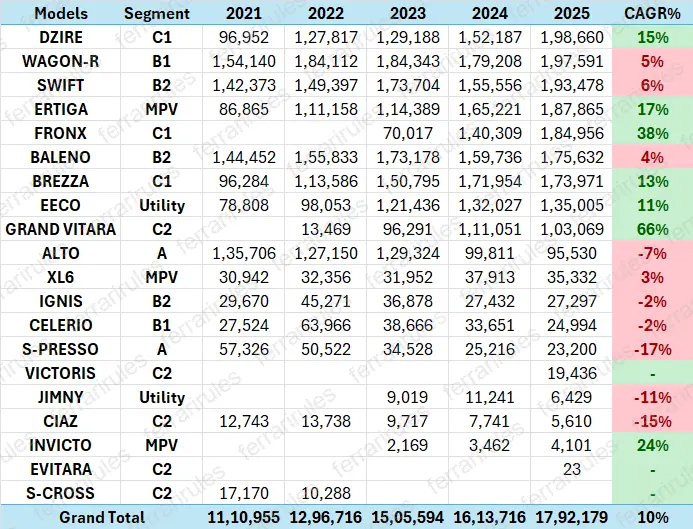
The 2021–2025 data reveals a ruthless prioritization of high-demand body styles over legacy models. The shift is most visible in the contrast between emerging SUV stars and the sunsetting of traditional budget and sedan models. The following table illustrates this migration from entry-level affordability to mid-size premiumization.

Top Gainers:
- C1 Segment: This segment has seen a massive 14% gain in sales share, showing a clear shift in consumer preference.
- C2 Segment: Despite its higher price point, this segment has secured a 4% increase in sales share.
Steepest Decliners:
- A Segment: A sharp -11% decline in sales share represents a mammoth shift in consumer preference.
- B1 Segment: Sales share has reduced to 12% in 2025, down from a 19% peak in 2022.
- B2 Segment: The erstwhile consumer favorite now plays second fiddle to the C1 segment. It has lost 6% of its sales share over the last five years.
Volume Context: The declining sales share in the A and B1 segments indicates that consumers are no longer seeking basic mobility. Buyers are looking for more premium options. For consumers shopping in the ₹3.5 lakh to ₹7 lakh price band, two main factors are driving this shift:
- Lower-trim models of the B2 and C1 segments overlap with the top-tier models of the A and B1 segments.
- The maturity of the used-car market—players like Spinny, Cars24, and Maruti's own True Value now provide reliable ways for consumers to buy higher-segment cars within this same budget.
Model-Level Performance: Winners vs. Laggards
- The New Guard: The Fronx, Grand Vitara, and Brezza are the architects of this new era. The Fronx, starting from zero in 2023, surpassed the 100,000-unit milestone in 2025, proving that Maruti can move metal in the ₹10L+ space.
- The Consistent Pillars: Despite the SUV onslaught, the Baleno (175,632 units) and Swift (193,476 units) remain vital in 2025. Their resilience suggests that the "premium hatchback" still serves as a high-volume bridge between budget cars and SUVs.
- The MPV Surge: The Ertiga has grown from 86,846 units in 2021 to 187,861 units by 2025 (a 17% CAGR), effectively owning both the family and fleet mobility space.
Cab-Share Analysis: Navigating Fleet Dependence
The "Cab Share %" of overall sales has more than quadrupled, rising from 3% in 2021 to 13% in 2025. While this indicates a strong commercial foothold, the data reveal that certain models have become highly dependent on fleet sales.
Highest Cab Penetration (2025):
- Dzire: 49%
- Ertiga: 30%
- Ciaz: 29%
- Wagon-R: 23%
- Invicto: 23%
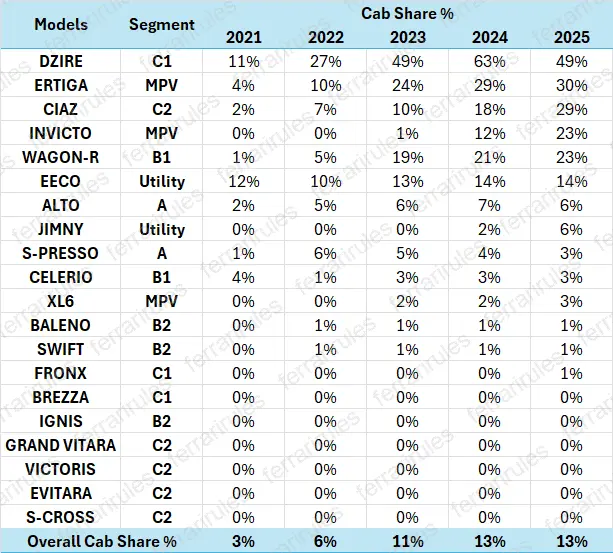
The Dzire Strategic Shift: A critical observation is the Dzire's fleet exposure. After peaking at a 63% cab share in 2024, it dropped to 49% in 2025. This 14-point reduction shows that the major model refresh and its 5-star safety rating have successfully brought the private car buyer back.
(Please note: The true commercial share for the Eeco is likely much higher, as many are used for commercial purposes like school vans but are registered as private vehicles.)
Fuel-Mix Analysis: The Rise of CNG and Strong Hybrids
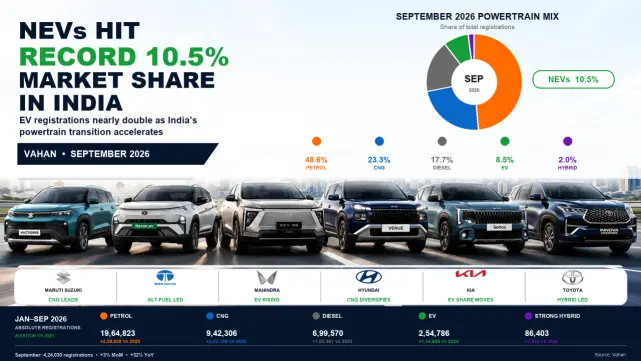
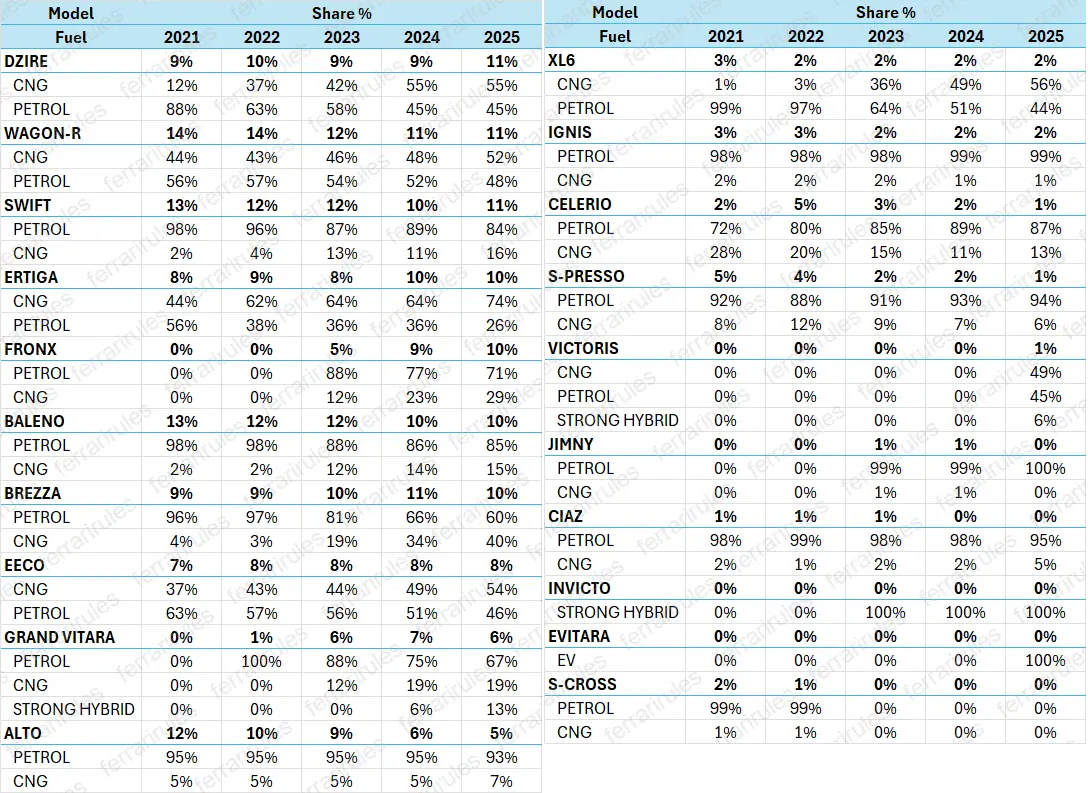
Having discontinued diesel—or rather, having failed to crack BS6 diesel—Maruti has successfully "de-risked" its portfolio. It turned CNG into a mainstream, high-volume alternative while finally introducing EVs at the end of 2025.
The CNG Takeover (2025 Mix): CNG is now the dominant fuel for Maruti's high-volume workhorses:
- Ertiga: 74% CNG
- Dzire: 55% CNG
- Wagon-R: 52% CNG
Premium Alternative Fuels: The transition to CNG is no longer restricted to budget segments. The Victoris, a C2-segment entrant, debuted with a 49% CNG mix and a 6% Strong Hybrid mix, leaving only 45% for pure petrol. This proves that even the ₹10L+ buyer is actively prioritizing fuel efficiency.
Electrification and Hybrids: The 2025 roadmap is solidified by the Strong Hybrid success of the Grand Vitara (which makes up 13% of its mix). Furthermore, the debut of the e-Vitara in 2025 marks the final piece of Maruti's multi-fuel puzzle.
eVitara and YMC (Future 7-Seater EV): The Electric Future
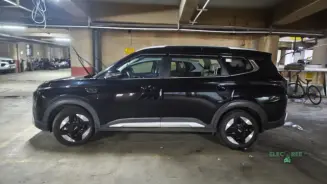
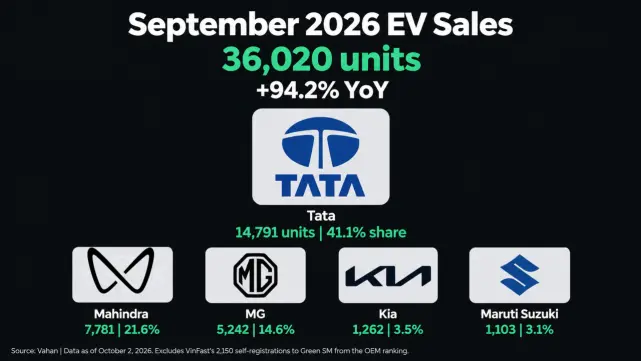
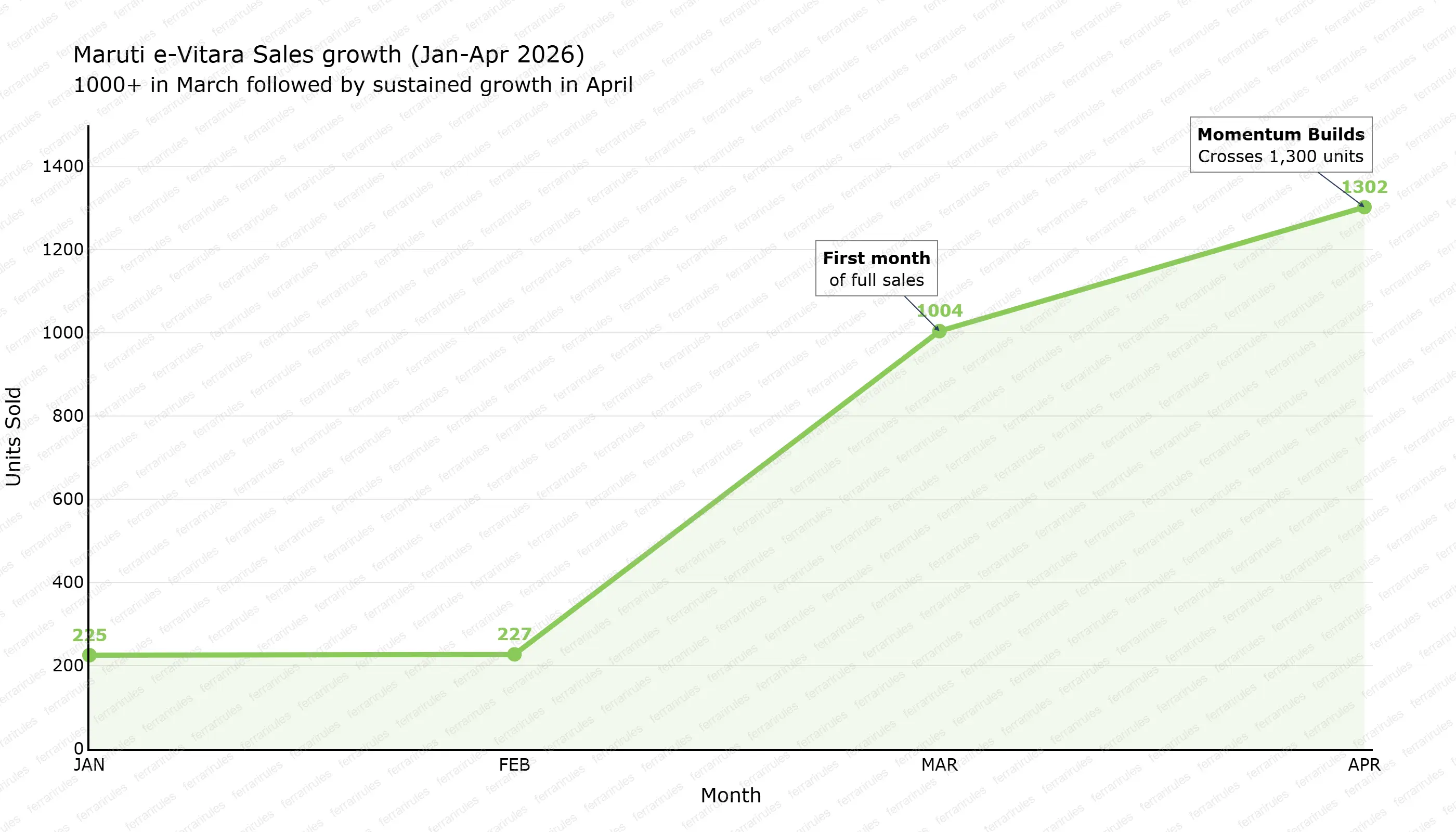
As the eVitara price reveal made waves in Feb-2026, the roadmap is clear: Maruti Suzuki wants EVs to play an important role in their future growth. eVitara sales have picked up pace in the first few months. Upcoming YMC (7-seater EV), which is going to launch in 2026, will add to the volume as well
Conclusion: The Transformation is Complete
Maruti Suzuki’s 2021–2025 journey is a masterclass in portfolio evolution. The consumer has aggressively changed their preference from the A and B1 segments, to C1 and C2 SUVs. Maruti has launched multiple products in these segments to capitalize this shift. By mastering CNG for fleet and budget buyers, normalizing Strong Hybrids for the premium segment, and finally plugging into the EV race with the e-Vitara, Maruti hasn't just adapted to the changing market—it has re-engineered its entire DNA
What do you think about it? Engage with us on our forum or social media handles
Disclaimer: All charts have been created by the author with Vahan as the a data source. Digitally removing the ElecTree logo and repurposing the charts will amount to copyright infringement. Cite this article as source and provide the link if sharing details on social media or a news publication.
Trending Articles