
Tata Launches New Tiago EV: First Hand Review and Pricing
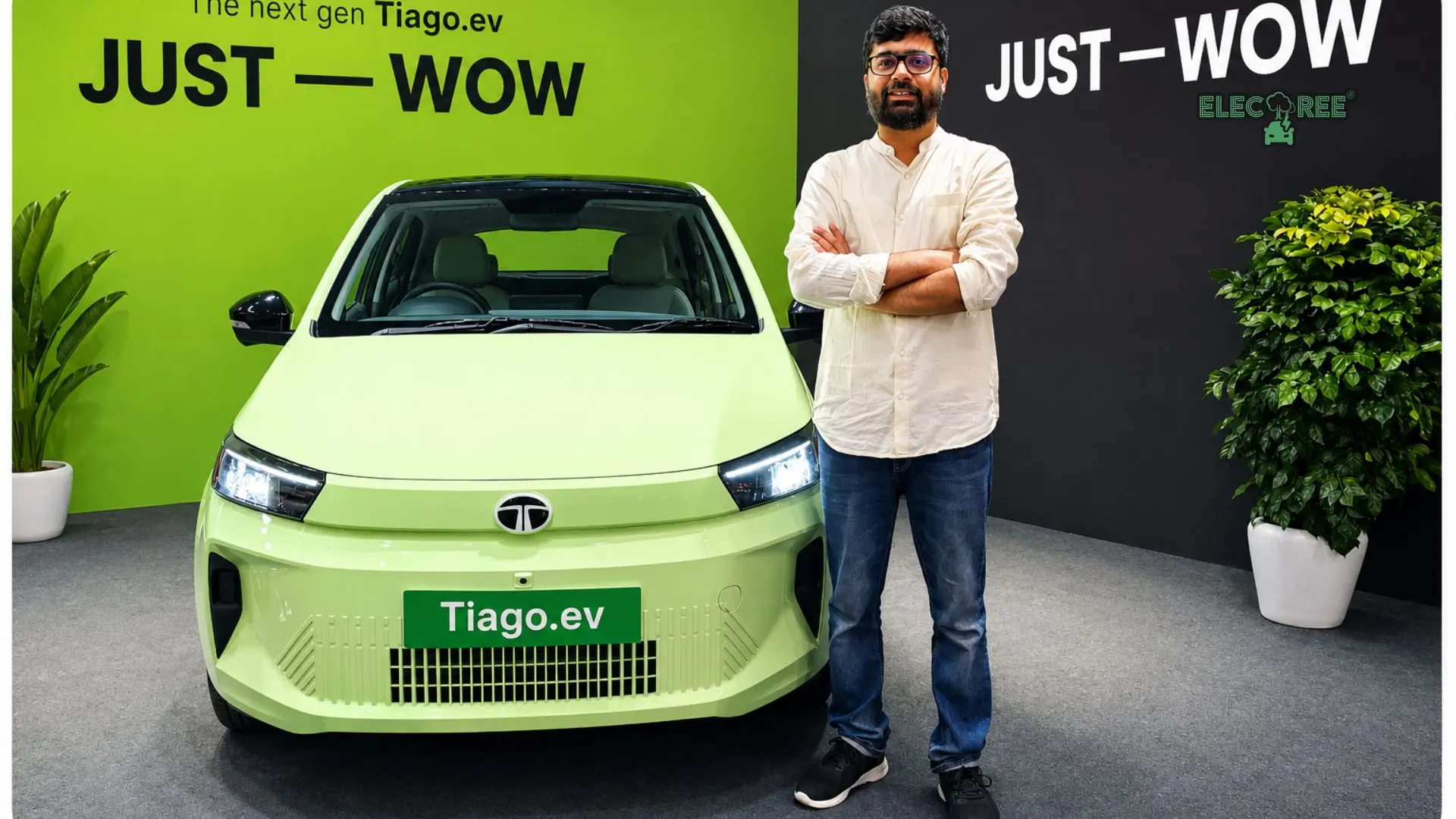
The Next Gen Tata Tiago EV has been launched at ₹6.99 lakh. We attended the launch and bring you a first hand walkaround covering exterior, interior, powertrain, pricing and our honest take on which variant to buy.


Category:
Tag:
- Tata Tiago EV 2026
Tata Motors launched the Next Gen Tiago.ev on 28 May 2026 — India's only electric hatchback, now in its second generation. ElecTree was present at the launch event and brings you a first hand account of the car covering design, interior, powertrain, safety and pricing.
The Next Gen Tiago.ev is offered in four variants across two battery packs — Smart 19 kWh, Pure+ 19 kWh, Pure+ 24 kWh and Creative+ 24 kWh — with prices ranging from ₹6.99 lakh to ₹9.99 lakh ex-showroom introductory.
Exterior
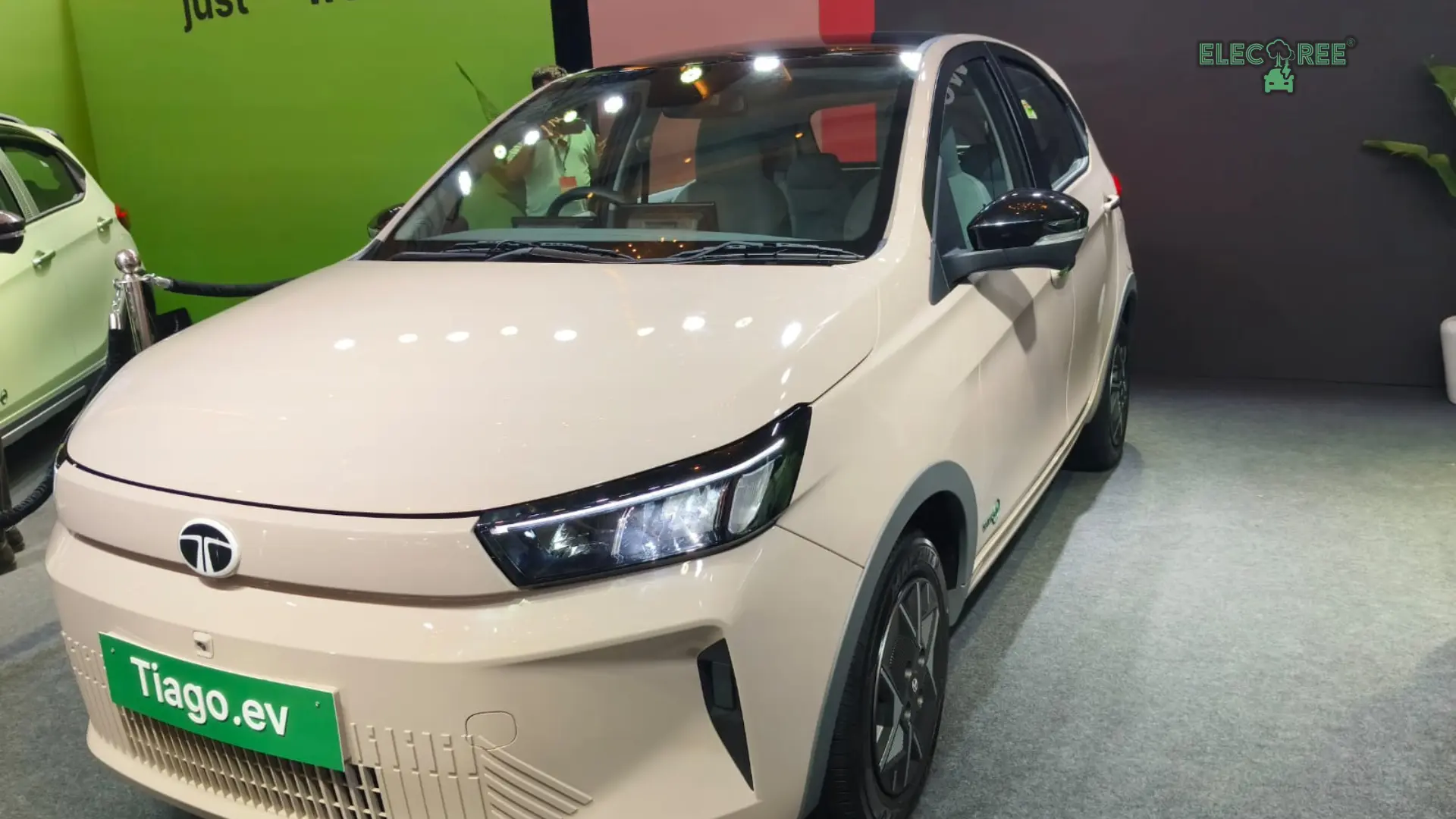
The Next Gen Tiago.ev does not try to shout. The design is confident and clean without being dramatic. The front grille is finished in body colour with no piano black treatment behind the badge, keeping the front end uncluttered. The new Lux Beam LED headlamps are the front's strongest element — up close they look genuinely premium, a level above what you would expect at this price point. Note that LED headlamps are available only on the Creative+ variant.
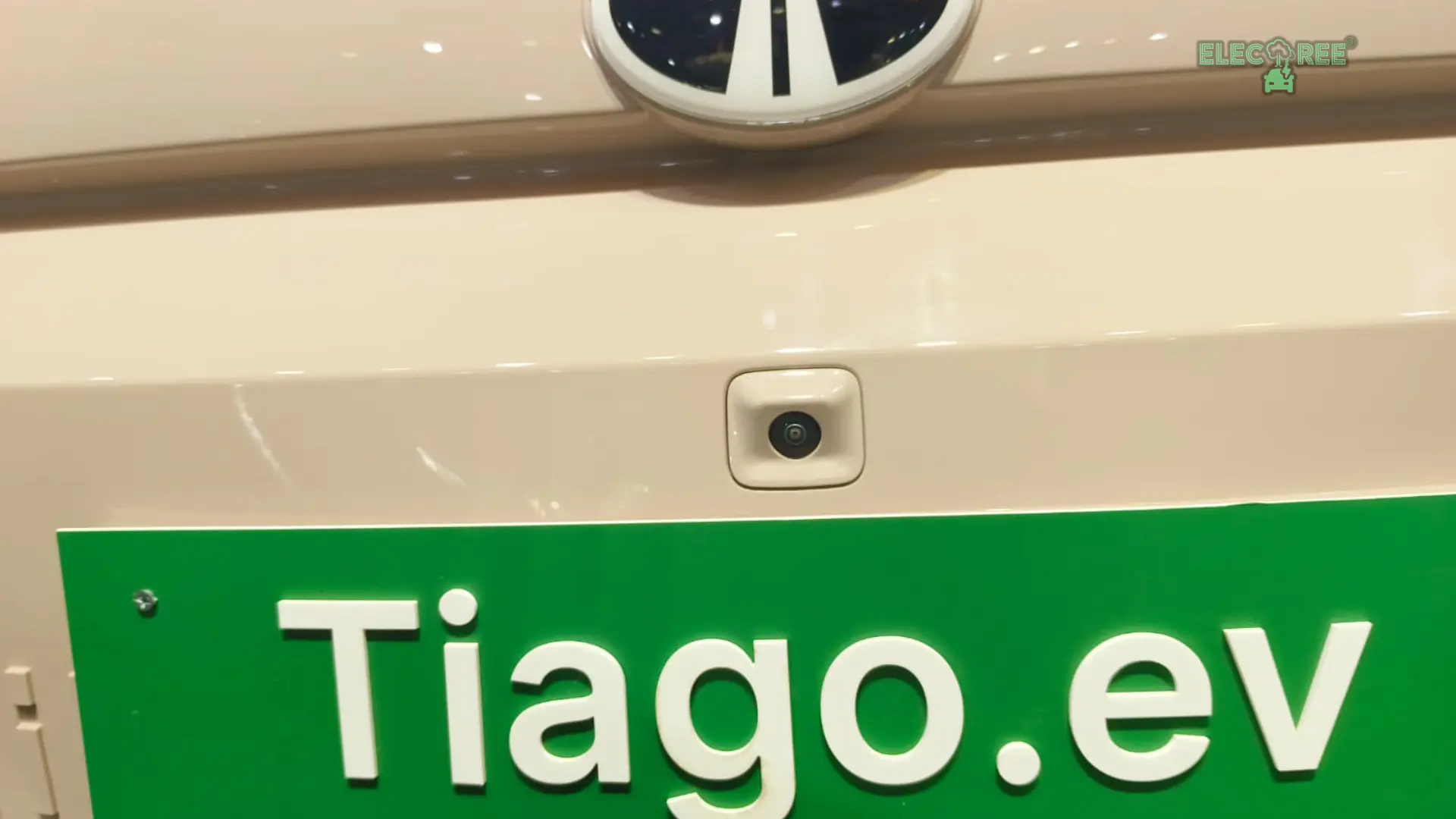
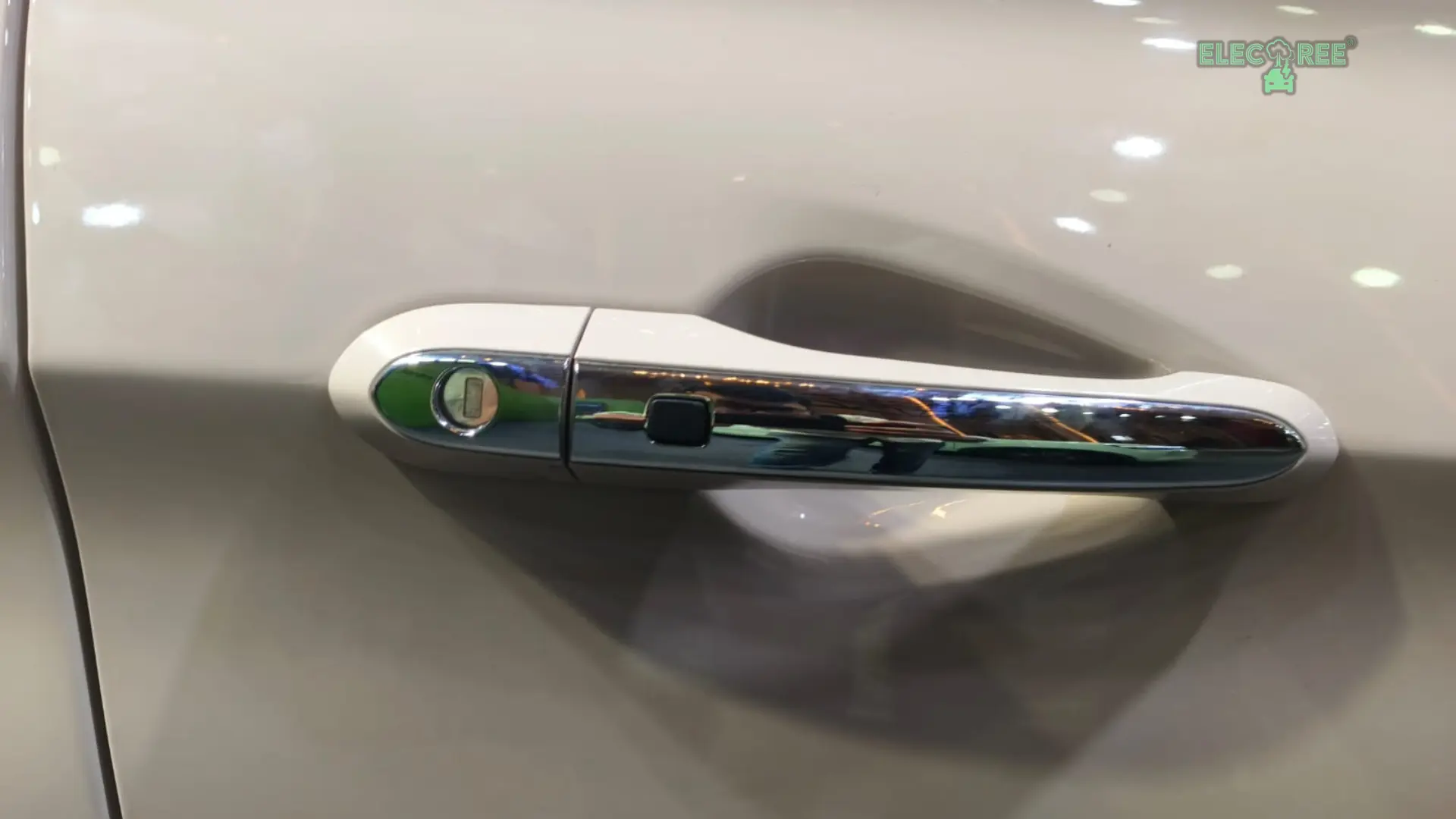
The front camera for the 360° SVS surround view system is neatly integrated into the bumper below the Tata badge. The ORVM-mounted cameras are similarly discreet. The driver's door handle carries a PEPS sensor for passive entry — the remaining three doors get the same chrome-line finish without the sensor. The Tata.ev badge sits quietly on the front door — subtle and well-placed.
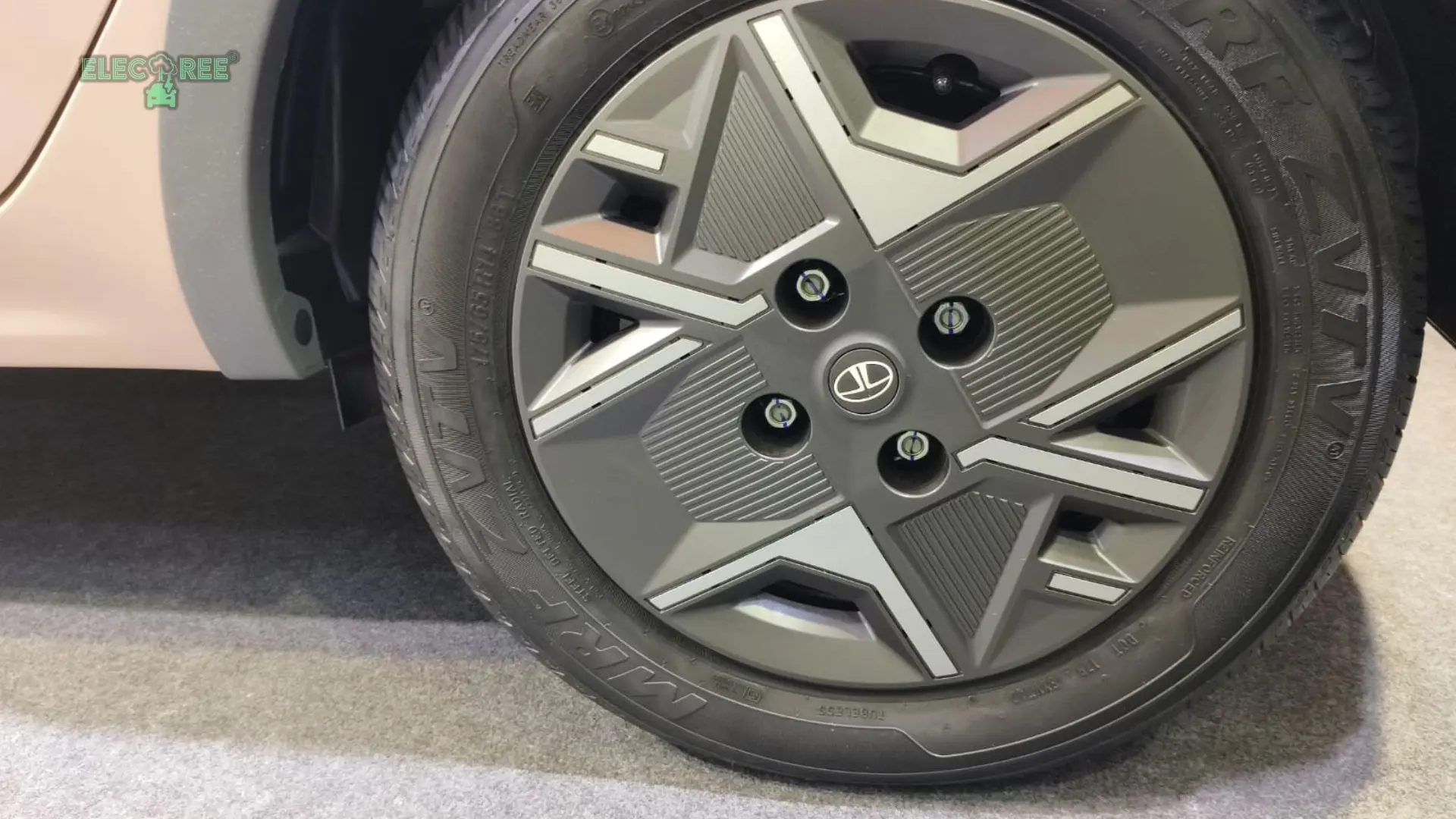
The R14 Hyperstyle styled wheels on the Creative+ variant carry a geometric, layered design that looks purposeful. It is worth noting these are styled covers over steel wheels — no variant of the Next Gen Tiago EV gets alloy wheels. Wrapped in 175/65R14 tyres, they are proportionate to the car's footprint. The Cosmo Grain textured wheel arch cladding adds visual width without needing additional body lines to do the work.
The rear is where the design makes its boldest statement. The Halo Lightbar connected tail lamps span almost the full width of the tailgate — wide enough to grab your attention before anything else does. It is not disproportionate to the car overall, but the light bar dominates the rear view. The "TIAGO.EV" badging across the tailgate and the centrally placed Tata logo complete a rear that is clean and contemporary. Build quality felt solid — panel gaps were tight and the body felt substantial.
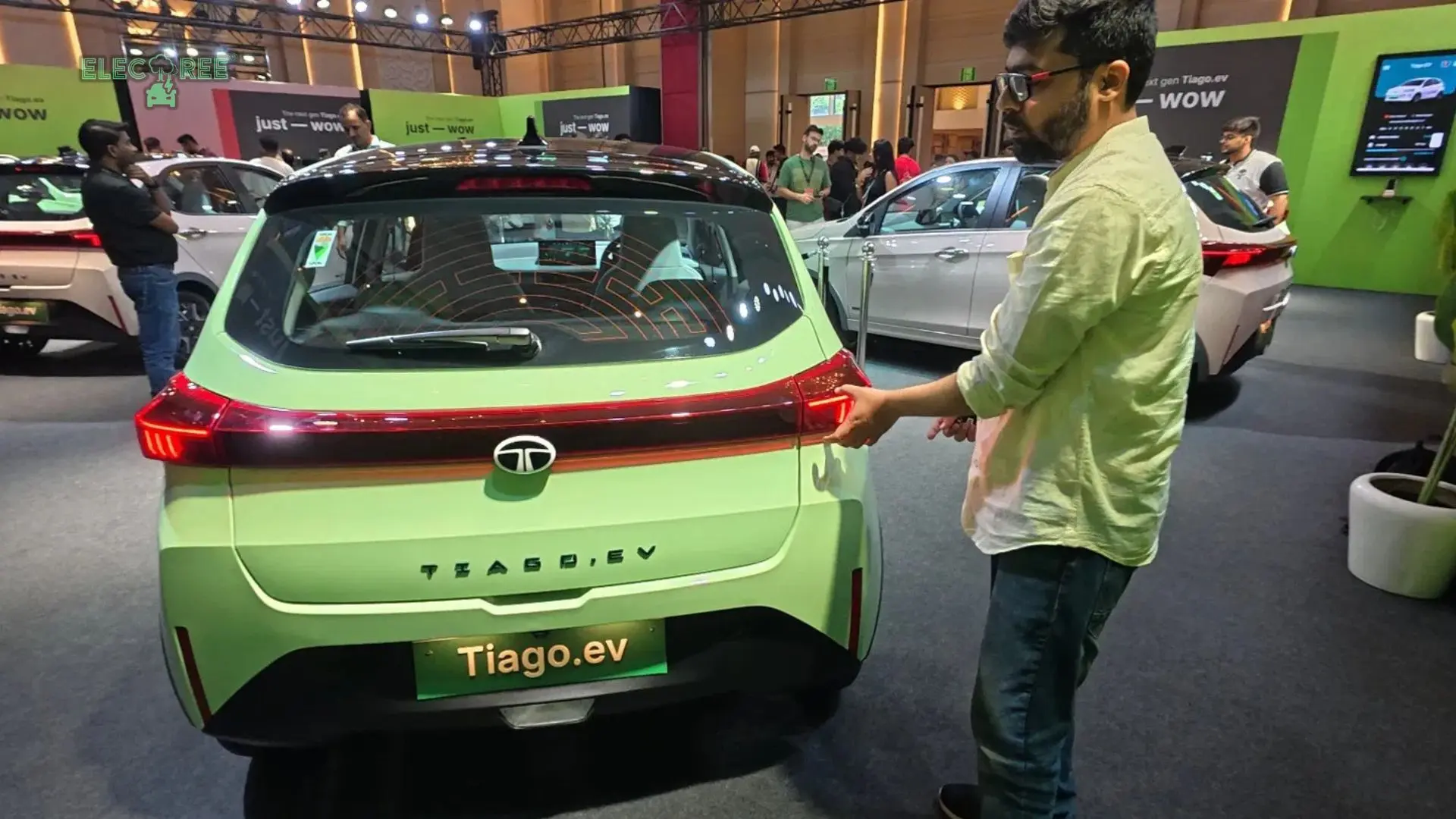
Six exterior colours are available — Dehradun Dew, Sobo Surge, Pangong Pulse, Matheran Monsoon, Pure Grey and Pristine White.
Interior
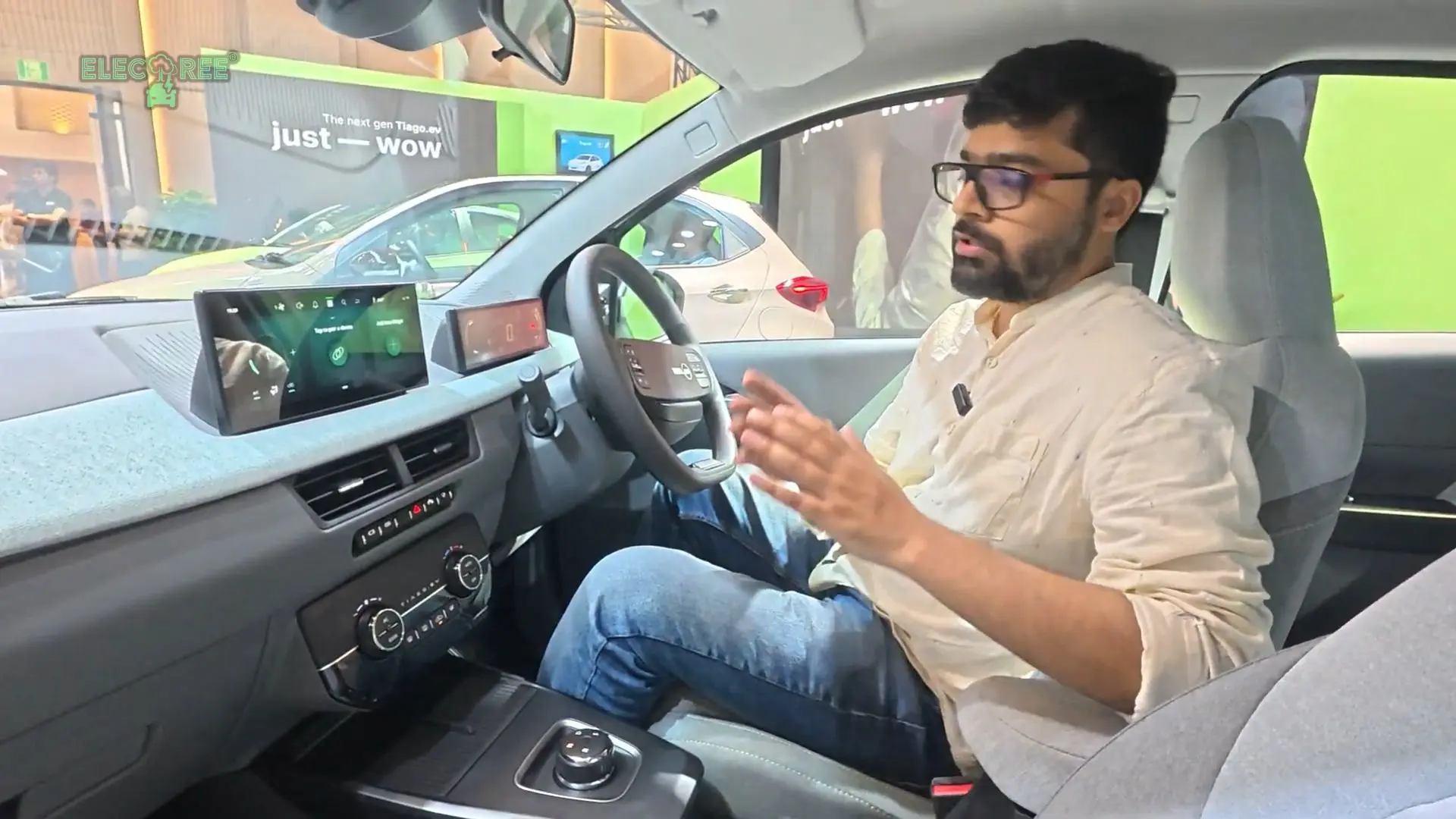
Sitting in the driver's seat, the first thing you notice is how the flatter central dashboard opens up the cabin. The previous Tiago EV's centre console felt more intrusive — here the layout is more restrained and the cabin feels noticeably roomier as a result.
The Fabricia Luxe dashboard with its soft touch fabric insert on the upper half is a genuine highlight. It looks and feels premium at this price point — and the same soft touch fabric carries through to the door armrests on the Creative+ variant, which adds to the sense of quality when you rest your elbow. The CosmoGrain textured pillar trims and the dual tone theme complete a cabin that does not feel like an entry-level product.
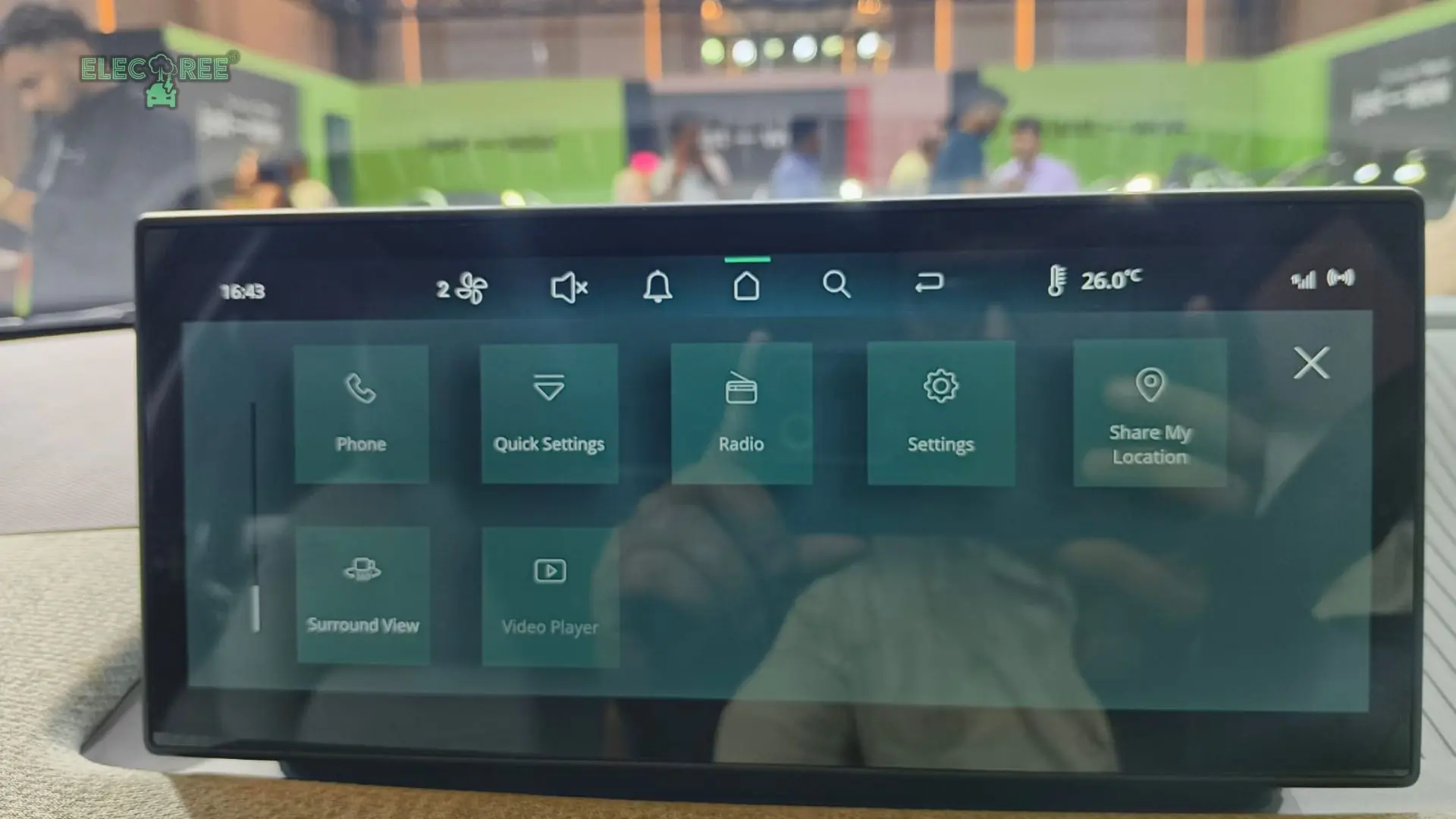
The 26.03cm HD touchscreen on the Creative+ is the same unit found across other Tata EVs — clean interface, responsive to touch, with the 360° surround view accessible directly from the home screen. It is an upgrade for the Tiago segment even if it is a familiar product across the Tata EV range. The Pure+ variants get a smaller 20.32cm unit.
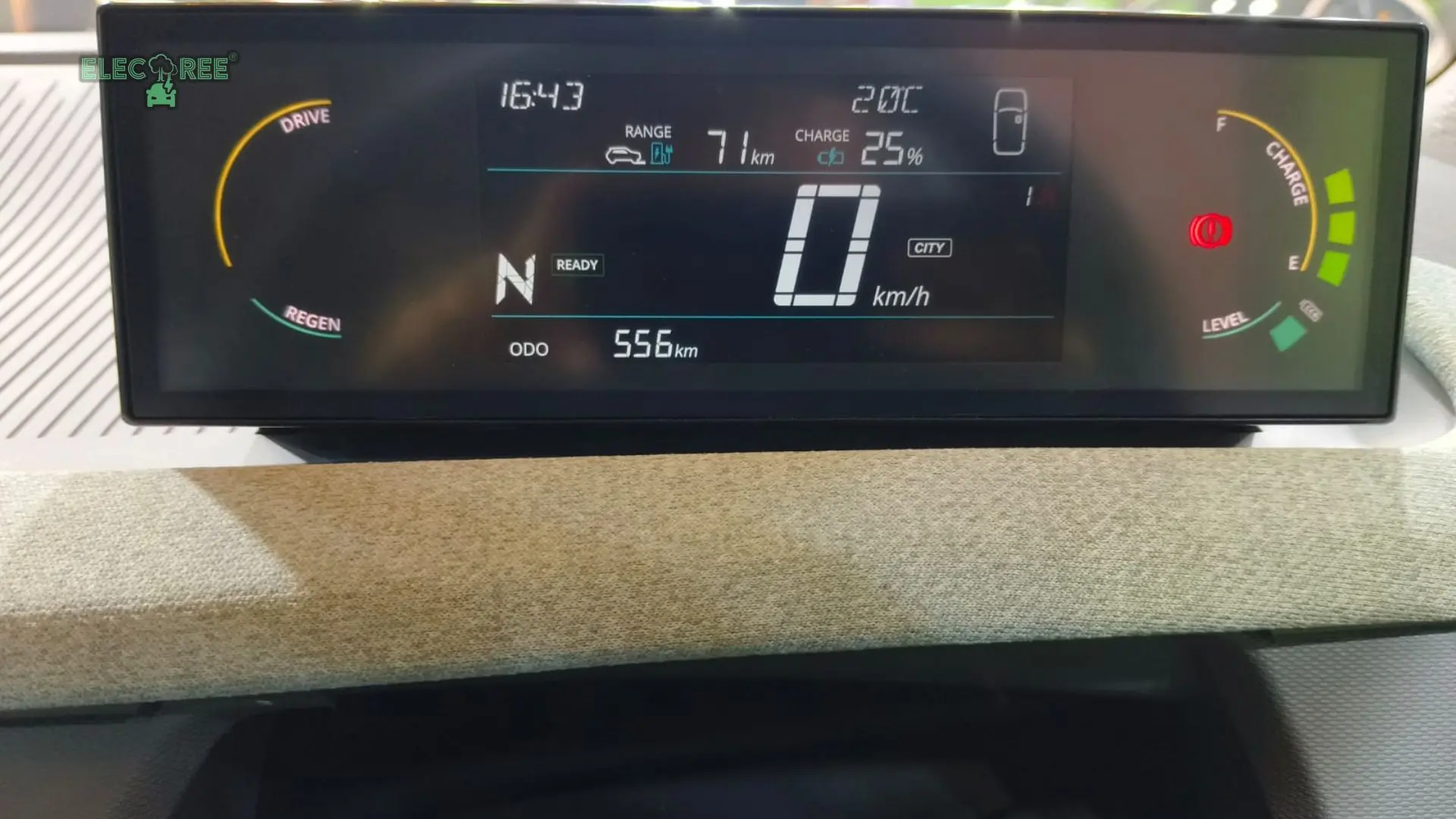
The Digital Island Cluster sits clearly behind the steering wheel — displaying speed, range, charge percentage and drive mode in a crisp, readable layout.
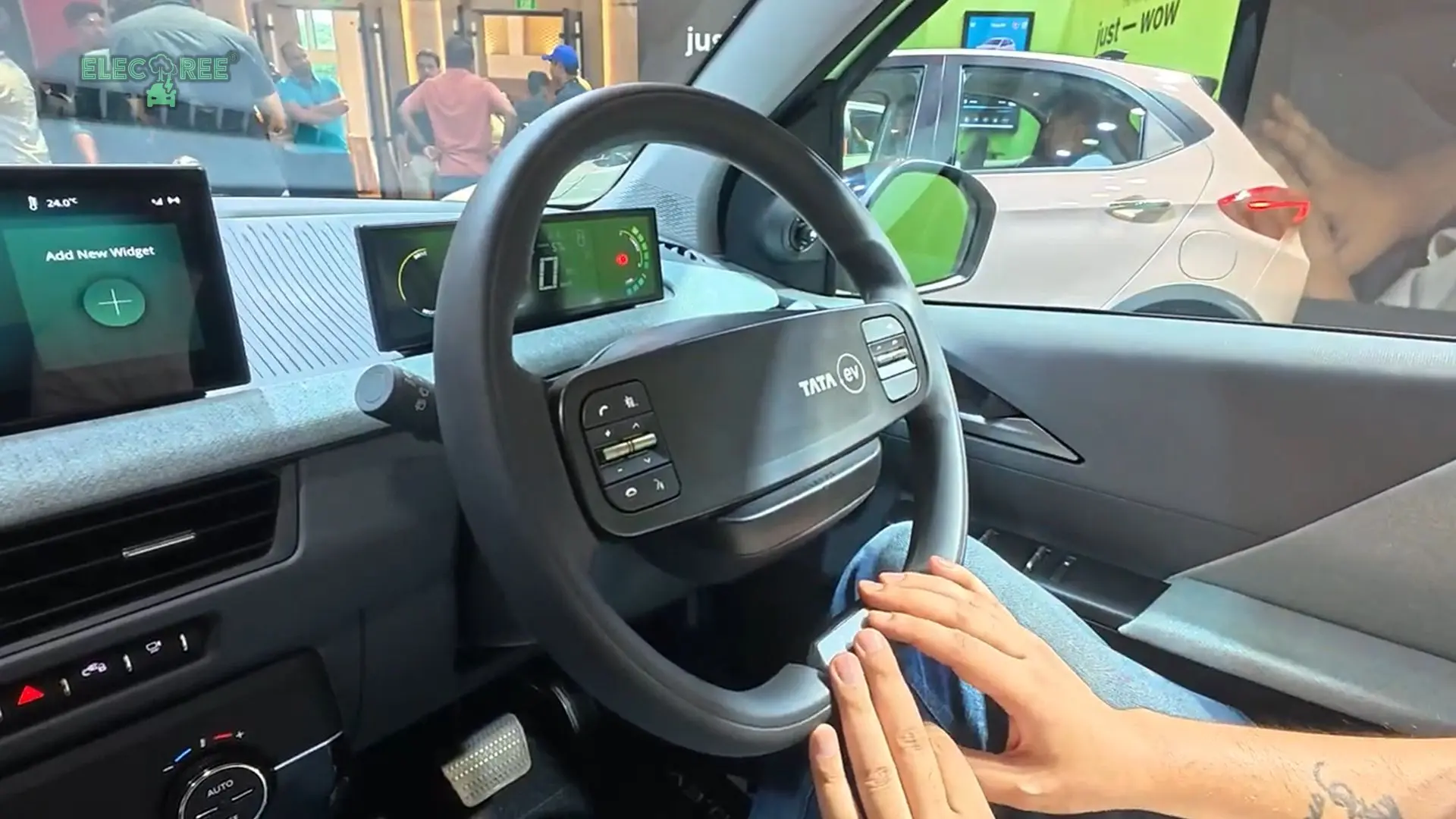
The SportLuxe steering wheel has a flat bottom and carries the Tata.ev logo as a print rather than an illuminated badge. In person it looks more premium than the illuminated version on the outgoing model. Steering mounted controls on both sides handle phone, media and cruise control functions. Horn response was sharp. Unlike the Punch EV and Nexon EV, the Tiago EV does not get steering-mounted paddle shifters for changing regenerative braking levels on the go — regen level adjustments are made through the console buttons instead.
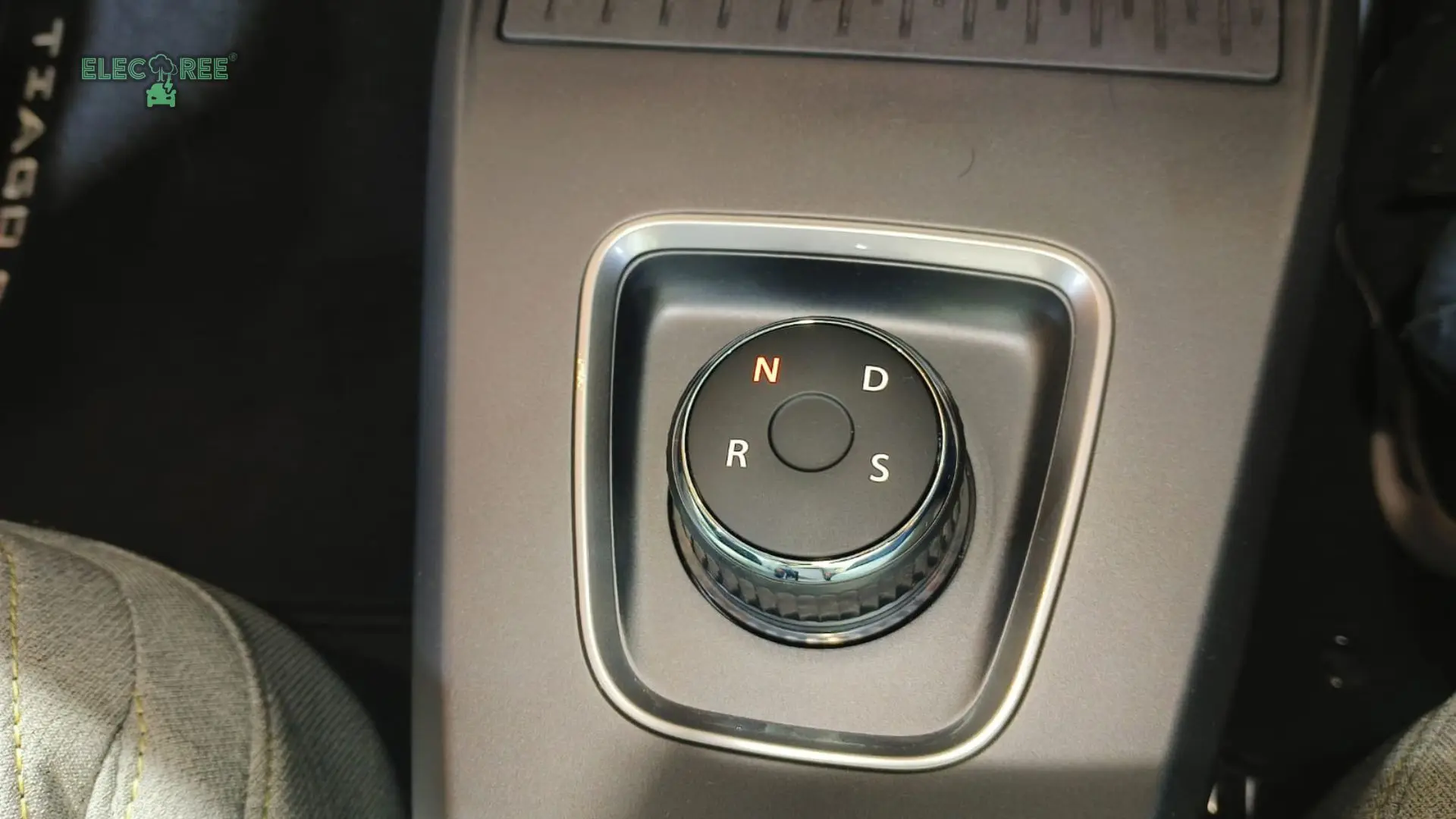
The rotary drive selector knob — with N, D, R and S positions around a chrome-ringed surround — feels solid and operates with no lag.
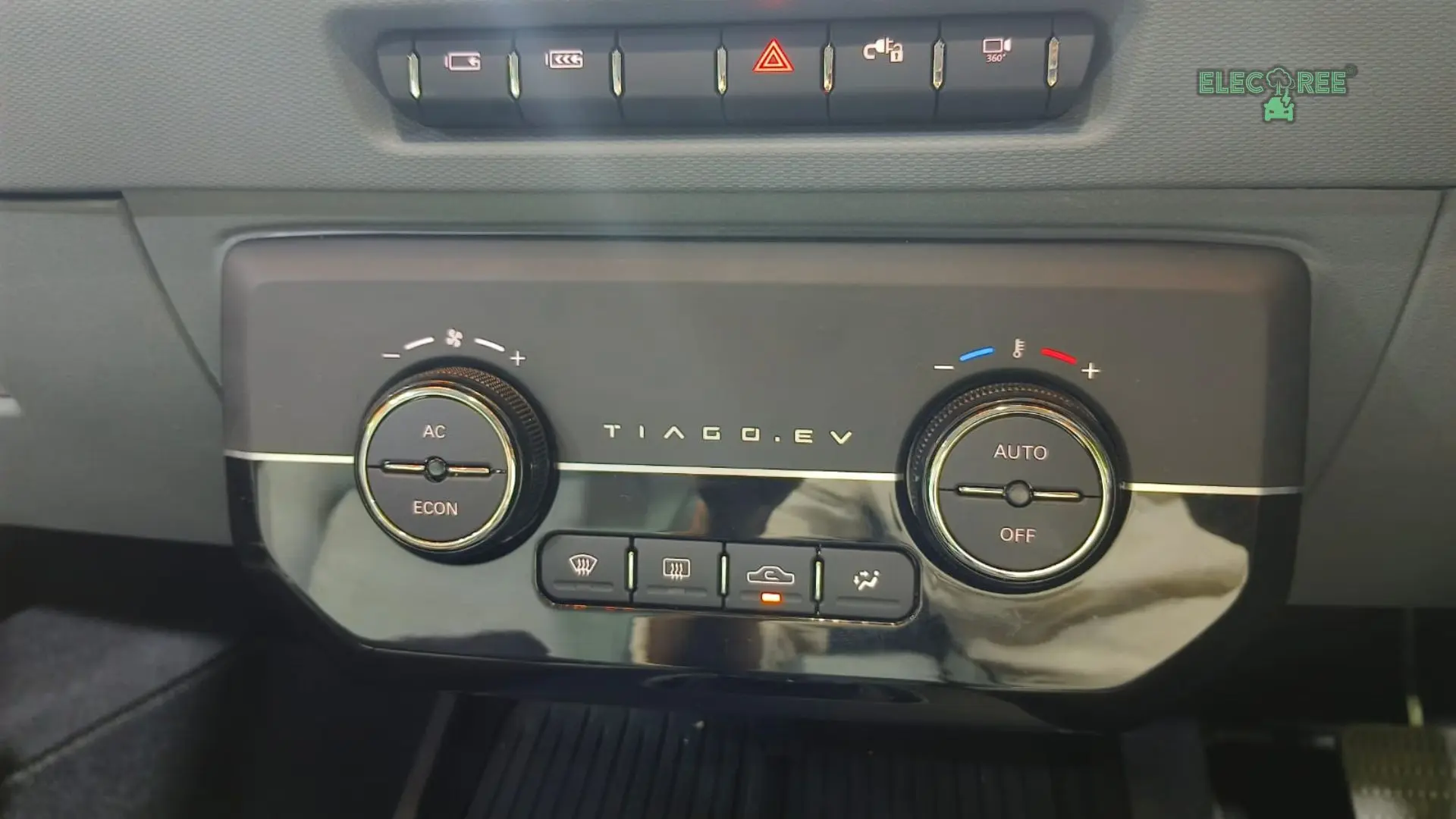
The AC console carries the TIAGO.EV branding between two rotary knobs for fan speed and temperature control, with a separate row of function buttons above for hazard, regen modes and the 360° camera.
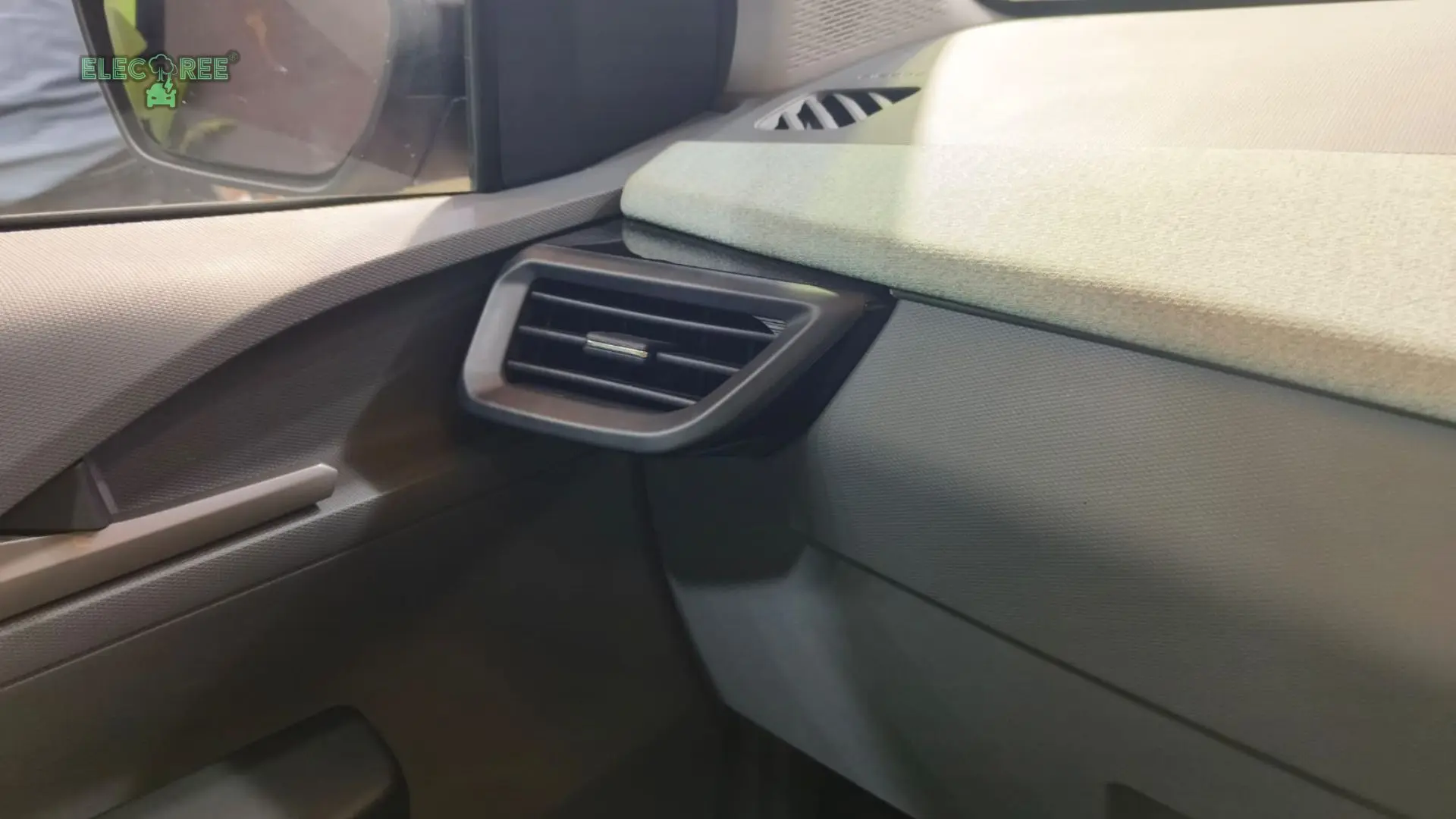
The front AC vents on the driver and co-passenger sides are angled directly towards the occupants rather than pointing straight ahead — delivering more targeted airflow. The rear AC vents on the Creative+ variant, while modest in size, appeared well-positioned. Combined, the ventilation layout should contribute to faster and more efficient cabin cooling — a practical consideration for Indian summers.
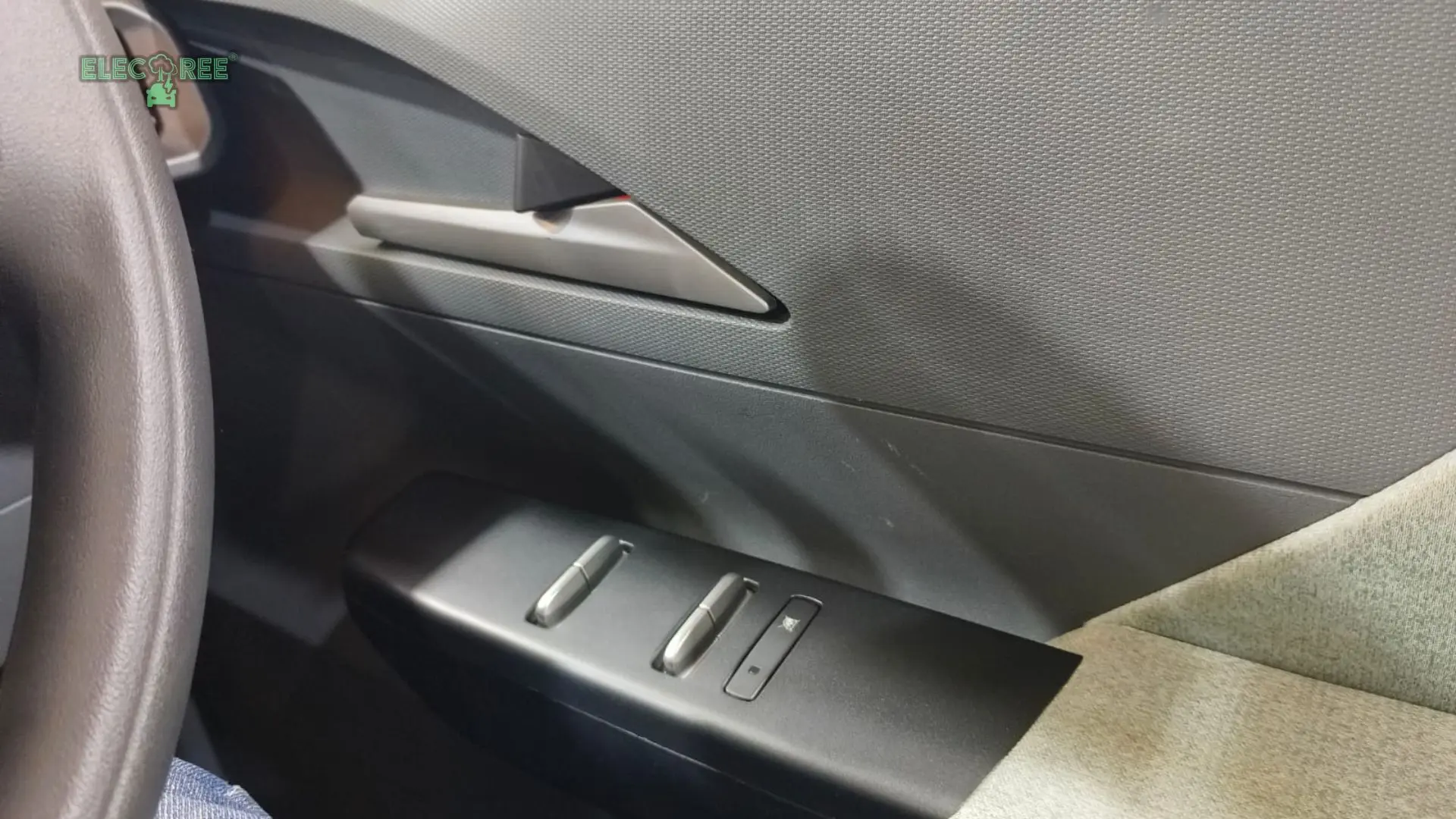
The iToggle window switches on the door are finished in metallic and feel well-made for the segment. The Ergo Comfort seats with under-thigh support work as advertised in the driver's position — the thigh support is noticeable and the seat holds you well for city use. The Premium Melange fabric in light grey is soft to touch and looks fresh.
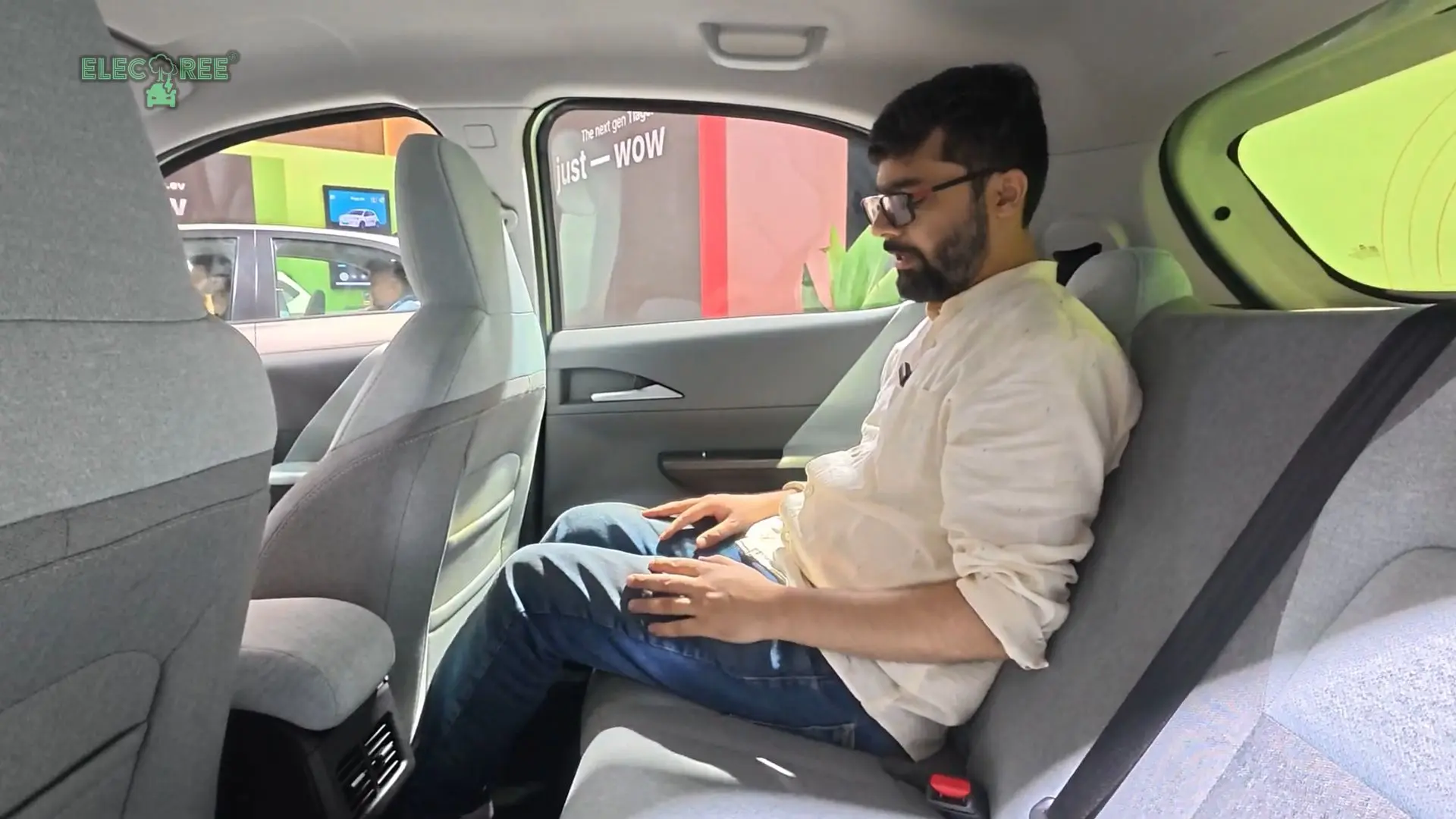
The rear seat is adequate for two adults. Legroom is decent and the rear AC vent on the floor tunnel on the Creative+ is a welcome addition. Thigh support at the rear is modest. The grab bar is mounted on the roof — likely a consequence of the curtain airbags — which also conveniently doubles as a suit hanger. The floor is not flat, which means three adults across the rear will not be comfortable. This is a car for two in the back, not three.
Powertrain and Charging
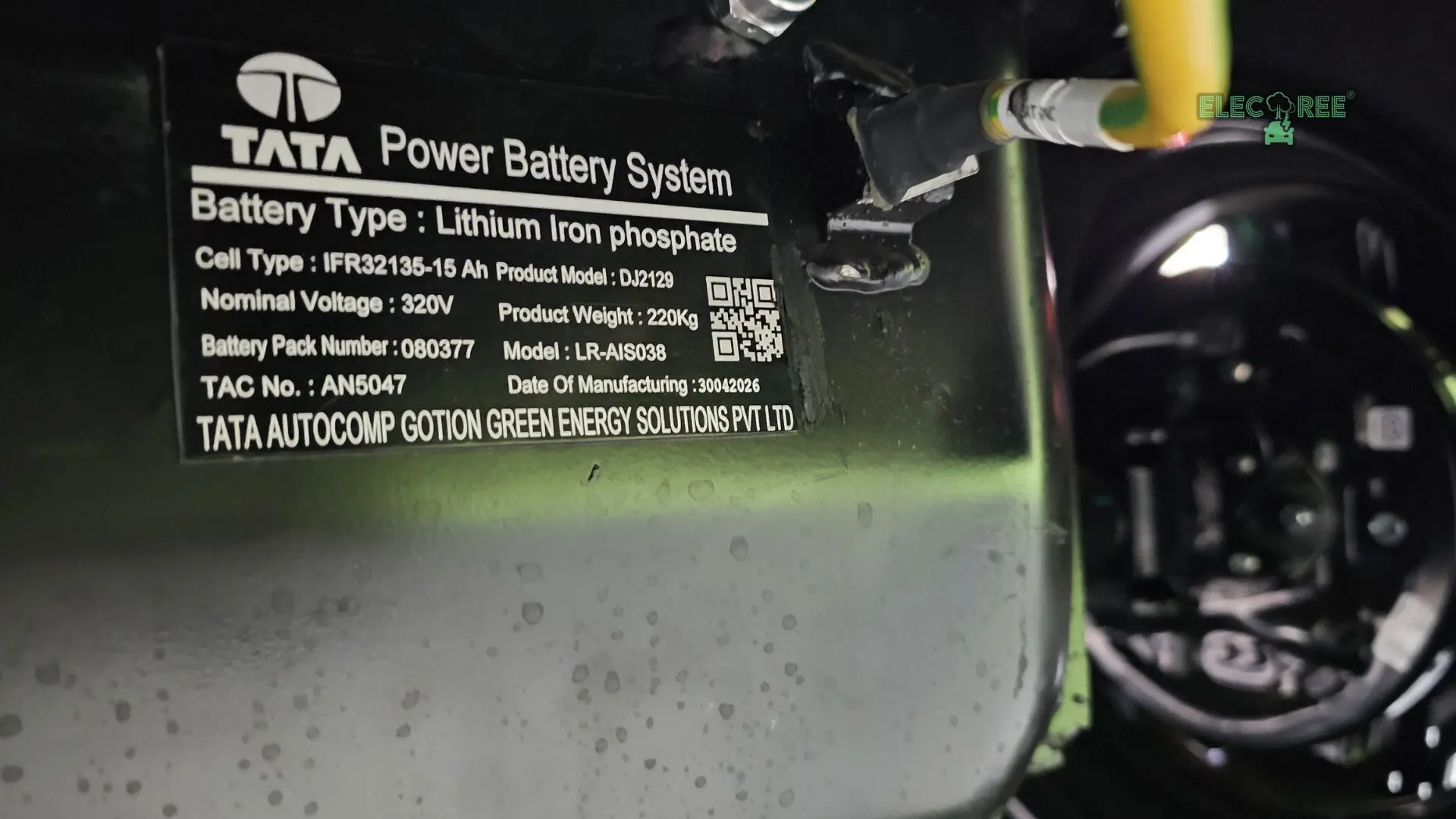
The Next Gen Tiago.ev is offered in two battery configurations — 19.2 kWh and 24 kWh — both using cylindrical Lithium Iron Phosphate cells. The battery packs are manufactured by Tata Autocomp Gotion Green Energy Solutions Pvt Ltd, a joint venture between Tata AutoComp and Chinese battery major Gotion High Tech. We confirmed this at the launch event from the battery label on the display unit — cell type IFR32135, denoting 32mm diameter and 135mm length, nominal voltage 320V, pack weight 220 kg, date of manufacture March 2026.
Tata claims the battery management system on the Next Gen has been significantly improved over the outgoing model — with tighter delta voltage control and dual balancing that operates both during charging and while driving. These are Tata's own claims and will need real-world validation over time.
The 19.2 kWh variant is paired with a 45 kW / 110 Nm permanent magnet synchronous motor, with a 0-60 km/h time of 6.2 seconds. The 24 kWh variant gets a 55 kW / 114 Nm motor, covering 0-60 km/h in 5.7 seconds. Both variants come with City and Sport drive modes, each with four levels of regenerative braking — giving eight driving mode combinations in total. In Sport mode, the 24 kWh variant delivers 114 Nm of instant torque at the tap of the accelerator.
Real world range on the C75 cycle — Tata's own estimate at 75% of certified range — is 160-170 km for the 19.2 kWh and 205-215 km for the 24 kWh. These are honest, conservative numbers rather than inflated certified figures.
Charging
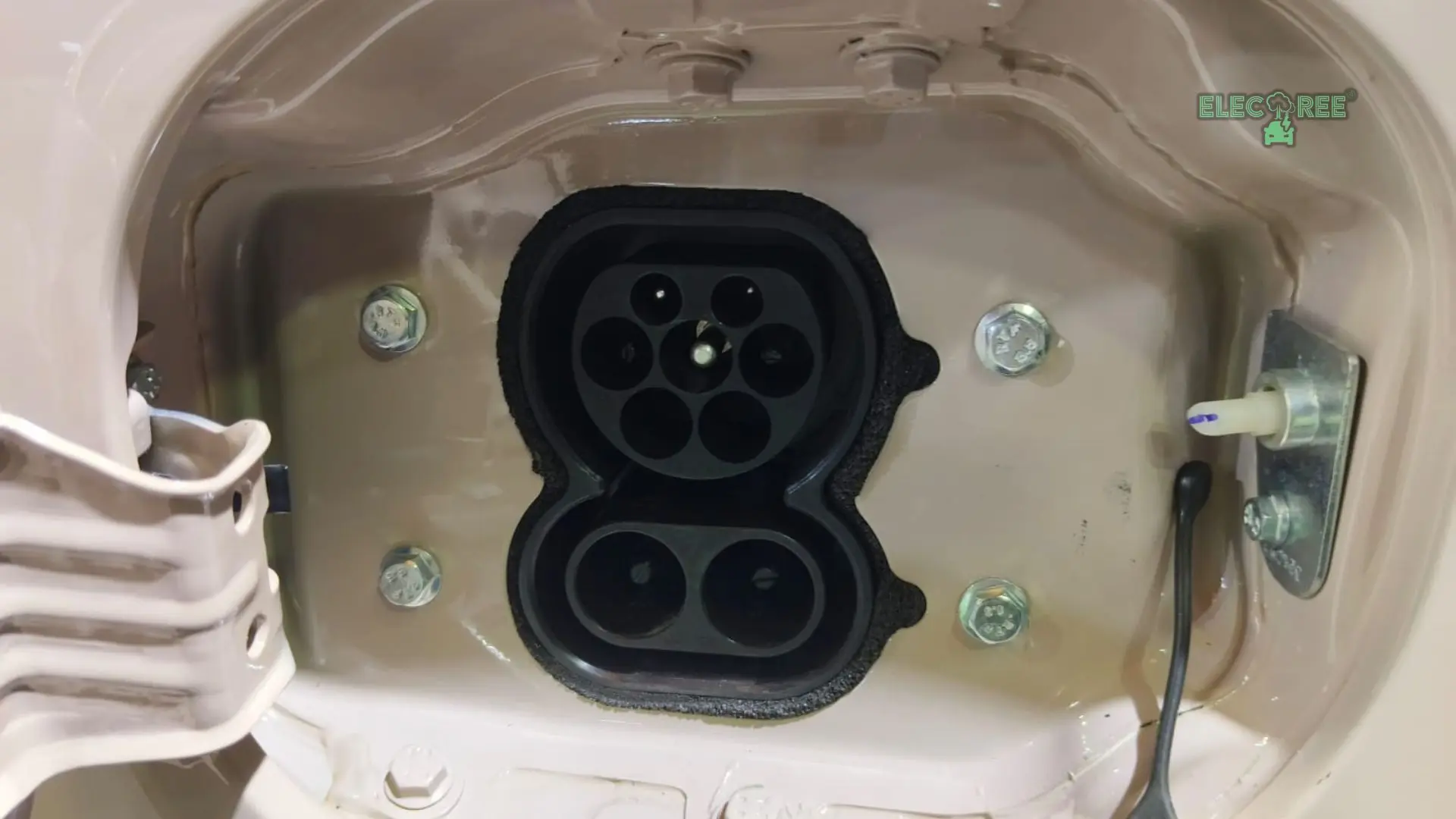
Both variants support CCS2 charging and come with a 3.3 kW AC wall box charger as standard. A 7.2 kW AC wall box is available as an upgrade. Full charge times on the 3.3 kW wall box are 6.9 hours for the 19.2 kWh and 8.7 hours for the 24 kWh — fully manageable for overnight home charging. On the 7.2 kW AC fast charger, the 19.2 kWh charges in approximately 2.6 hours and the 24 kWh in 3.5 hours.
For the 24 kWh variant, DC fast charging at 30 kW brings the battery from 10% to 80% in approximately 35 minutes, and from 20% to 80% in 30 minutes. Tata claims 100 km of range can be added in approximately 18 minutes on a DC fast charger. DC charging specifications for the 19.2 kWh variant will be confirmed separately.
Multi-mode regenerative braking offers four levels — Level 0 for coasting on highways, Level 1 as the default for city driving, Level 2 for moderate traffic and Level 3 for maximum regeneration in heavy stop-and-go conditions or on descents.
Warranty
The 24 kWh battery pack carries a lifetime HV battery warranty for the first registered owner — Tata defines lifetime as 15 years from the date of first registration under the Motor Vehicles Act, 1988. From the second owner onwards, the warranty reverts to 8 years or 1.6 lakh km, whichever comes first. The 19.2 kWh pack gets 8 years or 1.6 lakh km regardless of ownership. The motor carries a warranty of 8 years or 1.6 lakh km across both variants, and the vehicle warranty is 3 years or 1.25 lakh km.
For buyers planning to hold the car long term, the 24 kWh lifetime battery warranty is a meaningful advantage. Those buying used should note the warranty cover from the second owner is calculated from the date of first registration — not from the date of their own purchase.
Safety
Safety has received one of the most significant upgrades in this generation. Six airbags are now standard across all variants — up from two in the outgoing model. This alone is a substantial step forward for a car at this price point.
The 360° SVS HD Camera with multiple 2D and 3D views is a segment first, available on the Creative+ variant. At the launch we confirmed the front camera integrated neatly into the bumper and the ORVM-mounted side cameras. The Blind View Monitor — also a segment first on Creative+ — alerts the driver to vehicles approaching in blind spots. ESP with traction control, Hill Hold Control, ABS with EBD and corner stability control and ISOFIX are all on board on the Creative+ variant.
The body structure uses Ultra High Strength Steel with Tata's 360° Impact Protection architecture. Tata demonstrated a dual impact crash scenario at the launch — a Tiago CNG crashed into a pillar, followed by a second Tiago impacting the rear of the same car. No BNCAP or GNCAP rating is available yet. IP67 ingress protection for both the motor and battery pack is standard across all variants.
Pricing
The Next Gen Tiago.ev is priced across four variants:
Smart 19 kWh — ₹6.99 lakh Pure+ 19 kWh — ₹8.49 lakh Pure+ 24 kWh — ₹9.49 lakh Creative+ 24 kWh — ₹9.99 lakh
All prices are ex-showroom introductory. The entire range sits under ₹10 lakh. The starting price of ₹6.99 lakh is lower than the outgoing model's entry price — notable given the significant upgrades this generation brings.
Buyers considering the Pure+ 24 kWh at ₹9.49 lakh should look carefully at what they are missing. For just ₹50,000 more, the Creative+ 24 kWh adds LED headlamps, the larger 26.03cm touchscreen, 360° SVS HD Camera, Blind View Monitor, ESP with traction control, Hill Hold Control, cruise control, PEPS, autofold ORVMs, electric tailgate release, rear AC vents, all-door soft touch armrests, cooled glovebox, 6-way adjustable driver seat and rain sensing wipers among others. The value gap between these two variants is disproportionately large in the Creative+'s favour.
Battery as a Service
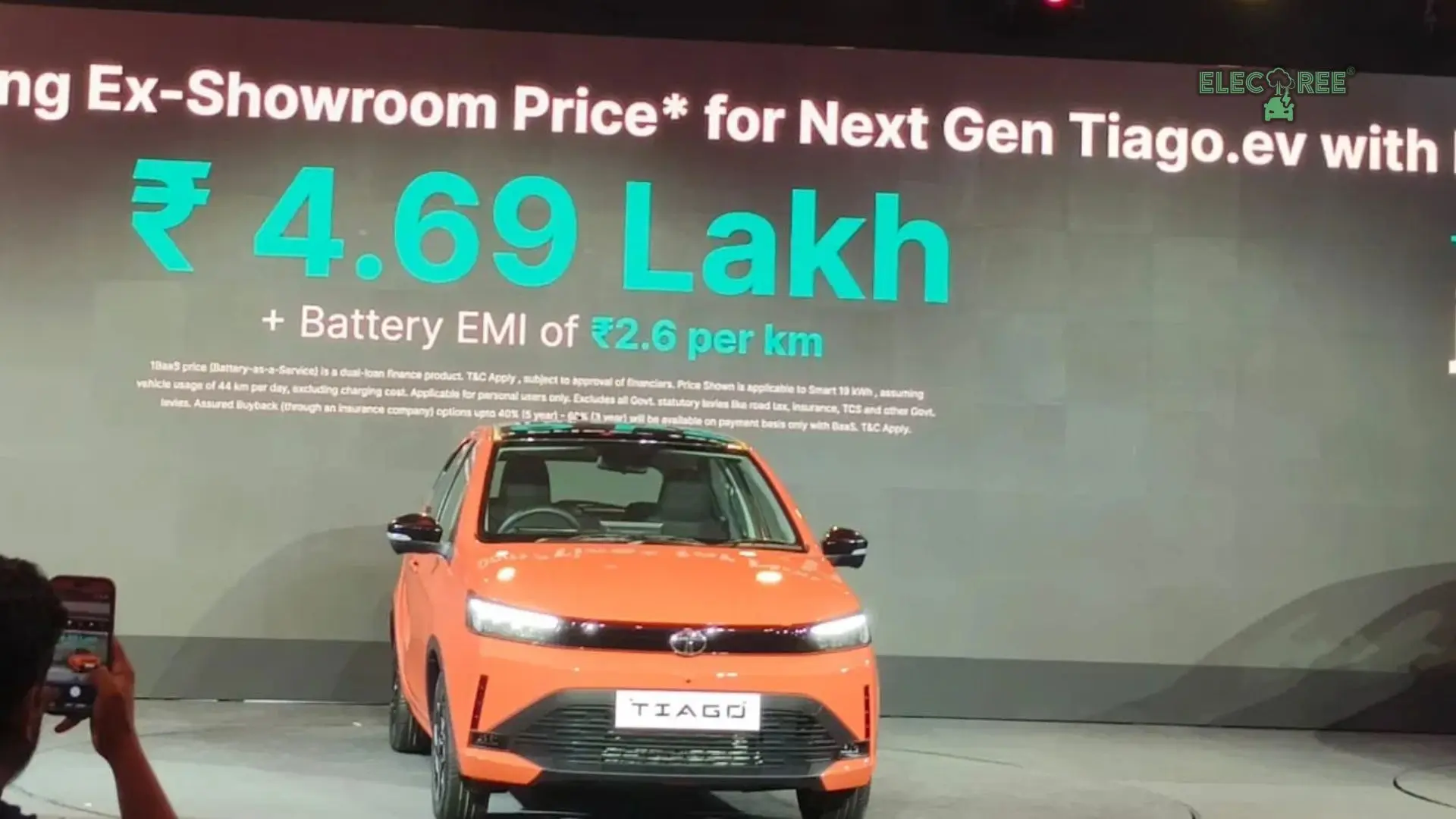
Tata has introduced a BaaS option for the Smart 19 kWh variant, bringing the ex-showroom vehicle price down to ₹4.69 lakh. Under BaaS, the battery is separated from the vehicle cost and charged at ₹2.6 per km as a battery EMI. Tata's calculation assumes 44 km of daily usage — at that run, the monthly battery charge works out to approximately ₹3,432. This is a floor charge regardless of actual daily distance driven — buyers who drive less than 44 km per day will still pay for 44 km.
BaaS is a dual-loan finance product, subject to financier approval, available for personal users only and excludes government levies like road tax, insurance and TCS. Charging costs are also excluded from the battery EMI. An assured buyback option — 40% of value at 5 years and 60% at 3 years — is available on payment basis exclusively with BaaS.
The ₹4.69 lakh headline price will attract attention. But buyers should calculate the total monthly outgo — vehicle EMI plus the minimum ₹3,432 battery charge — against the full ownership alternative before deciding which route works better for their usage pattern.
Our Take
The Next Gen Tiago EV is not a facelift. It is a genuine generational update — new design, new interior, significantly upgraded technology and safety, faster charging and more accessible pricing.
The Creative+ 24 kWh at ₹9.99 lakh is where this car makes its strongest case. For a buyer who drives primarily in the city, commutes daily from home to office, charges overnight at home and wants a feature-rich low running cost car — it is difficult to find a more complete package anywhere near this price in India today. The 24 kWh battery with 205-215 km real world range covers most urban commutes comfortably, the lifetime battery warranty for the first owner removes long term ownership anxiety, and the feature list punches well above this segment.
The BaaS option at ₹4.69 lakh will attract attention — but buyers must do the full monthly cost calculation before committing. The floor charge of ₹3,432 per month on battery usage is not insignificant when added to the vehicle EMI.
What we did not get to assess is the driving experience — how the improved BMS translates to real world range, how the suspension handles Indian roads and whether the 0-60 km/h time of 5.7 seconds feels as brisk in practice. A full road test will follow. We will bring you that as soon as we get the car.
Disclaimer: All Images are property of ElecTree. Removing watermark and using them for own purpose will amount to copyright infringement.
Trending Articles



Recent Articles
Top 5 Best Selling EVs This Year: Windsor Leads with Clear Margin

Renault Duster Hybrid vs Maruti Suzuki Grand Vitara Hybrid: Base, Mid, and Top Variant Comparison

Exclusive: MG Hector Tomahawk EV Charges Faster than MG Advertises

Renault Duster Hybrid Launched At ₹16,99,000 - See How It Compares With Its Rivals