
Tesla’s Massive Model Y Price Drop: How It Disrupts the Premium EV Market
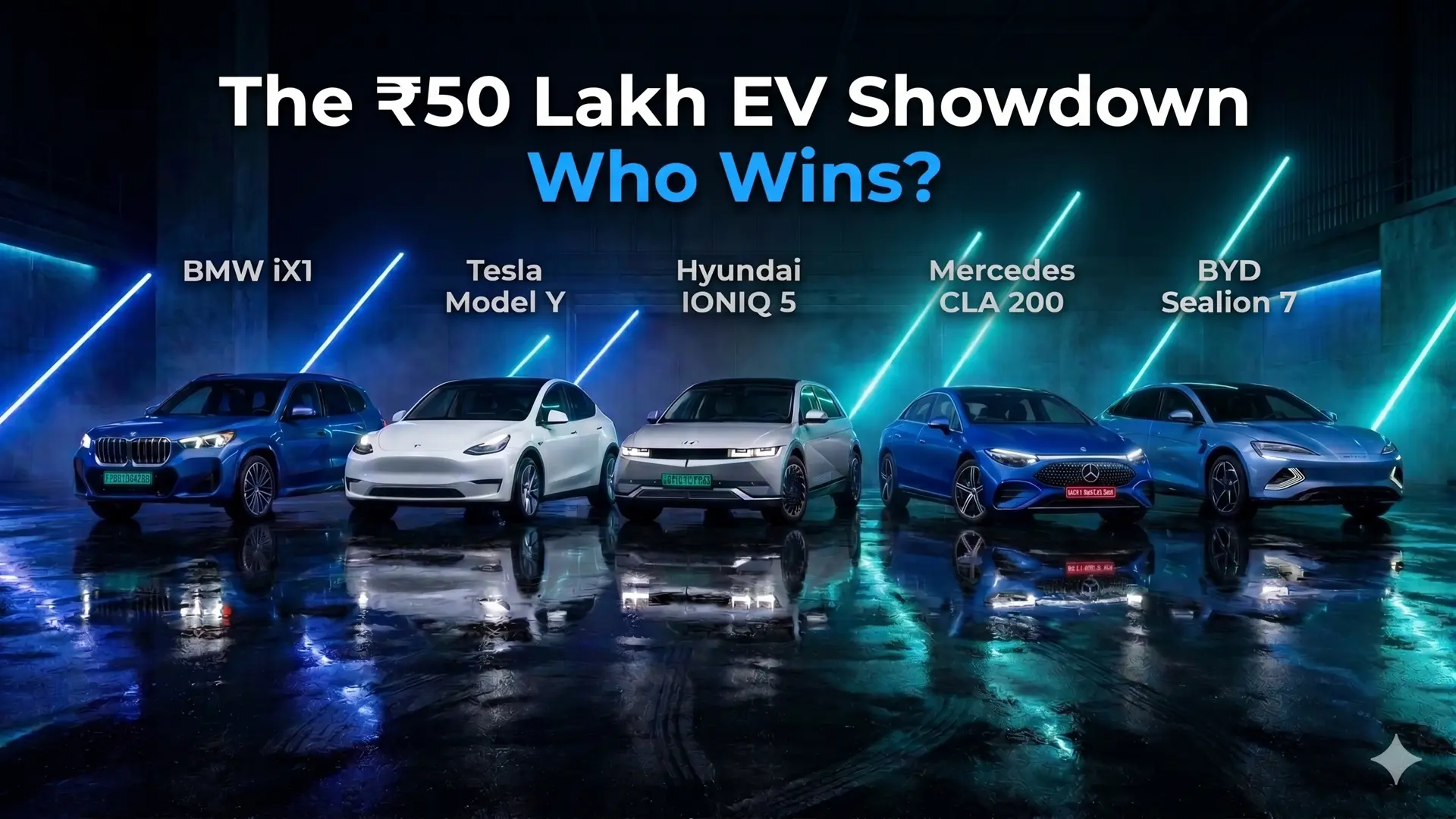
Tesla has done a massive price rejig of its portfolio for India, Model Y LR has been discontinued, and the price of Model Y SR has been reduced to 50.89 lakhs. We take a deep dive on how Tesla Model Y stacks against the competition - BMW iX1 LWB, Hyundai IONIQ 5, BYD Sealion 7, Mercedes CLA 200


Category:
Tag:
- Premium EVs
- Luxury EVs
- EV comparison
Comparison between ₹50L -₹60L EVs
Performance - Torque and acceleration
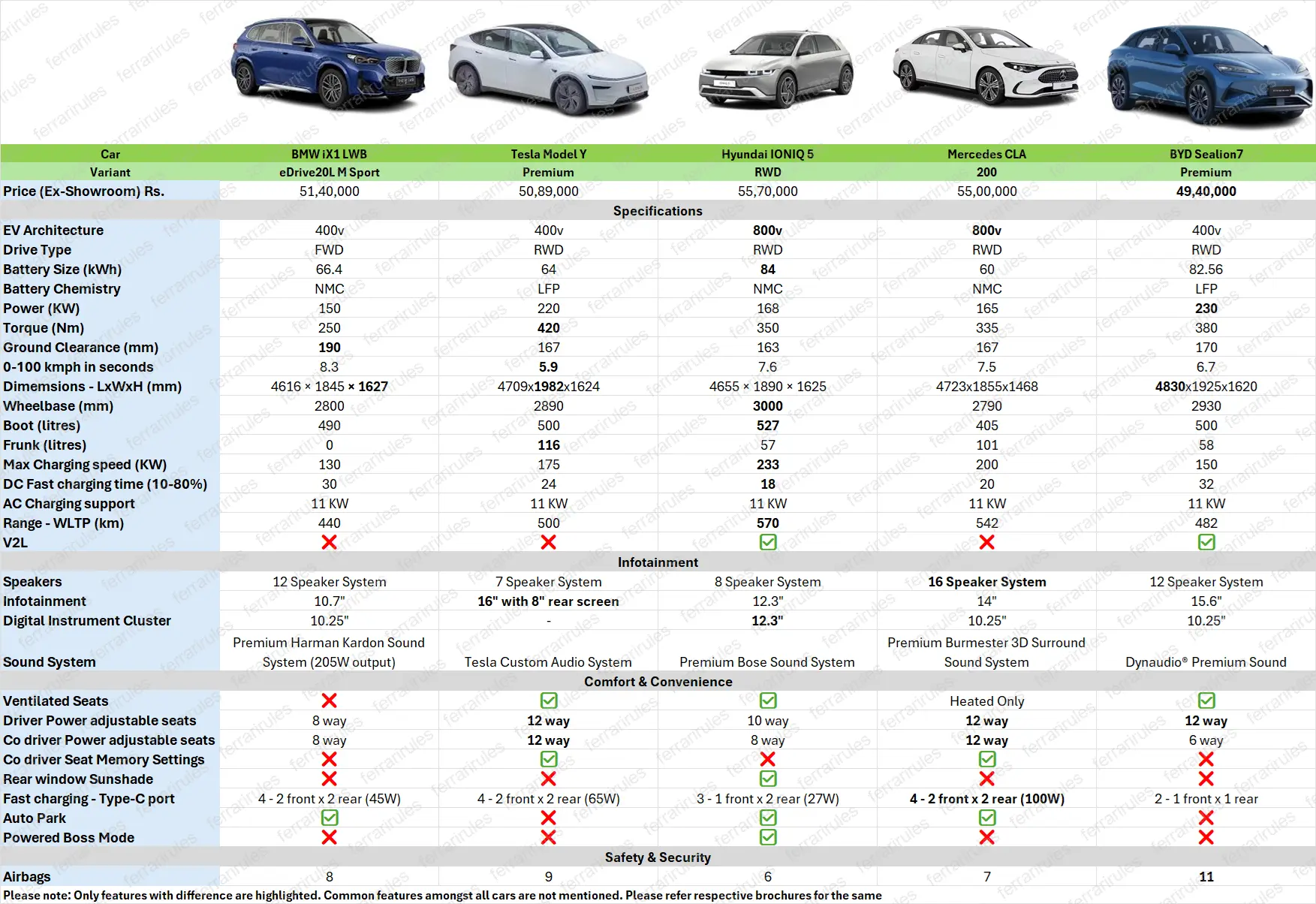
Tesla Model Y is the quickest car here, producing 420 Nm of torque and accelerating 0-100 kmph in 5.9 seconds, giving it the strongest straight-line performance in this comparison.
BYD Sealion 7 comes next with 380 Nm and a 0-100 kmph time of 6.7 seconds, making it the second-fastest car of the lot.
Mercedes CLA 200 produces 335 Nm and does 0-100 kmph in 7.5 seconds, so it is marginally quicker than the IONIQ 5 despite having lower torque.
Hyundai IONIQ 5 delivers 350 Nm and reaches 0-100 kmph in 7.6 seconds, which puts it in the middle of the pack on outright acceleration.
BMW iX1 LWB has the lowest torque figure here at 250 Nm and is also the slowest to 100 kmph at 8.3 seconds.
Range and Efficiency: The 800V Advantage
The electric vehicle game is won and lost on battery architecture and pure efficiency. While legacy platforms are adapting, dedicated EV architectures are demonstrating massive inherent advantages.
The 800V Kings: Advanced 800V architectures unlock superior thermal management and blistering charge times. The Hyundai IONIQ 5 leverages its massive 84.0 kWh pack to deliver 570 km (WLTP) while hitting a class-leading 233 kW peak charge speed, completing a 10-80% top-up in just 18 minutes. However, the Mercedes CLA 200 puts on an efficiency masterclass: it squeezes a segment-best 542 km (WLTP) from a significantly smaller battery pack, while still sustaining a rapid 200 kW charge (10-80% in 20 minutes).
The 400V Contenders: Operating on standard 400V architecture forces different trade-offs. Tesla relies on aggressive software optimization, giving the Model Y Premium a robust 500 km (WLTP) range and a 175 kW peak charge (10-80% in 24 minutes). BYD’s Sealion 7 brute-forces a 482 km (WLTP) range using a large 82.56 kWh battery, charging at 150 kW to hit 80% in 32 minutes. Meanwhile, the BMW iX1 LWB trails the pack objectively—both in range (440 km WLTP) and charging capability, maxing out at 130 kW and requiring a full 30 minutes for a standard 10-80% charge.
Space and Practicality: The Wheelbase Wars
Cabin Space:
The length of the wheelbase directly correlates to interior passenger volume, specifically rear legroom.
The Dedicated EV Advantage: The Hyundai IONIQ 5 demonstrates the power of a dedicated EV platform. By pushing the wheels to the absolute corners, it achieves a massive 3000 mm wheelbase, the largest in this comparison, translating to an unmatched lounge-like interior.
The Competitors: The BYD Sealion 7 offers a highly competitive 2930 mm wheelbase, trailing just behind the IONIQ 5. The Tesla Model Y sits solidly in the middle with 2890 mm, while the sleek Mercedes-Benz CLA 200 prioritizes aerodynamics over maximum cabin length, offering the shortest wheelbase at 2790 mm.
The LWB Strategy: BMW has localized the Long Wheelbase (LWB) version of the iX1, offering a 2800 mm wheelbase. This directly addresses the rear-seat comfort demands of Indian luxury buyers.
Ground Clearance:
Ground clearance is a critical factor for Indian driving conditions.
The High Riders: The BMW iX1 LWB boasts the highest ground clearance at an impressive 190 mm, making it the most capable over challenging speed breakers. It is followed by the BYD Sealion 7 at 170 mm.
The Low Slung: The Tesla Model Y (167 mm), Mercedes CLA 200 (167 mm), and Hyundai IONIQ 5 (163 mm) all sit lower to the ground, trading some rough-road capability for better high-speed aerodynamics and efficiency.
Boot and Frunk Space:
Storage solutions reveal differing engineering priorities among the automakers.
Space leader: Tesla remains the undisputed champion of total cargo space. The Model Y Premium offers a massive 500-liter boot and a highly usable 116-liter frunk.
The Balanced Haulers: The Hyundai IONIQ 5 and BYD Sealion 7 offer strong rear boot capacities of 527 liters and 500 liters, respectively, paired with identical 57/58-liter frunks.
The Luxury Practicality: The Mercedes-Benz CLA 200 offers a 405-liter boot but compensates with an impressive 101-liter frunk (a first for Mercedes in decades). The BMW iX1 LWB provides a respectable 490-liter boot but completely lacks a frunk, utilizing that front space for motor and HVAC components instead.
Comfort & Convenience
Seating & Climate Adjustments: In the Indian climate, ventilated seats are non-negotiable. Yet, only the Tesla Model Y and Hyundai IONIQ 5 include them as standard. The Mercedes CLA shockingly offers "Heated Only" seats—a glaring omission for this market—while the BMW iX1 LWB misses out entirely. For pure adjustability, the Model Y and CLA lead the pack, offering 12-way power seats for both the driver and co-driver, complete with co-driver memory settings.
The Chauffeur Experience: The Hyundai IONIQ 5 completely outclasses the luxury badges in rear-seat comfort. It is the only vehicle in this lineup to offer a rear window sunshade and a "Powered Boss Mode". Ironically, the BMW iX1 LWB, despite its "Long Wheelbase" marketing designed for the chauffeur-driven buyer, lacks both of these crucial features.
Cabin Tech & Charging: Mercedes strikes back with sheer device-charging dominance. The CLA is equipped with four Type-C ports rated at a massive 100W—enough to fast-charge flagship laptops on the go. The Model Y follows with highly capable 65W ports. The IONIQ 5 falls flat here, offering just three ports capped at a sluggish 27W. For urban manoeuvring, the Model Y is the only car lacking Auto Park, a feature standard across the iX1, IONIQ 5, and CLA.
Safety
Safety is a baseline expectation at the ₹50 lakh mark. While all these vehicles boast strong global NCAP crash test ratings, their actual passive safety hardware varies surprisingly. The Tesla Model Y and BYD Sealion 7 lead the pack, each equipped with a comprehensive 9-airbag system. The European luxury contenders sit in the middle—the BMW iX1 LWB offers 8, while the Mercedes CLA 200 provides 7. Ironically, the Hyundai IONIQ 5, which wins on interior space, offers the segment minimum with a standard 6-airbag setup.
To comment and participate in discussion Click Here
Trending Articles

Recent Articles
Renault Duster Hybrid vs Maruti Victoris Hybrid: All Variants Compared
Duster Hybrid vs Hyryder Hybrid: Prices, Powertrain and Variants Compared
Top 5 Best Selling EVs This Year: Windsor Leads with Clear Margin
Renault Duster Hybrid vs Maruti Suzuki Grand Vitara Hybrid: Base, Mid, and Top Variant Comparison