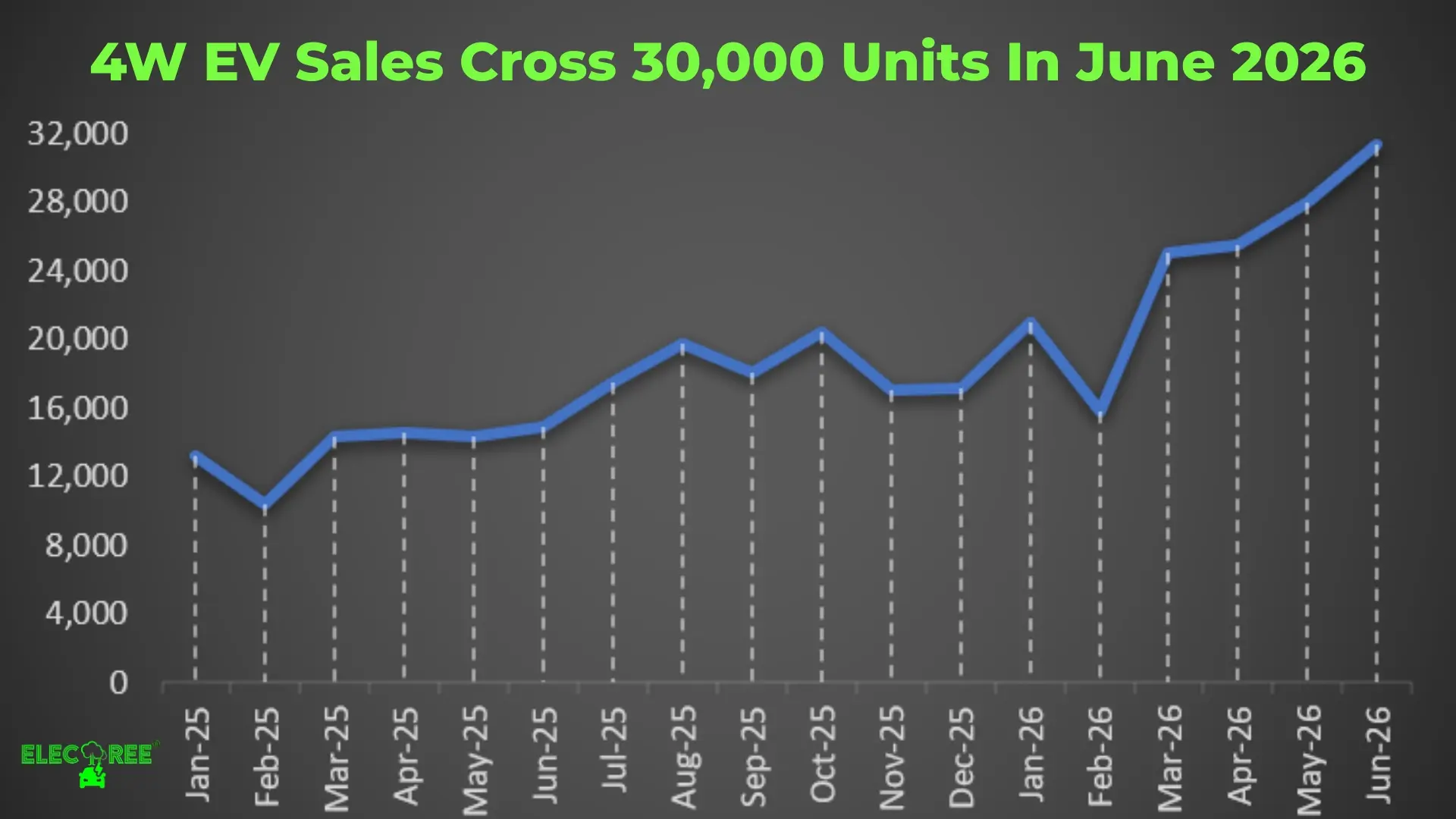
4W EV Sales June 2026: Monthly Units Cross 30,000 for the First Time
India's four-wheeler EV market crossed 30,000 monthly units for the first time in June 2026, registering 31,353 units — the second consecutive all-time high. ElecTree brings a complete breakdown of OEM performance, state-wise trends and fuel distribution data.


Category:
Tag:
- June 2026 Sales Analysis
India's four-wheeler EV market registered 31,353 units in June 2026 — the highest monthly volume ever recorded, and the second consecutive month of a new all-time high. Month on month growth stood at 12%, year on year at 110%. On a quarter on quarter basis the market grew 37%, reflecting a sustained structural acceleration rather than a single-month event. Year to date, the market has clocked 1,46,656 units between January and June 2026, against 81,743 units in the same period last year — a YTD growth of 79%. The market has added nearly 65,000 units more in the first half of 2026 than it did in the first half of 2025.
Sustained fuel price elevation — partly linked to global crude volatility from ongoing Middle East tensions — continues to strengthen the running cost case for EVs and has visibly accelerated consideration among buyers who were previously undecided.
OEM Performance
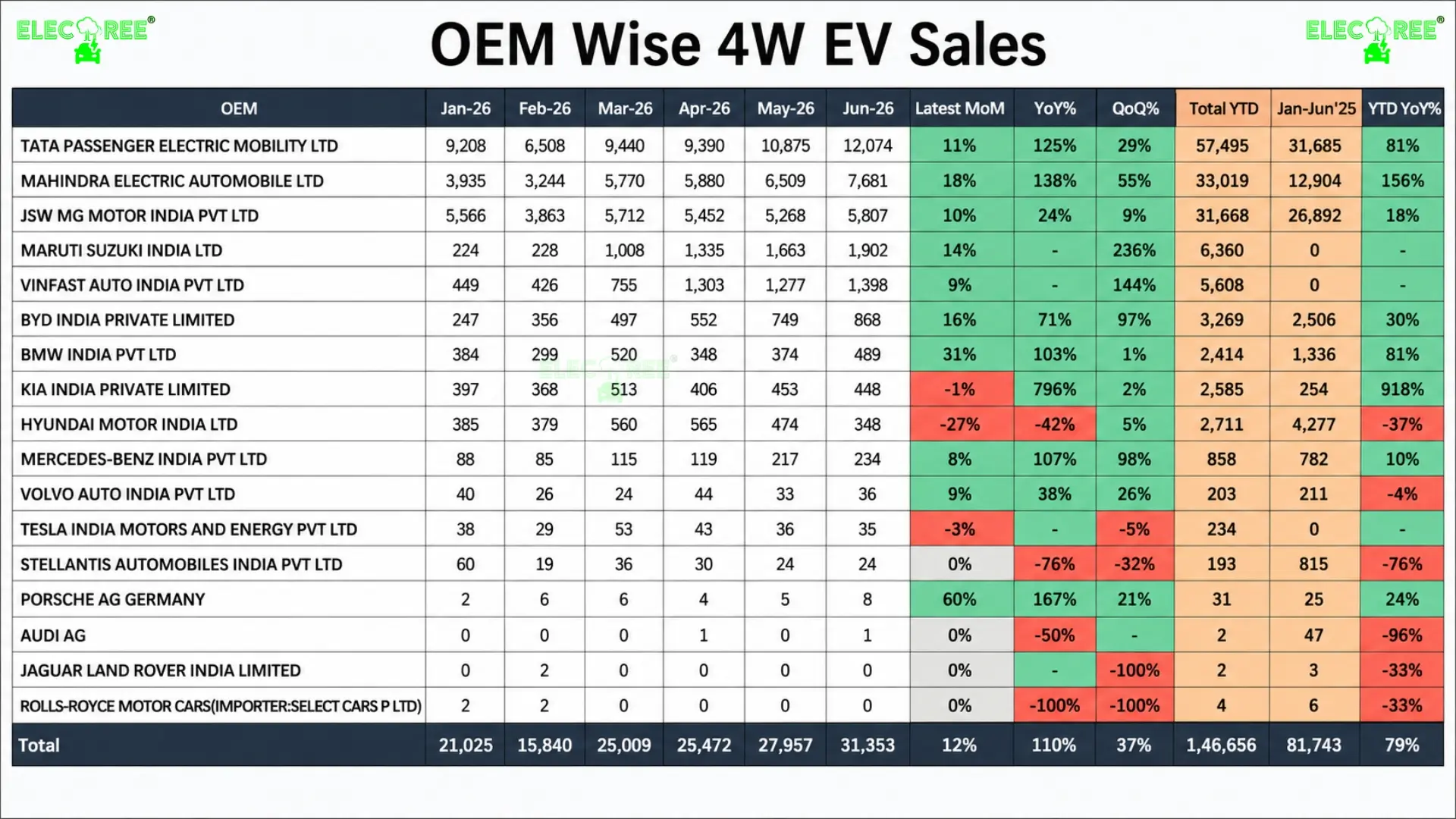
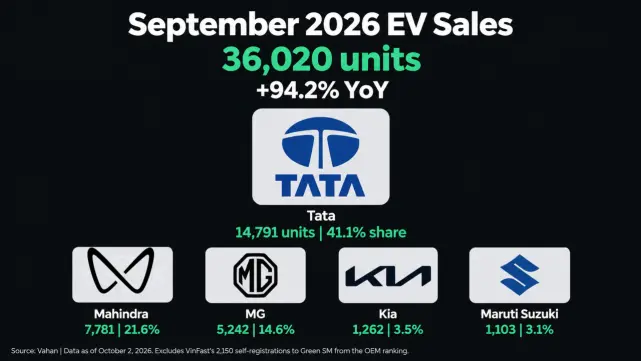
Tata Passenger Electric Mobility recorded 12,074 units in June 2026 (39% market share) — its second consecutive month above 10,000 units, confirming that the run rate established in May is holding. Two factors are driving the momentum: the Punch EV 40 continues to see strong demand with waiting periods at dealerships, and the Curvv EV price correction has brought it back into active consideration for buyers in that segment. YoY growth stands at 125% and YTD units total 57,495 against 31,685 in the same period last year — an 81% increase.
Mahindra Electric recorded 7,681 units — its highest ever monthly volume. MoM growth of 18%, YoY of 138%, and QoQ of 55% make it the stronger growth story this month. The XEV 9S is the primary volume driver, having found strong traction since its launch. On a YTD basis Mahindra has now crossed JSW-MG for the first time — 33,019 units against JSW-MG's 31,668 — a competitive milestone that marks a clear shift in the market's second position.
JSW-MG Motor recorded 5,807 units, a MoM increase of 10% but a YoY growth of just 24% in a market that expanded 110%. The Windsor continues to carry the entire portfolio and the over-reliance on a single model is compounding month on month. JSW-MG has now fallen to third on a YTD basis, behind both Tata and Mahindra.
Maruti Suzuki recorded 1,902 units — a MoM increase of 14% and the fourth consecutive month of growth since the e-Vitara's launch in March 2026. Maruti is now firmly established as the fourth largest four-wheeler EV player in India, a position it has built steadily without a single month of decline since entering the segment.
VinFast recorded 1,398 units in June. Of these, 310 are fleet registrations under Green SM, VinFast's captive cab service. Green SM has broadly achieved its initial target of 1,000 cabs in Delhi-NCR, with around 10 units now registered in other states marking the early stages of geographic expansion. Retail sales to individual buyers crossed 1,000 units in June — a meaningful milestone for a brand less than a year into the Indian market.
BMW India recorded 489 units in June — outselling both Hyundai and Kia in the same month. A premium brand registering more units than two established mass-market players is a data point worth pausing on. BMW's YoY growth stands at 103% and YTD units are 2,414 against 1,336 in the same period last year.
Hyundai Motor India recorded 348 units — a MoM decline of 27% and a YoY decline of 42%. YTD units stand at 2,711 against 4,277 in the same period last year, a decline of 37%. This is no longer a temporary soft patch. The Creta Electric is being outcompeted at its price point in a market that has become significantly more crowded and price-competitive since its launch.
Kia India recorded 448 units with a YoY growth of 796% — a number that requires context. The Carens Clavis EV launched on 15 July 2025, meaning June 2025 had near-zero Kia EV registrations. The YoY figure is entirely a base effect. The actual monthly volume of 448 units is modest.
Tesla India recorded 35 units in June — essentially flat despite the price correction on the Model Y and the launch of the Model Y L. Deliveries at the revised pricing have already begun but the market response is not yet visible in registration numbers.
State-wise Performance — June 2026
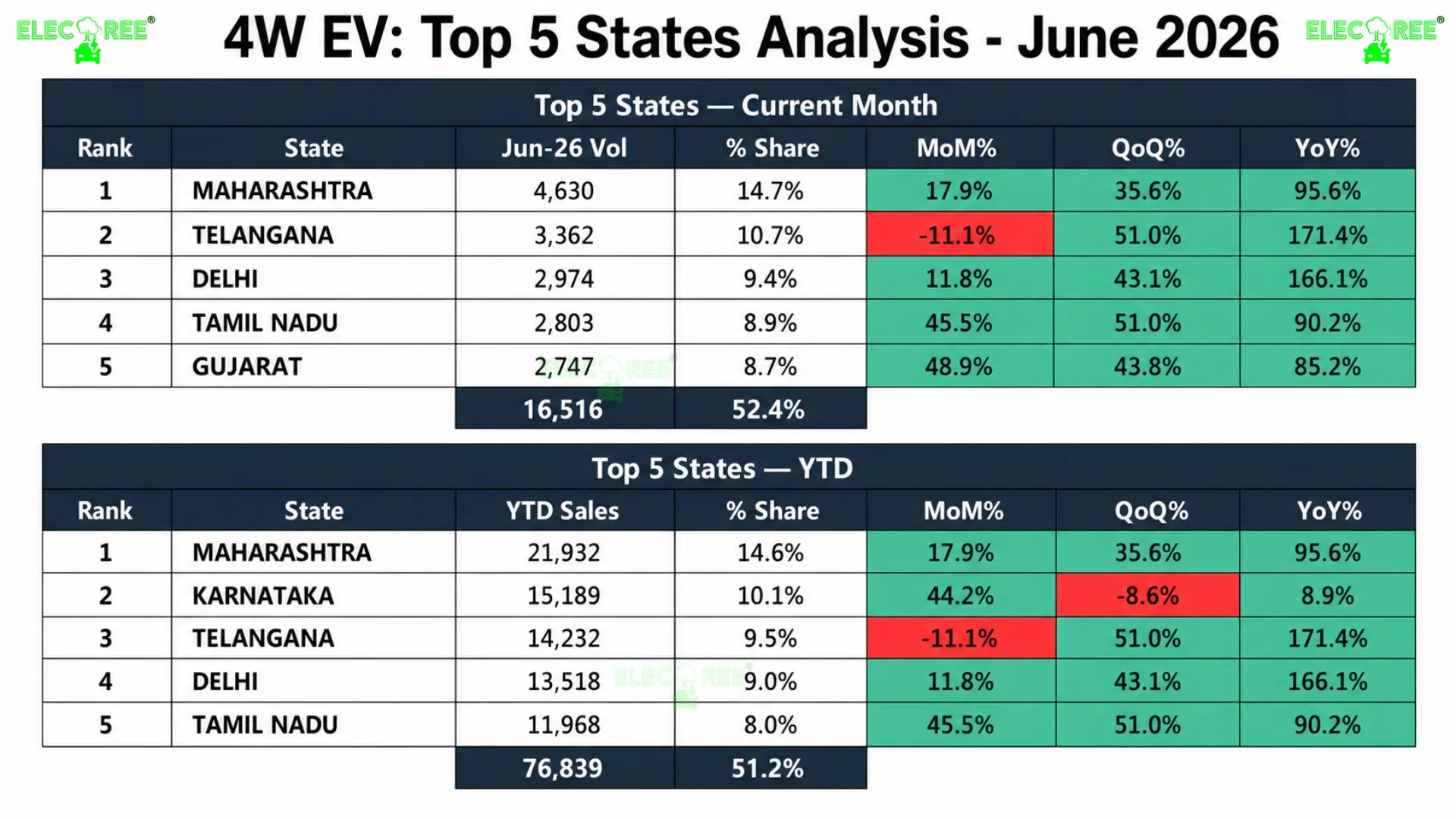
The top five states in June 2026 accounted for 16,516 units — 52.4% of the total market.
Maharashtra retained the top position with 4,630 units — 14.7% market share, MoM growth of 17.9% and YoY growth of 95.6%. Consistent and dominant.
Telangana held second with 3,362 units — 10.7% share and a remarkable YoY of 171.4% and QoQ of 51%, though MoM softened by 11.1% after a strong April-May run.
Delhi came in third with 2,974 units — 9.4% share, MoM growth of 11.8% and YoY growth of 166.1%. Delhi's EV Policy 2026 takes effect from July, making next month's data particularly worth watching for the capital.
Tamil Nadu recorded 2,803 units with a strong MoM jump of 45.5% and YoY growth of 90.2%.
Gujarat entered the monthly top five for the first time with 2,747 units — 8.7% share, MoM growth of 48.9% and YoY growth of 85.2%. Rajasthan had made its debut in May's monthly top five and has now dropped out, replaced by Gujarat. Two different new entrants in consecutive months points to a genuine geographic spread of EV adoption beyond the traditional markets.
On a YTD basis, Karnataka holds second position with 15,189 units — but has been absent from the monthly top five for several months following the withdrawal of the state's EV road tax exemption in April 2026. The picture is now more nuanced: Karnataka recorded a 44.2% MoM increase in June, a clear recovery signal after two months of suppressed demand. The hangover is fading.
Fuel Distribution — June 2026
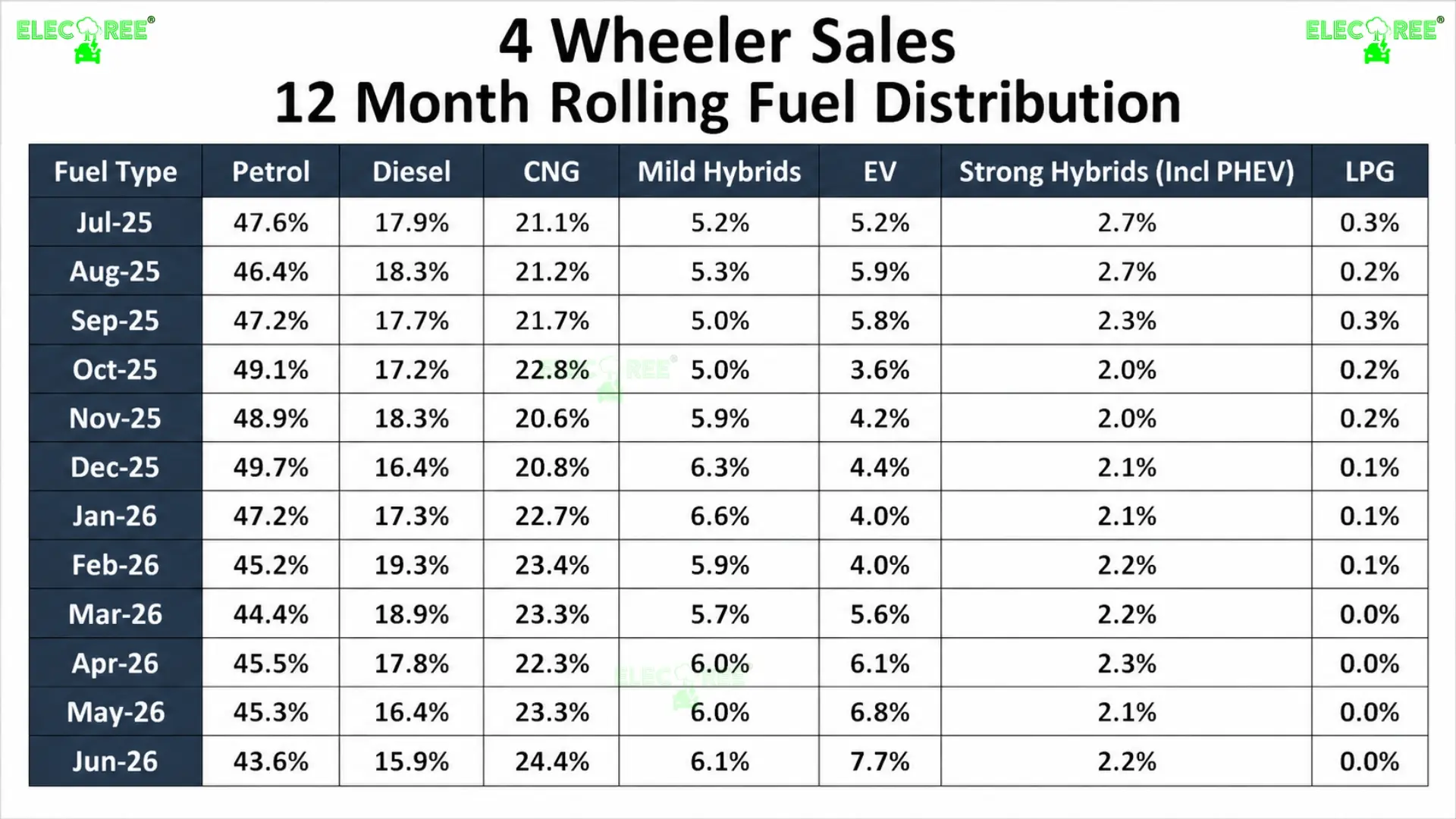
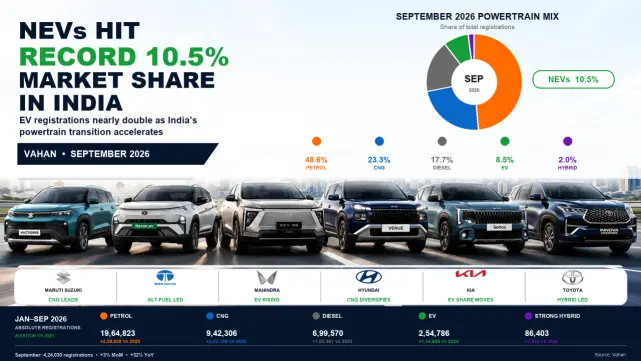
EV's share of the overall passenger vehicle market reached 7.7% in June 2026 — the highest figure in the twelve-month period shown and the third consecutive month of acceleration, up from 6.1% in April and 6.8% in May.
CNG also reached its highest level in the period at 24.4%, up from 23.3% in May. Together CNG and EV now account for over 32% of new passenger vehicle registrations in India — a threshold that would have seemed ambitious at the start of 2026.
Petrol fell to 43.6% — its lowest in the twelve-month period. Diesel continued its structural decline to 15.9%, also the lowest in the period and down from 17.9% in July 2025. Petrol and diesel combined have fallen below 60% of the market for the first time. The share being absorbed by CNG and EV in roughly equal measure tells the story of where Indian buyers are moving as fuel costs remain elevated.
Mild hybrids held at 6.1% and strong hybrids including PHEVs at 2.2% — both broadly stable.
Outlook
India's four-wheeler EV market has now recorded back-to-back all-time highs. EV penetration at 7.7% in June and YTD growth of 79% point to a market that is no longer in an early-adoption phase — it is in an expansion phase. Double-digit penetration in the near term is no longer a distant projection.
For that trajectory to hold, two things need to keep pace with the demand. Home charging regulations need to be progressive and clearly enforceable, removing the friction that urban apartment buyers increasingly face when trying to set up charging at their own allotted parking spaces. And public charging infrastructure — particularly at OMC fuel stations, which have the widest geographic footprint — needs to move beyond installation numbers to operational accountability, with charger uptime as a measurable and monitored standard. A charger that exists on paper but is non-functional when a driver needs it does not serve the market.
The demand is there. The infrastructure and the regulatory environment need to keep pace with it.
Disclaimer: All numbers reported are from the Vahan Dashboard as on 02 July, 2026. The analysis is by the author and ElecTree holds all rights. Using images by removing the watermark or logo will amount to copyright infringement. Provide a link to this article when citing data on any social media, publication or forum.
To comment and participate in discussion Click Here
Trending Articles