The Multi-Fuel Advantage: Decoding Tata's EV and CNG Surge (2021-2025)
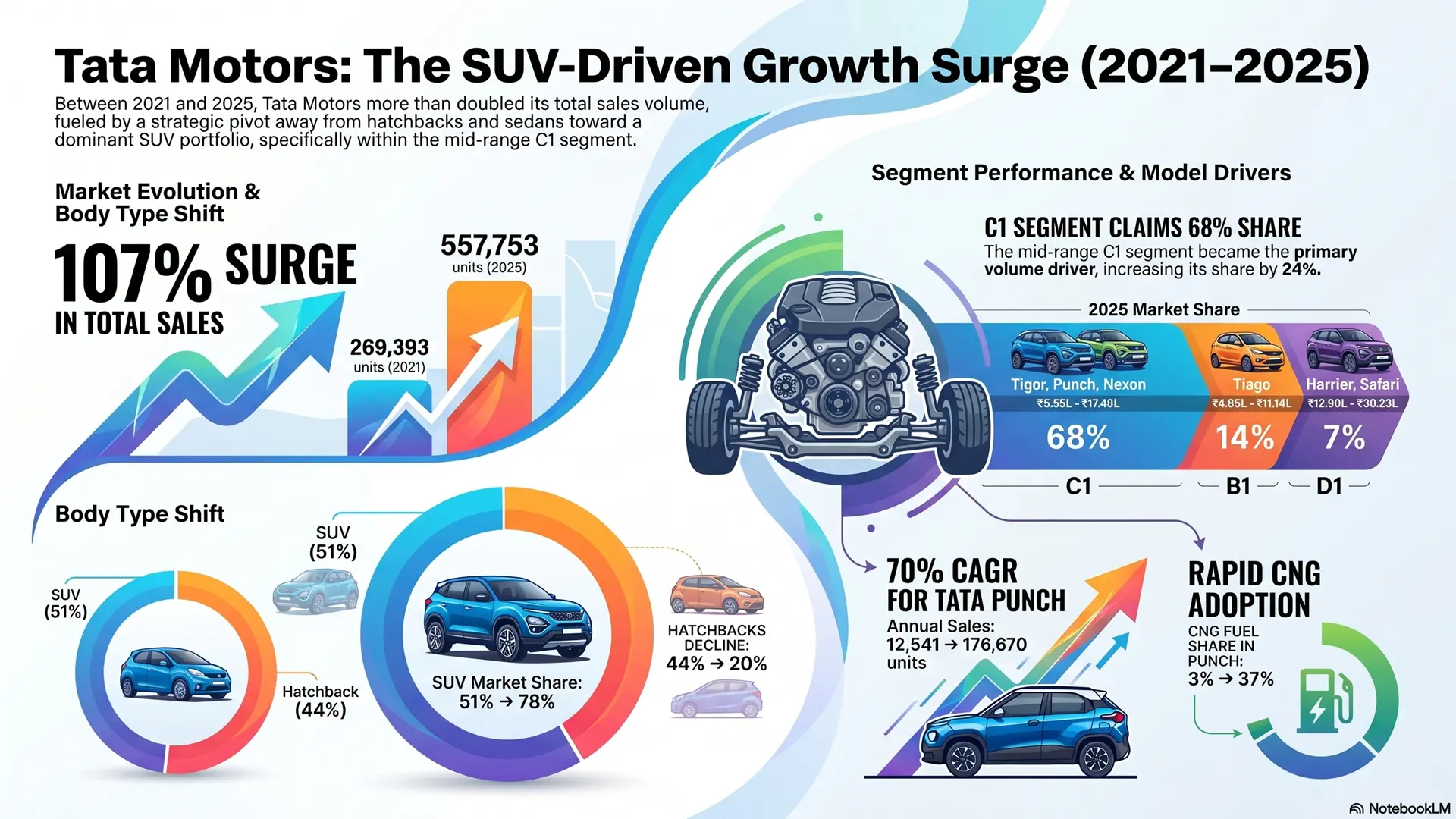
Between calendar years 2021 and 2025, Tata Motors executed a structural overhaul of its Passenger Vehicle (PV) business, scaling annual volumes from 269,393 units to 557,753 units—a 16% Compound Annual Growth Rate (CAGR). This expansion relied on a multi-fuel ecosystem heavily weighted toward SUVs.


Category:
Tag:
- Tata Motors Sales
- Auto Industry Trends
Volume Scaling and SUV Hegemony
Tata has successfully expanded its footprint from small hatchbacks to large SUVs, with the latter serving as the central pillar of its volume growth. The sales curve climbed steadily, reaching over half a million units by 2025, driven largely by a fundamental rewrite of the portfolio’s composition. Tata sales have doubled in the last 5 years.
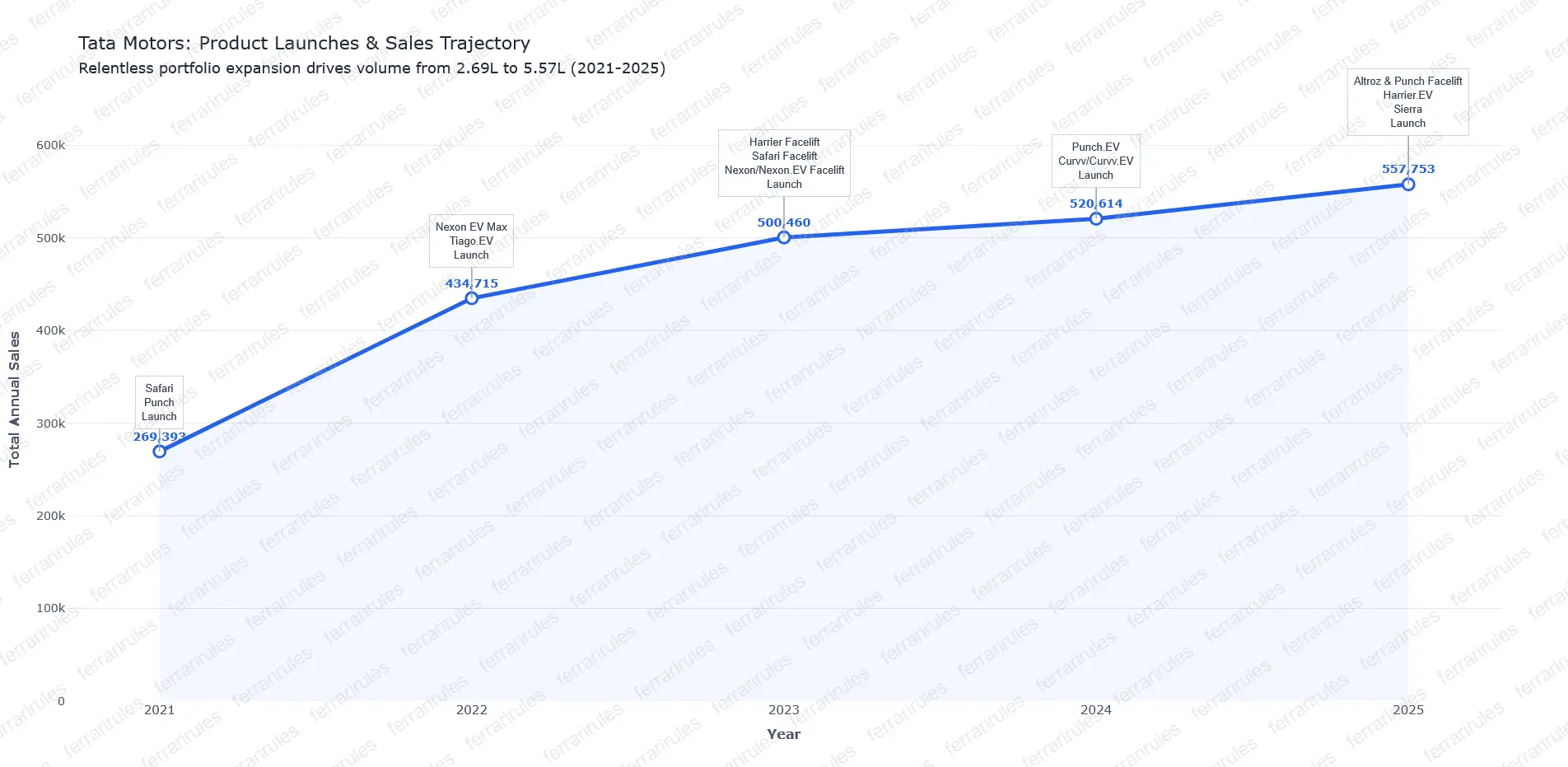
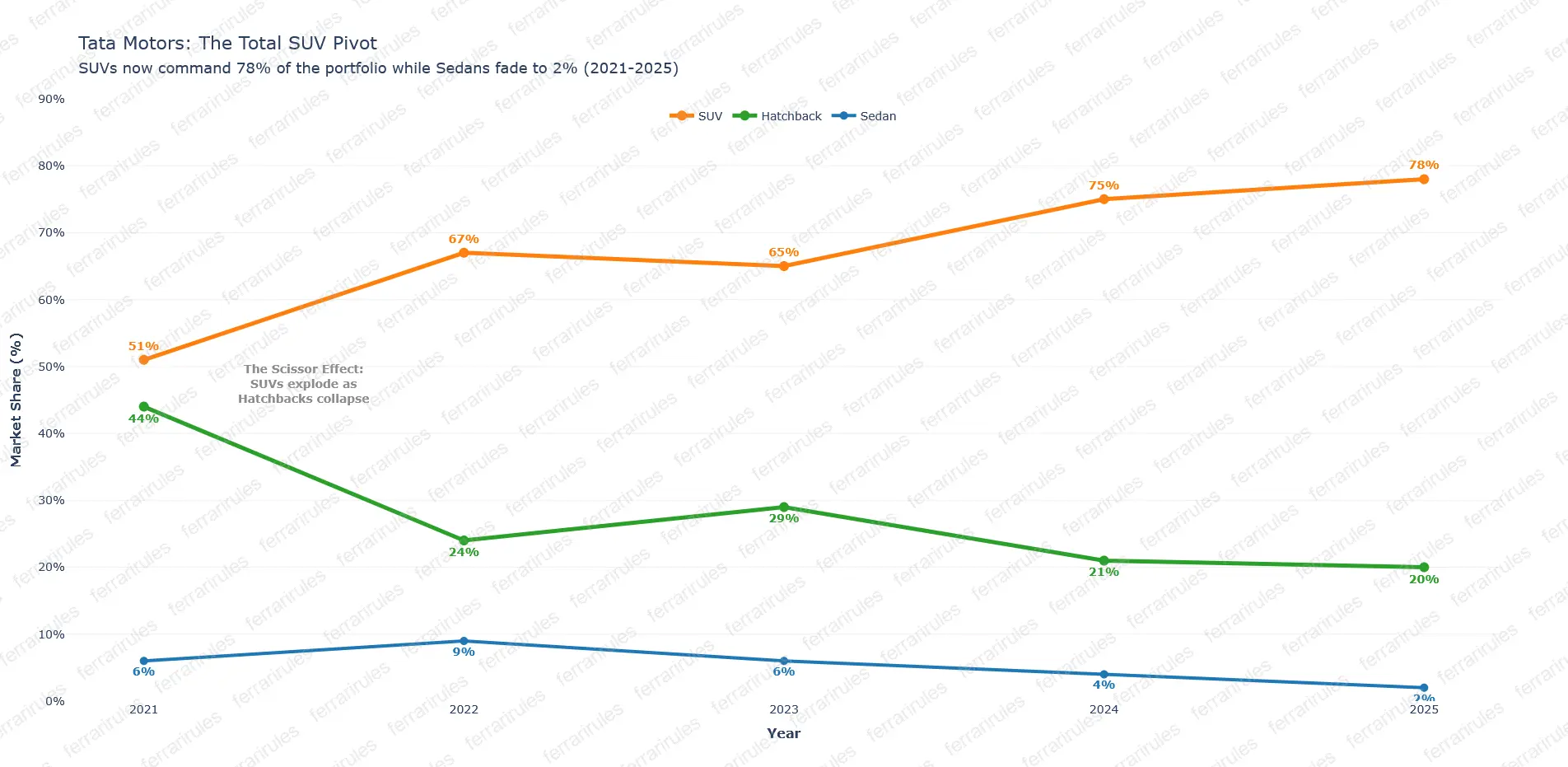
Market data reveals a definitive "SUV Takeover." While SUVs already constituted a healthy 51% of Tata's mix in 2021, they surged to 78% by 2025. This 27-percentage-point gain was realized through the managed decline of the hatchback segment, which dropped from a 44% to a 20% share, and the marginalization of sedans to a negligible 2%. This macro-shift confirms an intentional focus on aspirational categories that now underpin the brand’s volume floor.
Model Portfolio Dynamics
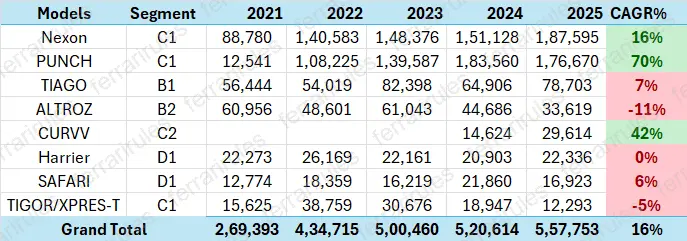
Over the last five years, Tata kept its lineup highly competitive and refreshed with four entirely new models (Punch, Safari, Curvv, and Sierra), five EV additions (Nexon EV Max/45, Tiago.EV, Punch.EV, Curvv.EV, and Harrier.EV), and five major facelifts (Nexon, Harrier, Safari, Altroz, and Punch).

Portfolio Growth Engines
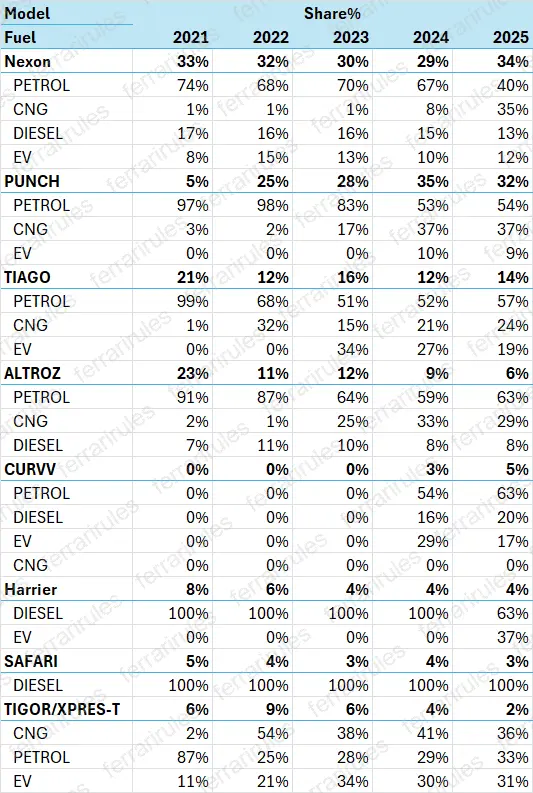
- Nexon: Sparking Tata’s transformation in 2017, this sub-compact SUV remains the core pillar of the brand's success and is the only model offering every fuel option. Through tasteful facelifts and the integration of a DCT gearbox, EV trims, and dual-cylinder CNG (including CNG AMT), the Nexon sold 1.87 lakh units in 2025, commanding a 34% internal sales share.
- Punch: Launched in 2021, this entry-level SUV has seen massive adoption, though sales remained flat between 2024 and 2025 as buyers awaited an impending facelift. By 2025, the combined force of the Nexon and Punch accounted for 56% of Tata’s total sales.
- Tiago: Despite an industry-wide pivot toward SUVs, Tata's entry-level hatchback maintained an upward momentum with a 7% CAGR, even as its overall sales share naturally diluted from 21% to 14%.
- Curvv: Representing Tata’s crucial entry into the highly competitive C2 segment, sales are growing steadily as the brand works to establish a stronger foothold here.
Portfolio Laggards
- Altroz: Entering the premium hatchback space in 2020, the Altroz saw reasonable success until 2023, after which demand dwindled to a -11% CAGR. Despite offering three fuel options, it now holds just a 6% sales share.
- Harrier: Designed to rival the XUV700 in the D1 segment, the Harrier was losing traction until the first half of 2025. The strategic launch of the Harrier.EV with an AWD powertrain breathed new life into the nameplate.
- Safari: Positioned as the flagship replacement for the original body-on-frame Safari, the new iteration has struggled to capture the same emotional connection with buyers, resulting in a modest 6% CAGR that falls short of segment expectations.
The Multi-Energy Strategy
Tata utilized a balanced powertrain approach to hedge against regulatory volatility and shifting fuel price parities. In the entry and mid-SUV segments, the brand aggressively leveraged CNG and EV adoption to offset the stagnation in pure internal combustion engine (ICE) sales.
Deploying EVs across almost the entire lineup, alongside dual-cylinder CNG and CNG Automatics up to the Nexon, proved to be a highly lucrative bet. The sales mix highlights the success of this powertrain diversification:
- Nexon: 47% of sales come from EV and CNG variants.
- Punch: 46% of sales come from EV and CNG variants.
- Tiago: 43% of sales come from EV and CNG variants.
- Altroz: 29% of sales come from CNG variants.
- Harrier: The late 2025 EV launch instantly shifted 37% of the model's sales to electric.
Fleet Segment Decoupling
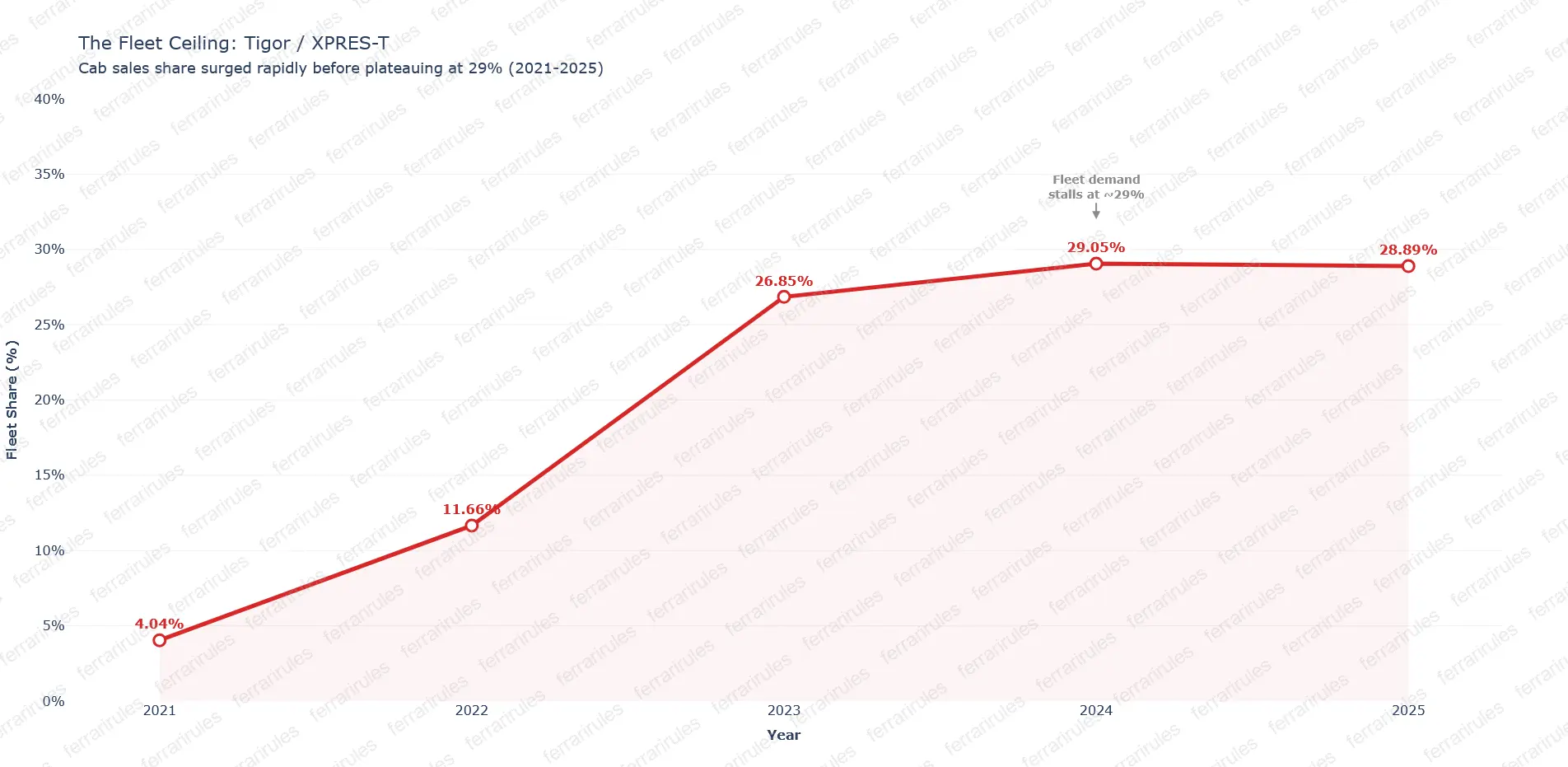
A foundational element of Tata’s 2021-2025 strategy was the siloing of its commercial operations. Today, taxi sales account for less than 1% of Tata’s overall volume.
The Tigor and XPRES-T platforms served as the primary vehicles for this isolation. While the Tigor line’s overall contribution to Tata’s portfolio dropped to a mere 2% by 2025, its internal cab sales percentage surged to nearly 29%. By concentrating fleet penetration exclusively into the XPRES-T (EV) and Tigor (CNG) platforms, Tata effectively shielded flagship retail models like the Punch and Nexon from brand-diluting taxi associations.
The Road Ahead
Tata has maintained an aggressive innovation pipeline for 2026. The introduction of the Sierra brings a new 1.5L TGDI engine alongside an NA option. Crucially, this 1.5L TGDI has also been tuned for the Harrier and Safari, finally giving both flagship SUVs a much-needed petrol option. During Q4 results, Tata confirmed a packed launch calendar for the year, including the Sierra EV, four model facelifts, and the highly anticipated Avinya architecture.
While the company continues to bet heavily on its CNG and EV multi-fuel strategy, future market dominance will require a sharper focus. To become a truly formidable all-rounder and sustain its growth trajectory, Tata must now prioritize improvements in quality control and its after-sales service network.
Disclaimer: All charts have been created by the author with Vahan as the data source (without Telangana data). Digitally removing the ElecTree logo or any watermarks and repurposing the charts will amount to copyright infringement. Cite this article as a source and provide the link if sharing details on social media or a news publication.
Trending Articles