
Tata Punch EV 40kWh Real-World Charging Curve on a 120kW Charger: 10-70% in 27 Minutes
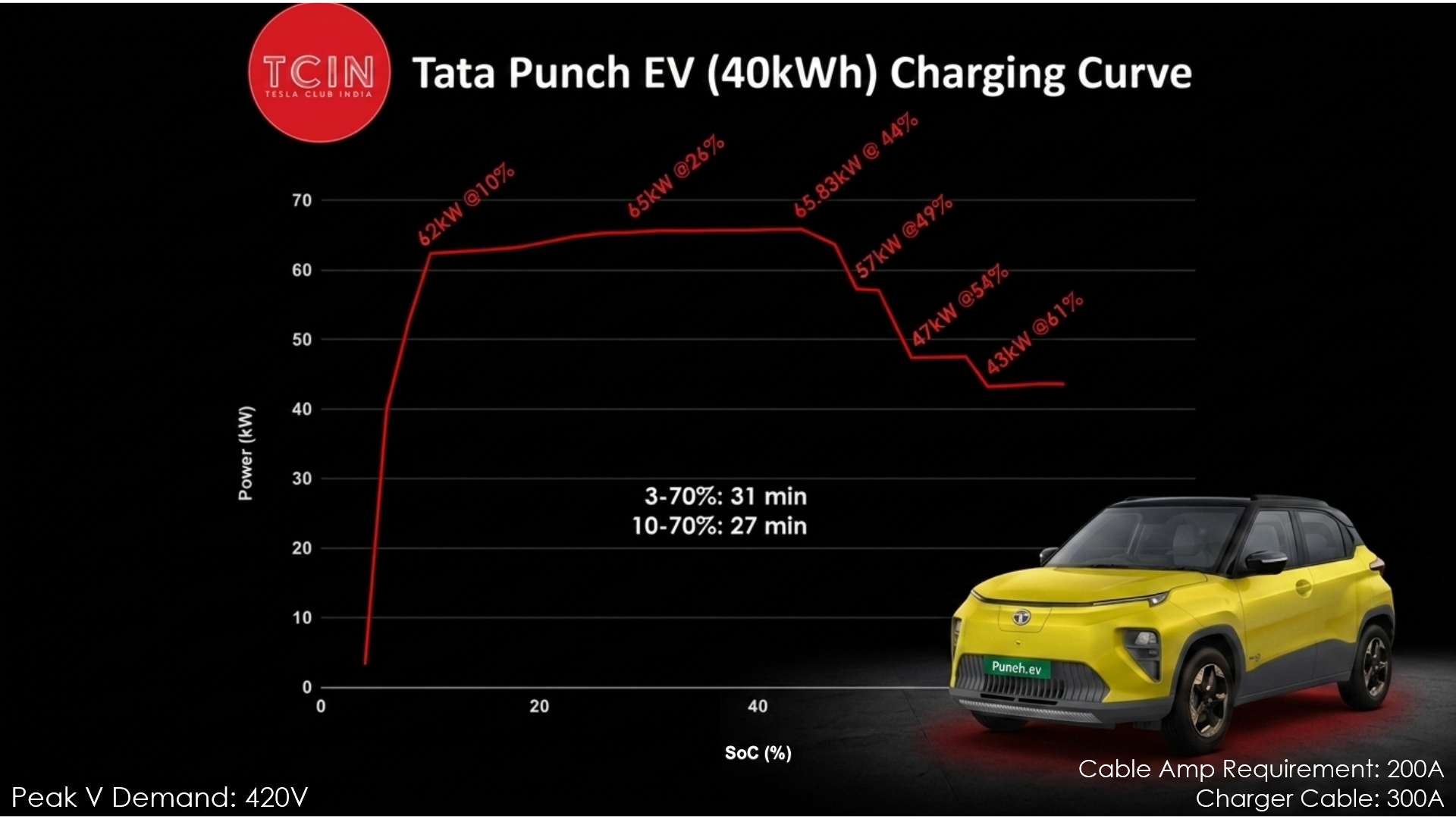
Real-world charging curve data for the Tata Punch EV 40kWh on a 120kW DC fast charger, captured by Tesla Club India. Peak acceptance hits 65.83kW — and the data tells an important story about charger choice.


Category:
Tag:
- Tata Punch EV
- Charging Curve
- Fast Charging
A new real-world charging curve for the Tata Punch EV 40kWh, captured on a 120kW DC fast charger, has been published by Tesla Club India (TCIN) — and the data offers a cleaner, more complete picture of how the car actually charges.
ElecTree is publishing this data with permission from TCIN.

What the Curve Shows
The session recorded a peak charging power of 65.83kW at 44% SoC, with the curve holding broadly flat from around 10% to 44% before beginning a gradual taper. Key data points from the curve:
- 62kW at 10% SoC
- 65kW at 26% SoC
- 65.83kW at 44% SoC — peak
- 57kW at 49% SoC
- 47kW at 54% SoC
- 43kW at 61% SoC
Charging times recorded:
- 3-70%: 31 minutes
- 10-70%: 27 minutes
Session parameters: Peak voltage demand 420V, cable amp requirement 200A, charger cable 300A.
The 120kW Charger Makes No Difference Beyond 65kW
Despite being plugged into a 120kW DC fast charger, the Punch EV 40kWh accepted a maximum of 65.83kW. This confirms that the car's onboard charging hardware — not the EVSE — is the limiting factor. Any CCS2 charger rated above approximately 65kW will deliver identical charging speeds on this car. Owners choosing a charging stop can use any available fast charger above that threshold without any practical benefit from higher-rated stations.
How This Compares to Tata's Official Claim
Tata Motors officially claims 20-80% in 26 minutes for the Punch EV 40kWh on a 65kW DC fast charger.
This session on a 120kW charger recorded 10-70% in 27 minutes. The two figures are not directly comparable — the SoC windows are different. Tata's 20-80% window includes the slower charging tail above 60% SoC, while the TCIN session's 10-70% window covers a broader lower range that stops before the taper steepens.
What the data does suggest is that real-world charging performance on the Punch EV 40kWh aligns broadly with manufacturer claims. A wider SoC window completed in comparable time, on a different charger, points to consistent charging behaviour in real-world conditions.
A Note on the Previous Curve
ElecTree previously published a charging curve for the same Punch EV 40kWh, also captured by TCIN, which showed significant power drops to 5kW at 63%, 67%, and 71% SoC — behaviour that appeared abnormal. We flagged at the time that this could indicate a TMS response or an EVSE-side issue.
The new curve, captured on a different 120kW charger, shows none of those drops. The taper is clean and gradual, consistent with normal LFP charging behaviour. This strongly suggests the anomalous drops in the previous session were caused by the charger, not the car. Owners who experienced similar behaviour during a charging session should consider trying a different EVSE before concluding there is a vehicle issue.
Data Credit
Charging curve data: Tesla Club India (TCIN). Published with permission.
Trending Articles




Recent Articles

Renault Duster Hybrid vs Maruti Victoris Hybrid: All Variants Compared

Duster Hybrid vs Hyryder Hybrid: Prices, Powertrain and Variants Compared

Top 5 Best Selling EVs This Year: Windsor Leads with Clear Margin

Renault Duster Hybrid vs Maruti Suzuki Grand Vitara Hybrid: Base, Mid, and Top Variant Comparison