
Tata Punch EV 40kWh Charging Curve: Peak 64kW, 20-80% in 34 Minutes
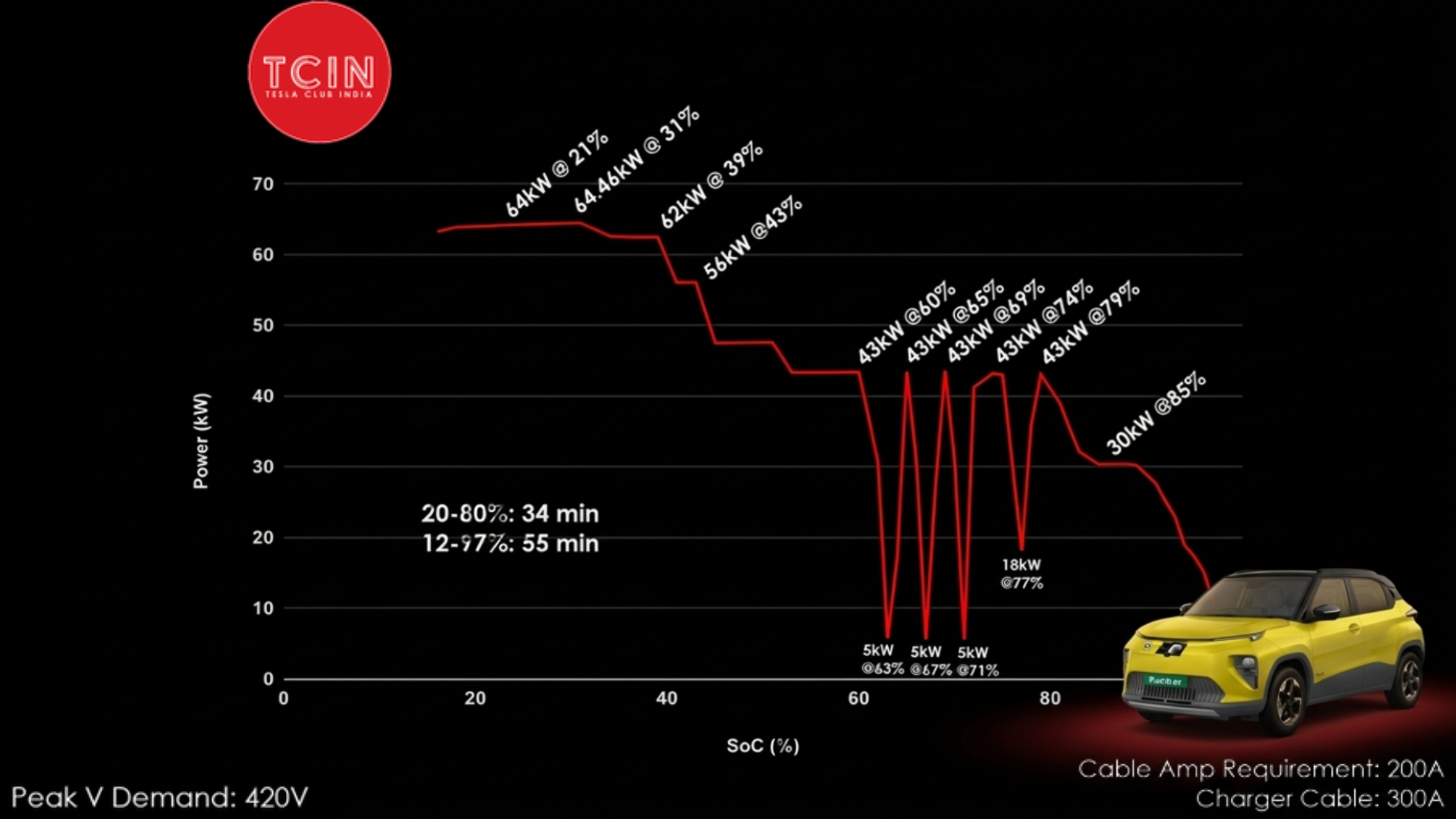
Tesla Club India has shared the DC fast charging curve for the Tata Punch EV 40kWh pack. The headline numbers are competitive — and there are some anomalies in the mid-charge range worth understanding.


Category:
Tag:
- Tata Punch 40 Charging Curve
Charging curve data sourced from Tesla Club India (TCIN). Image credit: TCIN / @TeslaClubIndia on X.
Tesla Club India (TCIN) has published the DC fast charging curve for the Tata Punch EV 40kWh variant, tested on a 120kW DC fast charger at an ambient temperature of 34°C — conditions representative of normal Indian driving for a significant part of the year.
The Headline Numbers
The Punch EV 40kWh hits a peak charge rate of approximately 64-65kW between 21% and 31% SOC, which is competitive for a sub-₹13 lakh electric vehicle. The 20-80% charge completes in 34 minutes, and a fuller 12-97% session takes 55 minutes.
The car's peak voltage demand is 420V with a cable amp requirement of 200A. The test was conducted on a 120kW charger with a 300A cable — so the charger was not a limiting factor. What the curve reflects is the car's own charging behaviour.

The Curve Flattens, Then Drops
From peak, the charge rate begins tapering gradually after 40% SOC — dropping from ~64kW to ~56kW by 43% and continuing to step down toward 43kW around 60% SOC. This gradual taper is expected behaviour as the battery approaches mid-range.
What is less expected are three sharp drops to approximately 5kW at 63%, 67%, and 71% SOC, each followed by a rapid recovery back to 43kW. These are abrupt, brief, and repetitive interruptions in an otherwise stable charge rate.
A separate, softer drop to 18kW appears at 77% SOC before recovery, followed by a more sustained taper beginning around 85% SOC down to approximately 10kW approaching 100%. The 85%+ taper is entirely normal expected behaviour in lithium-ion chemistry.
A Question Worth Asking
The three brief 5kW drops in the 63-71% SOC range are the most notable feature of this curve. One possible explanation is thermal management intervention — at 34°C ambient with the pack under sustained DC fast charging, the battery management system may be briefly cutting charge rate to manage cell temperature before resuming. The pattern of drop-and-recover, repeated at similar SOC intervals, is consistent with this kind of thermal event.
This is, however, one data point. A single curve at a single ambient temperature on a single unit is not sufficient to draw firm conclusions. Charger-side communication handshakes can also produce brief power interruptions that appear similar in a curve. More sampling under comparable conditions is needed before any conclusion can be drawn.
What This Means for Owners
For everyday use — overnight AC charging or routine top-ups — none of this is relevant. For owners who regularly use DC fast chargers on longer drives, the 34-minute 20-80% time is practical. The mid-charge drops, if they recur consistently, could add a few minutes to a session but are unlikely to significantly affect the overall fast charging experience based on this sample.
Tata has not commented on the data.
Trending Articles




Recent Articles

Renault Duster Hybrid vs Maruti Victoris Hybrid: All Variants Compared

Duster Hybrid vs Hyryder Hybrid: Prices, Powertrain and Variants Compared

Top 5 Best Selling EVs This Year: Windsor Leads with Clear Margin

Renault Duster Hybrid vs Maruti Suzuki Grand Vitara Hybrid: Base, Mid, and Top Variant Comparison