
Do EVs Really Pollute More Than Petrol Cars? A Lifecycle Calculation for India
A structured lifecycle CO2 comparison between an LFP electric vehicle and a petrol car, calculated specifically for Indian conditions using peer-reviewed sources. The result may surprise you.


Category:
Tag:
- EV vs ICE
- CO2 emissions
- Lifecycle analysis
- India grid
- LFP
One of the most persistent arguments against electric vehicles in India is this: EVs are not actually cleaner because manufacturing the battery produces enormous carbon emissions, and India's coal-heavy grid makes the operational emissions worse too.
This argument deserves a serious, structured response — not a dismissal. So let us do the calculation properly, with sources, for Indian conditions.
The Framework
We will compare the full lifecycle CO2 emissions of an LFP electric vehicle against a petrol ICE vehicle over a lifetime of 1.5 lakh kilometres. LFP (Lithium Iron Phosphate) is the battery chemistry used in most Indian EVs — the Tata Punch EV, Tata Nexon EV, MG Windsor EV, Mahindra XEV 9S and others all use LFP cells.
The lifecycle is divided into two stages: Production and Operation. We are deliberately ignoring the disposal/recycling stage because no credible peer-reviewed study provides India-specific numbers — and ignoring it actually disadvantages EVs slightly, since EV battery recycling recovers more value than ICE disposal.
Our assumptions are intentionally tilted against EVs:
We use the pessimistic end of the range for EV battery emissions and the conservative end for ICE fuel emissions. If EVs win under these conditions, they win in any realistic scenario.
Specifically: 60 kWh battery size, 5.55 km/kWh EV efficiency, 14 kmpl petrol efficiency, and India's 2021 grid emission intensity of 713.2 gCO2/kWh — which is higher than today's figure, as India's grid has continued to get cleaner since then.
EV Lifecycle Emission Calculation
Stage 1 — Production
A study by Dr. Leopold Peiseler (PhD), a scientist at Stanford University, published in Nature, found that the global carbon footprint for LFP cell production lies between 54 and 69 kgCO2e/kWh (90% confidence interval).

We take the pessimistic end: 69 kgCO2e/kWh.
For a 60 kWh battery: 60 × 69 = 4,140 kgCO2e = 4.14 tCO2e
Vehicle assembly emission (non-battery manufacturing, same for EV and ICE): 9 tCO2e
Total EV Production Emission = 4.14 + 9 = 13.14 tCO2e
Stage 2 — Operation

India's grid emission intensity in 2021 was 713.2 gCO2/kWh (0.713 kgCO2e/kWh), as reported by the Climate Transparency Report 2021. The same report noted a 5-year declining trend of -2.6% annually — which we are ignoring to remain pessimistic.
Source: climate-transparency.org
At 5.55 km/kWh efficiency: 1,50,000 km ÷ 5.55 = 27,027 kWh consumed over the vehicle lifetime
Operational Emission = 27,000 × 0.713 = 19.25 tCO2e
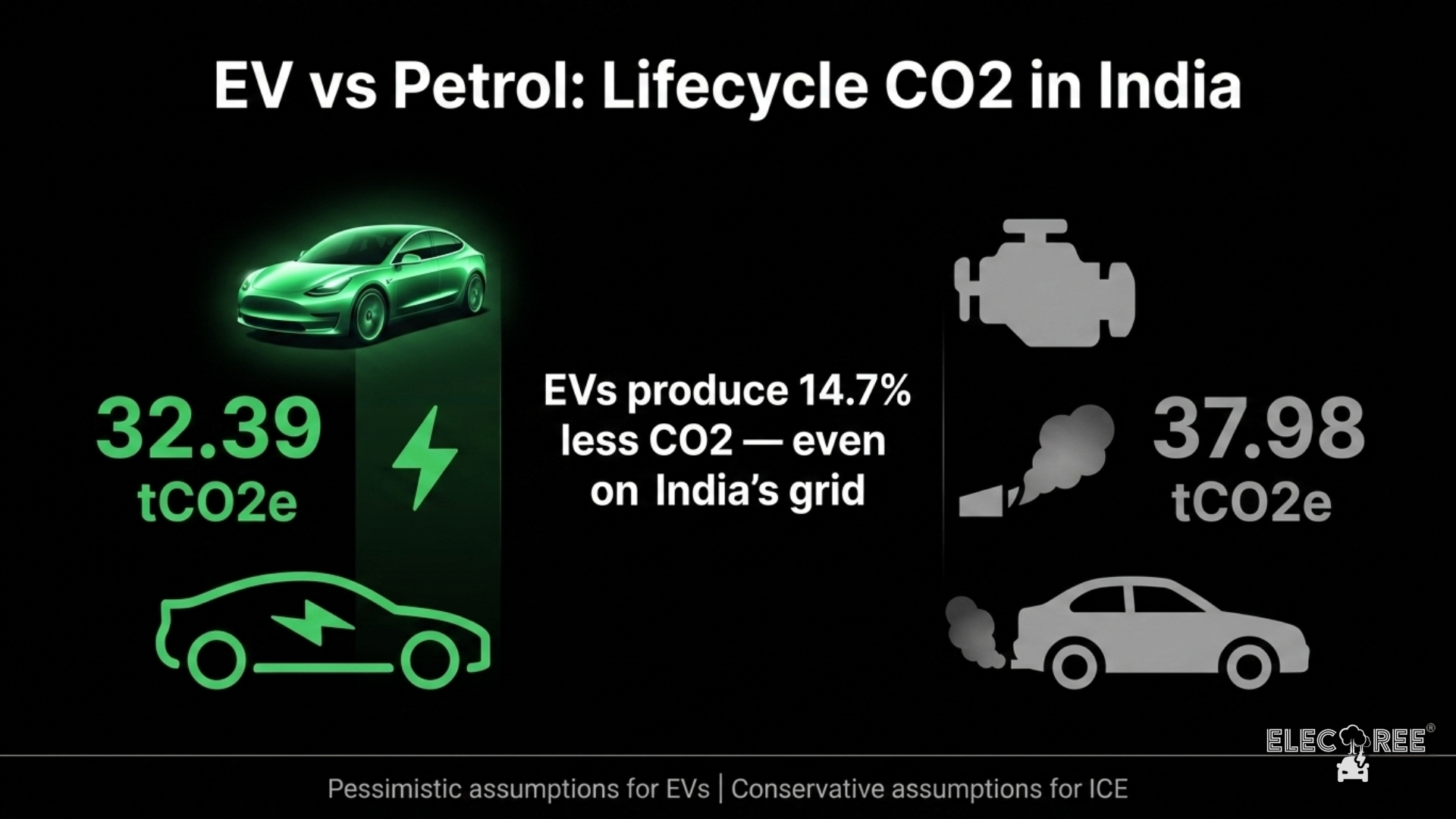
Total EV Lifecycle Emission = 13.14 + 19.25 = 32.39 tCO2e
Petrol ICE Lifecycle Emission Calculation
Stage 1 — Production
We use the same vehicle assembly emission as the EV: 9 tCO2e. We add Well-to-Tank (WtT) emissions — the carbon cost of extracting and refining the fuel before it reaches the engine. The US EPA puts WtT at approximately 28% of direct combustion emissions. We use a conservative 20%.

ICE Production Emission = 9 tCO2e
Stage 2 — Operation
A Canadian government study (Natural Resources Canada) confirms that burning 1 litre of gasoline produces approximately 2.3 kg of CO2.
Source: natural-resources.canada.ca
At 14 kmpl: 1,50,000 km ÷ 14 = 10,714 litres ≈ 10,500 litres (rounded conservatively)
Well-to-Tank emission = 20% of 2.3 × 10,500 = 0.46 × 10,500 = 4.83 tCO2e
Direct combustion emission = 2.3 × 10,500 ÷ 1,000 = 24.15 tCO2e
Total ICE Operational Emission = 4.83 + 24.15 = 28.98 tCO2e
Total ICE Lifecycle Emission = 9 + 28.98 = 37.98 tCO2e
The Verdict
| EV (LFP, 60 kWh) | ICE (Petrol, 14 kmpl) | |
|---|---|---|
| Production | 13.14 tCO2e | 9.00 tCO2e |
| Operation | 19.25 tCO2e | 28.98 tCO2e |
| Total | 32.39 tCO2e | 37.98 tCO2e |
EVs produce 14.7% fewer lifecycle CO2 emissions than petrol cars — calculated under conditions that are deliberately pessimistic for EVs and conservative for ICE.
The EV starts with a production disadvantage of 4.14 tCO2e due to battery manufacturing. But it more than recovers that disadvantage during operation — because electricity, even from India's coal-heavy grid, produces fewer emissions per kilometre than burning petrol.
The Gap Will Only Widen
This calculation uses India's 2021 grid emission intensity. In the years since, India's grid has become materially cleaner. As of September 2025, India's total installed power capacity crossed 500 GW, with non-fossil fuel sources — renewable energy, hydro, and nuclear — accounting for over 51% of total installed capacity, according to a Ministry of Power press release. India achieved its COP26 Panchamrit target of 50% non-fossil capacity five years ahead of the 2030 deadline.
Source: PIB Press Release, Ministry of Power, October 29, 2025
As coal's share of electricity generation declines, the operational emission of EVs falls further. The 14.7% lifecycle advantage calculated here is a floor, not a ceiling.
If we had included recycling and disposal values — where EV battery recycling recovers significantly more value than ICE vehicle disposal — the advantage would be even larger.
What This Means
The argument that EVs are dirtier than petrol cars does not hold up under scrutiny — not even in India, not even in 2021, and certainly not in 2026 when the grid is cleaner. The battery production carbon debt is real, but it is fully repaid within the operational phase, and the net result over a vehicle's lifetime is a meaningful emissions reduction.
This does not mean EVs are a perfect solution. Mining for battery materials, supply chain emissions, and end-of-life battery management are all legitimate concerns that deserve continued attention. But the lifecycle CO2 comparison — the most common argument used against EVs — favours EVs clearly and unambiguously, under Indian conditions, using the most conservative assumptions available.
Trending Articles


Recent Articles
Renault Duster Hybrid vs Maruti Victoris Hybrid: All Variants Compared
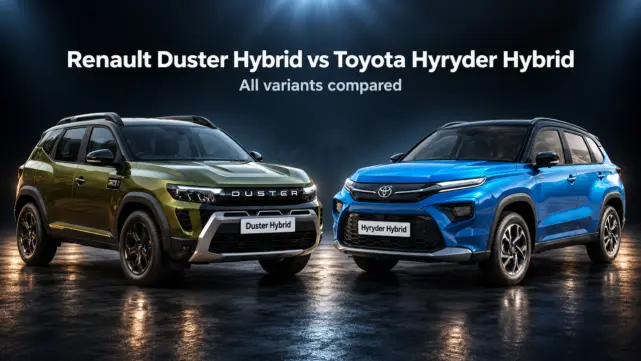
Duster Hybrid vs Hyryder Hybrid: Prices, Powertrain and Variants Compared
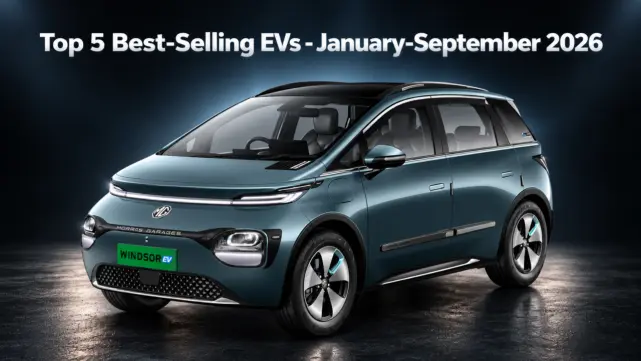
Top 5 Best Selling EVs This Year: Windsor Leads with Clear Margin
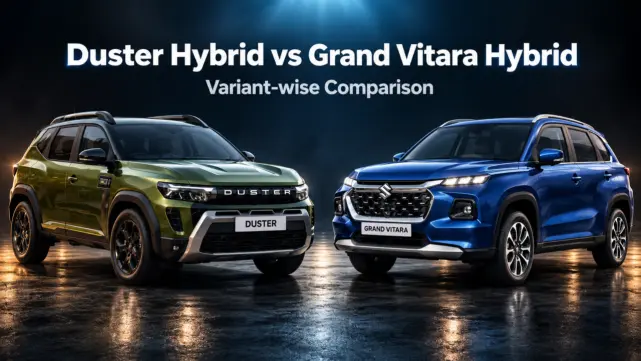
Renault Duster Hybrid vs Maruti Suzuki Grand Vitara Hybrid: Base, Mid, and Top Variant Comparison