Kia Carens Clavis EV vs VinFast VF MPV 7: India's ₹24.49 Lakh 7-Seater EV Decision
Kia Carens Clavis EV vs VinFast VF MPV 7: India's ₹24.49 Lakh 7-Seater EV Decision
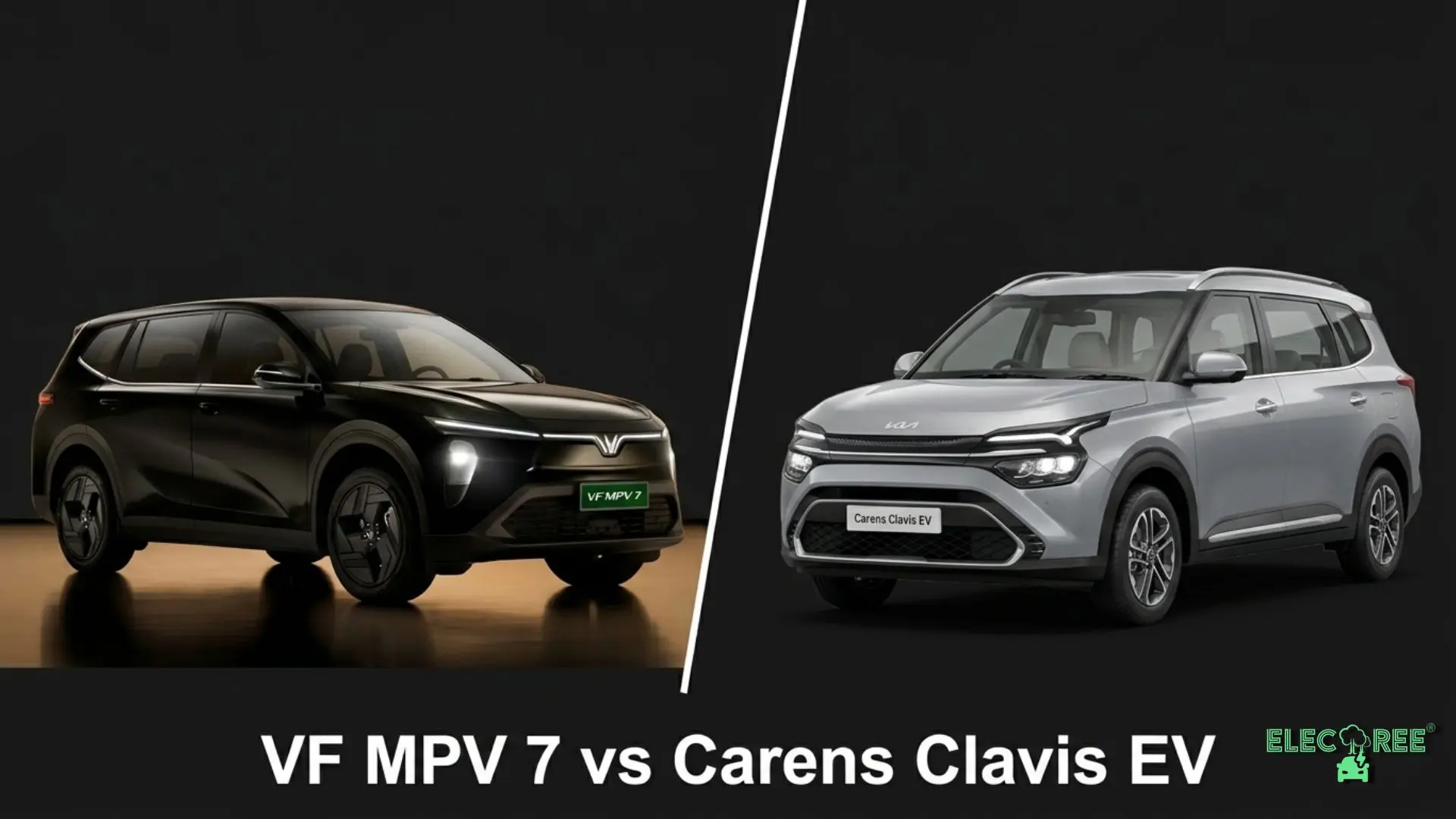
At ₹24.49 lakh, India now has two 7-seater electric MPVs at exactly the same price. The Kia Carens Clavis EV HTX+ ER and the VinFast VF MPV 7 could not be more different in philosophy. One bets on features, safety tech and real-world efficiency. The other bets on a bigger battery, more power and an aggressive warranty package. We compare them across every dimension that matters to a family buyer — and give you our honest assessment.
India's 7-seater EV segment has just become genuinely interesting.
For most of 2025, the Kia Carens Clavis EV was the only serious mass-market option for families wanting three rows and electric power. Then VinFast launched the VF MPV 7 in April 2026 at ₹24.49 lakh — exactly the same price as the Clavis EV's top HTX+ ER variant. One price point. Two cars. Two entirely different approaches to what a family electric MPV should be.
This comparison focuses on the top-spec variants of both cars at price parity — Clavis HTX+ ER at ₹24.49L vs VF MPV 7 at ₹24.49L. We also examine what the Clavis HTX ER at ₹22.49L offers, because it raises a question that every MPV 7 buyer should ask themselves before signing on the dotted line.
The Basics
Before the detail, here is where each car stands:
Kia Carens Clavis EV HTX+ ER
VinFast VF MPV 7
Price (ex-showroom)
₹24.49L
₹24.49L
Battery
51.4 kWh (NMC)
60.13 kWh (Svolt Blade LFP)
ARAI Range
490 km
517 km
Motor Output
171 hp / 255 Nm
204 hp / 280 Nm
DC Fast Charging
100 kW
80 kW
Drivetrain
FWD
FWD
Seating
7
7
ADAS
Level 2, 20+ features
None
Panoramic Sunroof
Yes (dual-pane)
No
V2L
Yes (internal + external)
No
Variants
6 (₹17.99L–₹24.49L)
1 (₹24.49L)
The Single Variant Question.
The VF MPV 7 is sold in a single fully-loaded variant at ₹24.49 lakh. There is no entry variant, no mid-trim, no choice. You pay ₹24.49 lakh or you do not buy the car. The upside is simplicity — every MPV 7 buyer gets everything VinFast has to offer. The downside is that a family with a ₹20L budget has no path into the car at all.
The Clavis EV offers 6 variants from ₹17.99L to ₹24.49L. This matters because the Clavis HTX ER at ₹22.49L — two lakh less than the MPV 7 — already includes ADAS Level 2 with 20 autonomous features and a dual-pane panoramic sunroof. Two features the MPV 7 does not offer at any price. We will come back to this.
ADAS — The Most Important Differentiator
This is where the comparison becomes straightforward.
The Clavis EV HTX+ ER comes with ADAS Level 2 featuring over 20 autonomous safety functions. These include Forward Collision Warning, Front Collision Avoidance Assist for cars, pedestrians and cyclists, Lane Keeping Assist, Lane Following Assist, Smart Cruise Control with Stop and Go, Highway Driving Assist, Blind Spot Collision Warning, Rear Cross Traffic Collision Avoidance, Safe Exit Warning and 360-degree camera.
The VF MPV 7 has none of these. Zero ADAS at ₹24.49 lakh. To put that in context: the Kia Carens Clavis EV HTX ER at ₹22.49L — two lakh cheaper than the MPV 7 — has full ADAS Level 2.
For a family car carrying children across Indian highways, the absence of ADAS is not a minor spec sheet gap. It is a real-world safety difference that no warranty period or buyback programme can offset.
Panoramic Sunroof and Cabin Experience
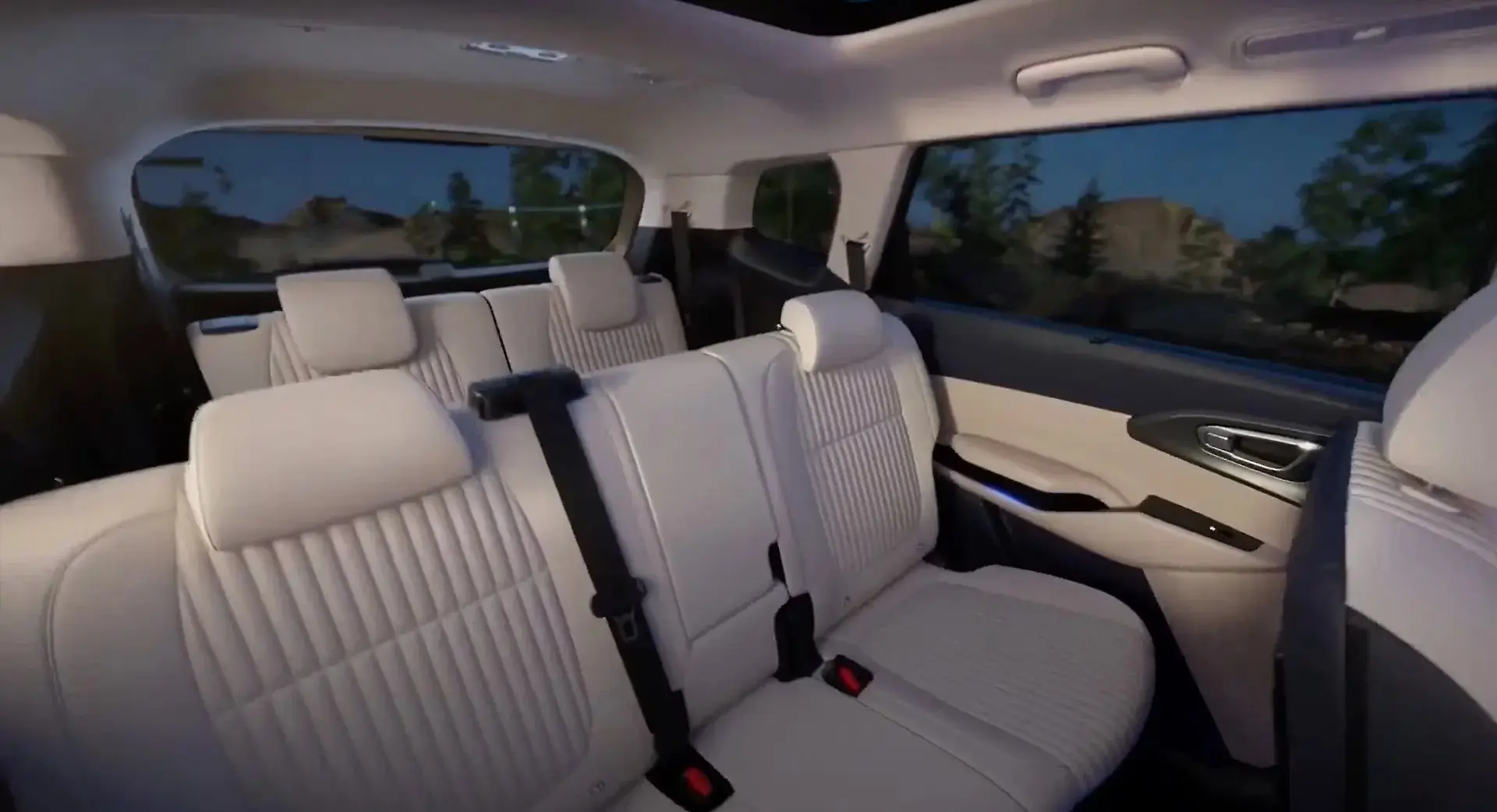
Cabin view of Kia Carens Clavis EV
The Clavis HTX+ ER gets a dual-pane panoramic sunroof. The VF MPV 7 gets no sunroof of any kind.
For a 7-seater family MPV — a car that will carry children on road trips, weekend drives and school runs — the panoramic sunroof is not a luxury. It is part of what makes the rear rows liveable. Third-row passengers in particular benefit from the openness it provides.
The Clavis cabin also features a 26.62-inch dual panoramic display combining the infotainment and instrument cluster, Bose premium audio with 8 speakers, 64-colour ambient lighting, front ventilated seats and a floating centre console with ambient lighting accents.
The VF MPV 7 offers a leatherette interior, a 12.3-inch infotainment screen, automatic climate control with third-row dedicated AC vents, 6-way power driver seat, and a PM 2.5 air filter. These are respectable features. But the cabin experience — in terms of technology, ambience and passenger comfort — sits a clear level below the Clavis.
V2L — A Feature Families Will Actually UseV2L Feature Displayed on the Kia Carens Clavis EV
The Clavis HTX+ ER supports Vehicle-to-Load both internally and externally. This means you can power a laptop, a camping cooler, an electric kettle or a projector directly from the car — inside the cabin or from an external outlet. In a family MPV context, V2L is the kind of feature that gets used on every road trip.
The VF MPV 7 does not offer V2L.
For a car positioned as a family road trip vehicle with 7 seats and a large battery, the absence of V2L is a missed opportunity. It is not a deal-breaker, but it is a meaningful gap against a competitor that includes it.
Battery, Range and the Real-World Picture
On paper, the VF MPV 7 appears to have the range advantage. Its 60.13 kWh battery claims 517 km ARAI. The Clavis HTX+ ER's 51.4 kWh battery claims 490 km.
Real-world data complicates this narrative — and not in the MPV 7's favour.
Autocar India tested the Clavis ER extensively. In real-world conditions with air conditioning active, the 51.4 kWh battery returned approximately 364 km — an efficiency of around 7.1 km/kWh combined.
VinFast's real-world range data for Indian conditions is not yet available for the MPV 7. However, VF6 and VF7 owners in India have reported real-world efficiency of approximately 5.5 km/kWh. Applying this to the MPV 7's 60.13 kWh battery gives an estimated real-world range of approximately 330 km — less than the Clavis despite carrying a larger battery.
This matters because the MPV 7's primary spec sheet advantage — its larger battery and higher ARAI range — may not translate to better real-world performance in Indian driving conditions. The Clavis's NMC battery chemistry is more efficient at varied speeds and temperatures than LFP chemistry, which tends to underperform at higher speeds and in heat. We must caveat that the MPV 7 uses Svolt Blade LFP cells rather than conventional LFP, which may improve on these figures — but without Indian real-world data, we cannot confirm this.
Charging
The Clavis HTX+ ER supports 100 kW DC fast charging, taking the battery from 10% to 80% in approximately 39 minutes on a compatible charger. It also supports 11 kW AC charging.
The VF MPV 7 supports 80 kW DC fast charging, with a claimed 10% to 70% charge in 30 minutes. AC charging is up to 6.9 kW.
The Clavis charges faster on DC and supports faster AC charging. On a road trip, the difference between 80 kW and 100 kW charging is meaningful — particularly as India's fast charging infrastructure matures and 100 kW+ chargers become more available.
Warranty and After-Sales — Where VinFast Fights Back
The VF MPV 7's warranty package is genuinely aggressive and deserves honest acknowledgement.
VinFast offers 7 years vehicle warranty, 10 years battery warranty, 3 years free maintenance, free charging until March 31, 2029, up to 75% assured buyback, and extended cover on suspension, paint and roadside assistance.
Kia's standard warranty terms are 3 years unlimited km for the vehicle. Battery warranty details for the Clavis EV are not stated in the same prominently aggressive terms as VinFast's offer.
For a buyer apprehensive about EV ownership — battery degradation, long-term maintenance costs, resale value — VinFast's package directly addresses these concerns. The 10-year battery warranty and 75% buyback are particularly strong signals, even if the buyback terms carry conditions worth reading carefully.
Service Network and Brand Confidence
Kia operates over 700 dealerships across India with an established service infrastructure, trained EV technicians and a multi-year track record of EV ownership in the country. Resale values for Kia vehicles in India are reasonably well established.
VinFast is building its India network. As of early 2026, the brand has a limited but growing presence. The VF6 and VF7 have been on Indian roads for over a year, which gives some basis for owner feedback — and early reports have been mixed, particularly on software quality and service responsiveness.
For a ₹24.49 lakh family car purchase, service network confidence is not an irrational consideration. The question is not whether VinFast will build out its network — the brand has committed to India seriously and the MPV 7 launch signals continued investment. The question is whether that network is mature enough today to support a buyer in their city when something needs attention.
The ₹22.49L Argument
Before the verdict, one number deserves special attention: ₹22.49 lakh.
The Clavis HTX ER at ₹22.49L includes ADAS Level 2 with 20 autonomous features and a dual-pane panoramic sunroof. It does not include V2L, Bose audio or front ventilated seats — but it costs ₹2 lakh less than the VF MPV 7.
A buyer considering the MPV 7 at ₹24.49L should ask: am I willing to pay ₹2 lakh more for a car with more power and a bigger battery on paper, but no ADAS, no sunroof and no V2L — when a competitor at ₹22.49L already offers the features the MPV 7 skips entirely?
For most family buyers, that question answers itself.
The Full Comparison
Feature
Clavis HTX ER ₹22.49L
Clavis HTX+ ER ₹24.49L
VF MPV 7 ₹24.49L
Battery
51.4 kWh
51.4 kWh
60.13 kWh
ARAI Range
490 km
490 km
517 km
Real-world range (est.)
~364 km
~364 km
~330 km*
Motor
171 hp
171 hp
204 hp
DC Charging
100 kW
100 kW
80 kW
ADAS
Level 2, 20 features
Level 2, 20 features
None
Panoramic Sunroof
Dual-pane
Dual-pane
None
V2L
No
Yes (in + out)
No
Bose Audio
No
8-speaker Bose
No (4 speakers)
Ventilated Seats
No
Front
No
Battery Warranty
Standard
Standard
10 years
Vehicle Warranty
3 years
3 years
7 years
Free Maintenance
No
No
3 years
Buyback Programme
No
No
75% assured
Service Network
700+ dealers
700+ dealers
Limited, growing
Estimated based on VF6/VF7 owner-reported efficiency. MPV 7 Indian real-world data not yet available.
Our Verdict
On paper, and with the data available today, the Kia Carens Clavis EV is the stronger buy at the ₹24.49 lakh price point — and arguably at ₹22.49 lakh too.
The reasons come down to three things that matter most in a family car: safety, real-world usability and ownership confidence. ADAS Level 2 on a car that will carry children on Indian highways is not a feature to trade away for more horsepower. A panoramic sunroof and V2L are features that get used on every family road trip. And Kia's established service network reduces the uncertainty that comes with any large purchase.
VinFast's warranty package — particularly the 10-year battery warranty and 75% buyback — is genuinely competitive and addresses the resale and longevity concerns that EV buyers legitimately carry. If VinFast's real-world range in India proves competitive with the Clavis, and if early MPV 7 owners report reliable software and service experience, the case for the MPV 7 strengthens considerably.
But that validation does not exist yet. The MPV 7 has just launched in India. The first real owner data — range figures, charging performance, software stability, service response — will emerge over the next three to six months. Until then, a buyer choosing between these two cars is making a decision based on specifications on one side and real-world evidence on the other.
The specifications, today, favour the Clavis.
ElecTree will update this comparison as real-world MPV 7 data becomes available from Indian owners. If you own or have driven the VF MPV 7, share your experience in the comments or on the ElecTree forum.