
India 4W EV Sales by State - March 2026: Maharashtra Leads, Karnataka Surges 124%, Gujarat Proves Policy Works
Maharashtra tops the March 2026 state-wise 4W EV rankings with 3,823 units. Karnataka grows 124% year-on-year but faces a new road tax regime from April. Gujarat's 365% YoY surge is entirely policy-driven. Kerala's declining numbers are a warning for states considering rolling back EV incentives.


Category:
Tag:
- EV Sales by State
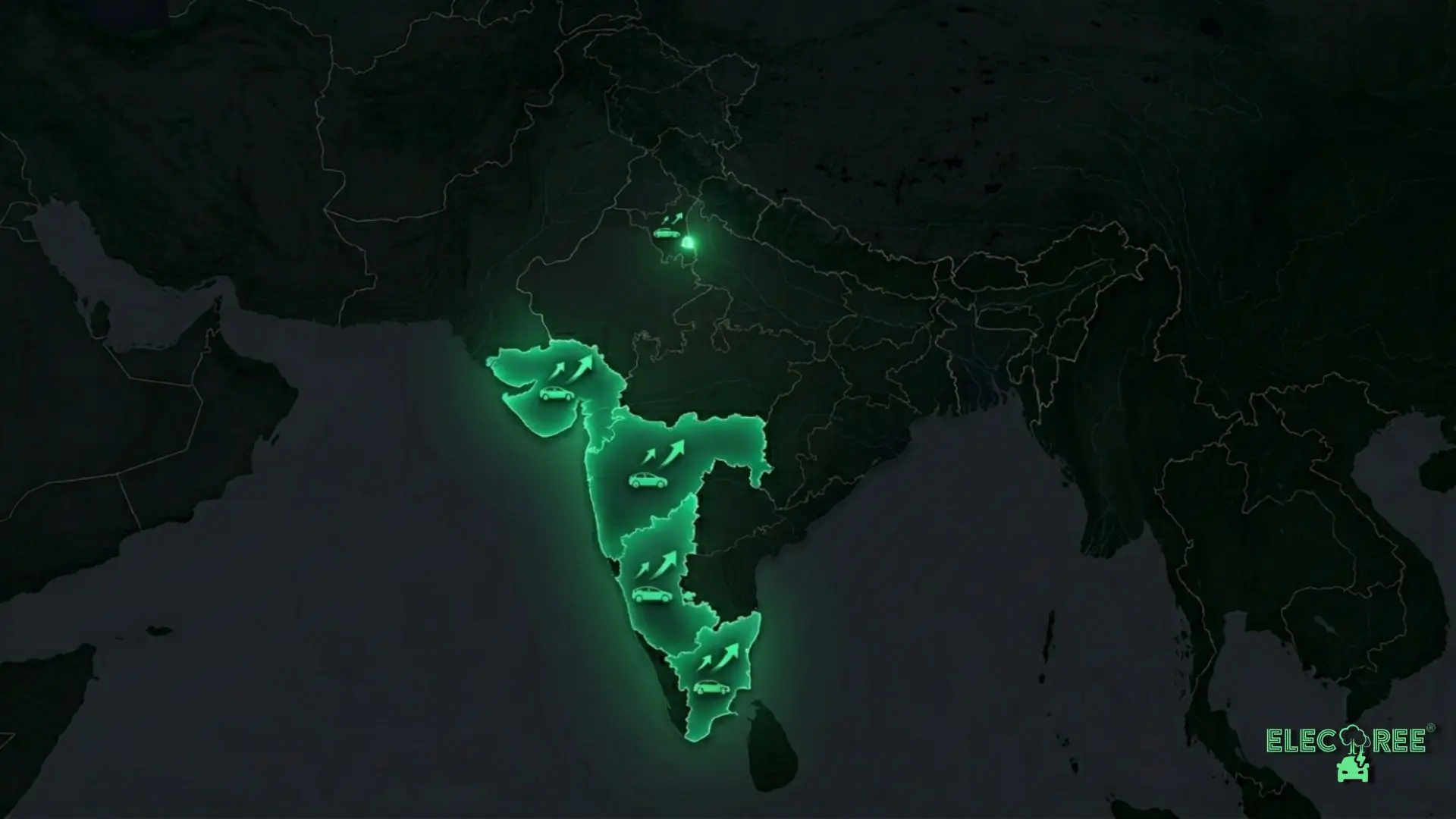
India's 4-wheeler EV market is not growing uniformly. The March 2026 state-wise data from the Vahan portal tells a story of diverging trajectories — states where policy tailwinds are accelerating adoption, and states where policy reversals are beginning to show up in the numbers. The top 5 states for March 2026 account for 13,646 units, or 60.6% of national sales of 22,159 units.
Note: All data sourced from the Vahan portal under MoRTH. Telangana is excluded from Vahan data.
The Rankings: Top 5 States in March 2026
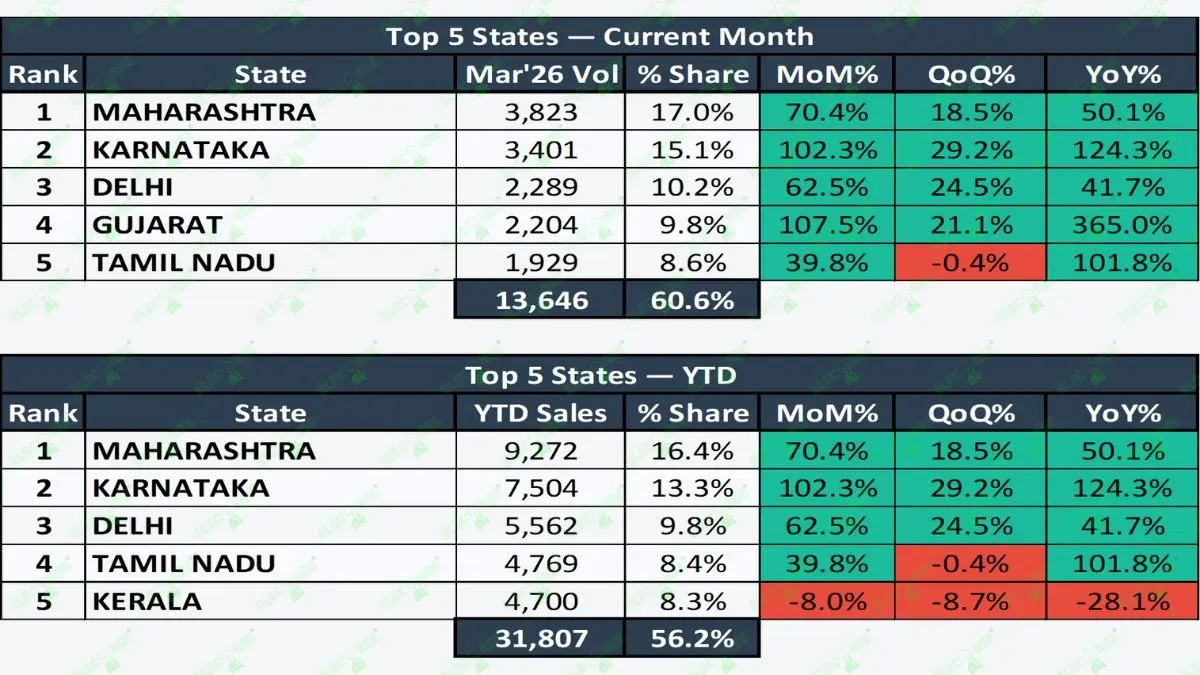
Maharashtra holds the top position with 3,823 units and a 17% share of national sales, growing 50.1% year-on-year from 2,547 units in March 2025. Karnataka is second at 3,401 units (15.1% share), Delhi third at 2,289 units (10.2%), Gujarat fourth at 2,204 units (9.8%) and Tamil Nadu fifth at 1,929 units (8.6%). Together these five states sold 13,646 units, representing 60.6% of all 4W EV registrations nationally.
February is seasonally the weakest month for auto sales in India — January benefits from year-end discounts on outgoing models and March sees pre-financial-year-end buying. The dip seen across most states in February is therefore a seasonal pattern, not a demand signal.
On a year-to-date basis for Q1 2026, Maharashtra leads with 9,272 units (16.4% share), followed by Karnataka at 7,504 (13.3%), Delhi at 5,562 (9.8%), Tamil Nadu at 4,769 (8.4%) and Kerala at 4,700 (8.3%). The top 5 YTD states account for 31,807 units, or 56.2% of Q1 2026's national total of 56,114 units.
Tamil Nadu deserves a brief mention — while the 101.8% YoY growth is strong, Q1'26 at 4,769 units is essentially flat against Q4'25's 4,788 units, a -0.4% quarter-on-quarter. The state is growing year-on-year but has lost sequential momentum and may need new model launches or a policy push to accelerate further.
Karnataka: India's Fastest-Growing Major EV Market — For Now
Karnataka is the standout performer of March 2026. At 3,401 units, the state has grown 124.3% year-on-year from 1,516 units in March 2025 — the highest YoY growth rate among the top 5 states by volume. The Q1 2026 progression tells an interesting story: January 2,422, February 1,681, March 3,401. February's seasonal dip aside, the March number represents a sharp acceleration that takes Karnataka to its highest single-month total.
The state's Q1 2026 total of 7,504 units compares favourably with its trajectory — Karnataka has been building volume steadily and is now a serious challenger to Maharashtra's top position.
However, the growth story now has a significant shadow over it. The Karnataka government passed the Motor Vehicles Taxation Amendment Bill 2026 on March 26, 2026 — just five days before the end of the month. The bill withdraws the 100% road tax exemption that electric cars under ₹25 Lakh previously enjoyed and replaces it with a lifetime tax structure: 5% on EVs priced up to Rs 10 lakh, 8% on EVs between Rs 10 lakh and Rs 25 lakh, and 10% on EVs above Rs 25 lakh. Electric two-wheelers continue to be exempt. The bill is currently awaiting the Governor's assent, which is widely expected to be a formality.
The practical impact on buyers is meaningful. An EV priced under ₹ 25 lakh — which covers most of the volume-selling models from Tata, Mahindra and MG — will now attract upto ₹2 Lakh in additional lifetime road tax at the time of registration. This directly increases the cost of ownership and partially offsets the running cost advantage that makes EVs attractive.
March's strong numbers therefore cannot be read as a post-bill reaction — the bill passed on March 26 and registrations for the month would have already been largely completed. April 2026 will be the first real data point showing consumer response. Buyers aware of the impending tax may pause purchases until the Governor's assent makes the new rates official. Equally, dealers may see a brief pre-notification rush once the bill receives assent. The April and May data will be closely watched.
What Karnataka's government gains is an estimated Rs 259 crore annually in additional revenue. What the state risks is slowing down one of India's most promising EV growth markets at a time when models like the Mahindra XEV 9S and the upcoming Tata Sierra EV were set to drive significant volume growth in the Rs 20-40 lakh segment — exactly the price range that now faces the 8-10% tax burden.
Gujarat: Policy Works — 365% YoY Proves It
Gujarat is the article's clearest policy success story. From 474 units in March 2025 to 2,204 units in March 2026, the state has grown 365% year-on-year — by far the highest growth rate among any major state. This is not a low-base statistical anomaly. Gujarat registered 1,681 units in Q1 2025. In Q1 2026, the state registered 4,619 units — a 174.8% increase for the full quarter. March 2026 alone at 2,204 units exceeds the entire Q1 2025 figure.
The reason is straightforward: Gujarat reduced its EV road tax from 6% to 1% starting April 2025. The impact showed up immediately and has compounded through the year, with the Q1 2026 monthly progression of 1,353 → 1,062 → 2,204 showing that March delivered a particularly strong close to the quarter.
Gujarat's story is a direct and timely counterpoint to Karnataka's policy reversal. A 5 percentage point reduction in road tax produced a near-tripling of EV sales over four quarters. Karnataka is now moving in the opposite direction, adding 8-10 percentage points of tax on its highest-volume price segments. The Gujarat data makes the likely direction of Karnataka's April numbers easier to predict.
Kerala: A Policy-Driven Slowdown, Not Market Saturation
Kerala's absence from the monthly top 5 is one of the more significant stories in the March 2026 data. The state registered 1,305 units in March 2026, down 28.1% from 1,815 units in March 2025. The YTD picture is more nuanced — Kerala's Q1 2026 total of 4,700 units is actually higher than Q1 2025's 4,023 units, which means the state started the year reasonably well. But the within-quarter trend is the concern: January 1,977, February 1,418, March 1,305. Each month has been lower than the last, and March's number is the weakest of the three.
The QoQ comparison confirms the deterioration — Q1 2026 at 4,700 units is down 8.7% from Q4 2025's 5,146 units, and the monthly decline is accelerating rather than stabilising.
Is this market saturation? The data does not support that conclusion. Kerala has historically punched above its weight in EV adoption relative to its population and vehicle market size — the state's EV penetration rate has been among the highest in the country. What changed is policy, not appetite.
Kerala removed its 50% road tax discount on EVs, and the 2025 state budget increased taxes further. EVs priced above Rs 15 lakh now attract 8% road tax, while those above Rs 20 lakh pay 10%. Most of the volume-driving 4W EV models — Tata Nexon EV, Hyundai Creta Electric, MG Windsor, — fall in these price brackets, making them meaningfully more expensive in Kerala than they were 18 months ago.
The declining monthly trend within Q1 2026 suggests the policy impact is still feeding through. Unless Kerala reverses course or introduces fresh incentives, the state risks losing its position as one of India's model EV adoption markets — a status it earned through years of early and consistent policy support.
The contrast with Gujarat could not be sharper: one state cut taxes and tripled sales, another raised them and is watching sales fall. Both outcomes were predictable. Both are now confirmed by data.
What to Watch in Q2 2026
April and May 2026 data will be defining. Karnataka's April numbers will show whether the pending road tax bill has created buyer hesitation. Gujarat needs to demonstrate that March was a structural acceleration and not just a one-month spike driven by financial-year-end buying. Kerala's trajectory will indicate whether the decline is bottoming out or accelerating. And Maharashtra's consistency — growing 50% YoY while holding the top position — will be the benchmark against which all other states are measured.
The state-level data increasingly tells a story that the national aggregate cannot: India's EV market is a collection of very different policy environments, and sales follow policy with a short and predictable lag.
Disclaimer: Data sourced from Vahan portal under MoRTH. Telangana excluded. Analysis by ElecTree.
Trending Articles




Recent Articles

Renault Duster Hybrid vs Maruti Victoris Hybrid: All Variants Compared

Duster Hybrid vs Hyryder Hybrid: Prices, Powertrain and Variants Compared
Top 5 Best Selling EVs This Year: Windsor Leads with Clear Margin

Renault Duster Hybrid vs Maruti Suzuki Grand Vitara Hybrid: Base, Mid, and Top Variant Comparison