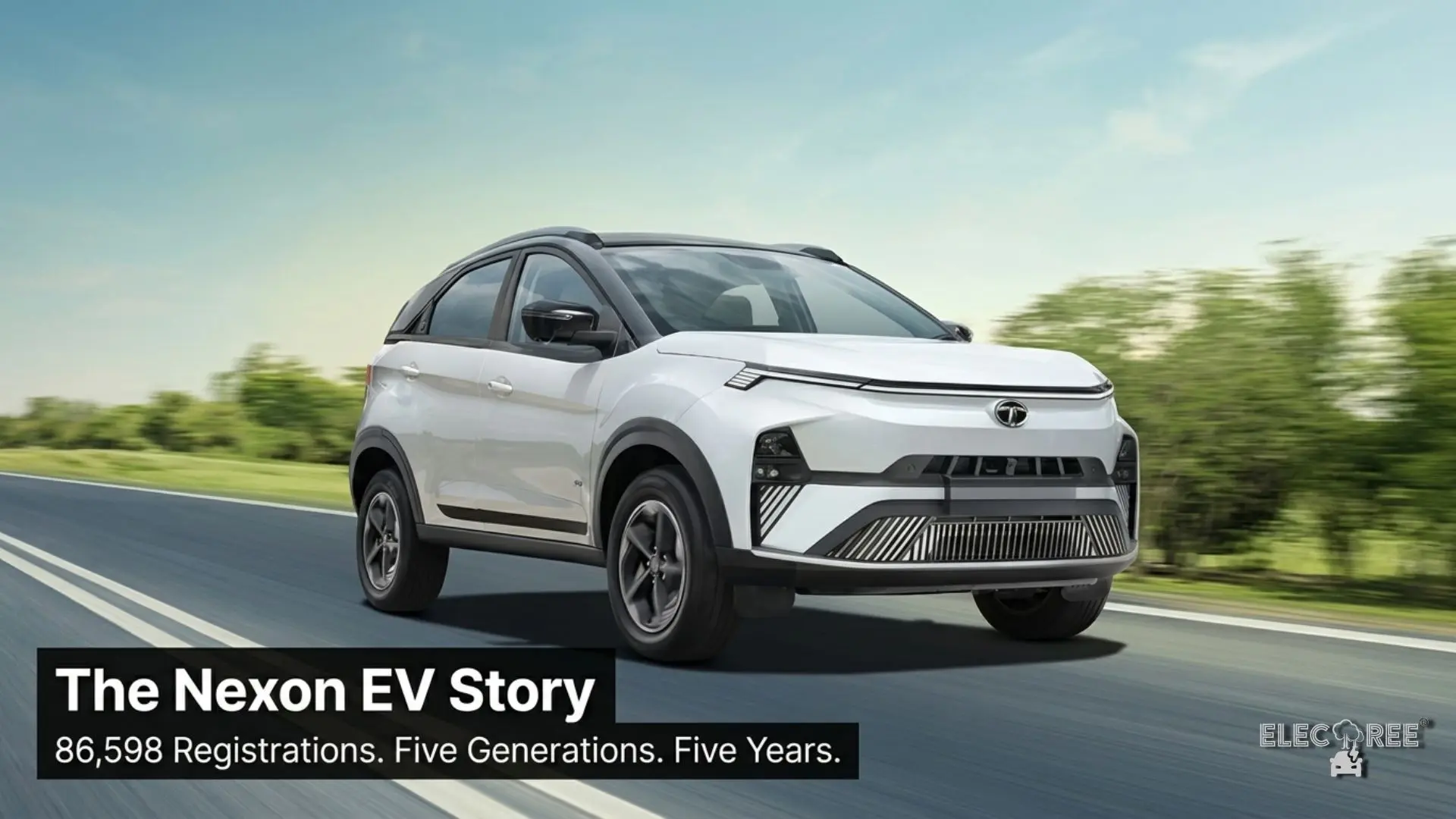
The Nexon EV Story: How One Car Carried Tata's EV Dream for Five Years
Between 2020 and 2025, Tata Motors registered 2,29,385 four-wheeler EVs in India. One model — the Nexon EV — accounts for 37.8% of every single one of them. This is its story, told through five years of verified Vahan registration data.


Category:
Tag:
- Nexon EV
- Tata EV
- EV Sales Data
Between 2020 and 2025, Tata Motors registered 2,29,385 four-wheeler electric vehicles in India. Six models contributed to that number across a period that saw India go from treating EVs as curiosities to buying them in serious volume.
One model carried more weight than any other.
The Nexon EV accounts for 86,598 of those registrations — 37.8% of Tata's entire EV portfolio over five years. It did this while competing against Tata's own newer, cheaper models. It survived two years of declining sales when serious competition arrived. And it came back stronger than ever.
All data in this article is sourced from the Vahan portal under MoRTH. Telangana is excluded from Vahan reporting. Note: The data has been collated by the author after extensive research. Please provide due credit if this is reproduced.
Where Tata's EV Portfolio Stands
Before the Nexon EV story, some context on the full picture.
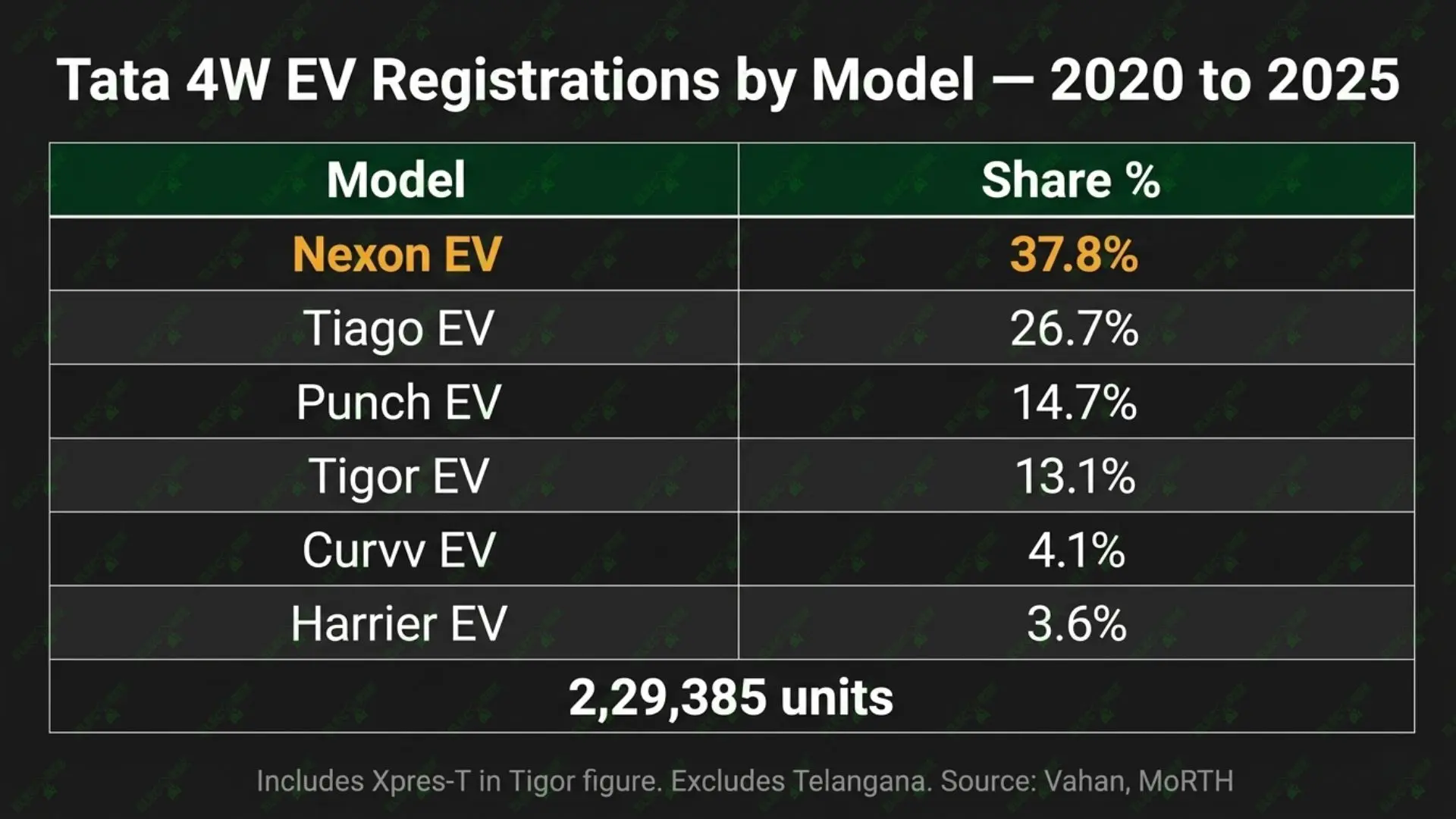
The Tiago EV at 26.7% and Punch EV at 14.7% together account for 41.4% of Tata's cumulative registrations — slightly more than the Nexon EV alone. This reflects Tata's successful strategy of expanding the EV market downward, bringing buyers who could not stretch to the Nexon's price point into electric mobility for the first time.
Tigor EV accounts for 13.1% of the total. A significant majority of Tigor registrations are cab and fleet vehicles — the model has been the backbone of India's electric taxi fleet rather than the retail market. This figure also includes the Xpres-T, which is Tata's dedicated fleet variant.
The Curvv EV at 4.1% and Harrier EV at 3.6% are both relatively recent launches — arrived in late 2024 and mid 2025 respectively — and their share will grow considerably as they accumulate more years on the road.
The Nexon EV's 37.8% share is particularly significant because it has been on sale the longest and has faced the most competition — including from within Tata's own lineup. Every rupee spent on a Punch EV top variant is a rupee that could have gone to Nexon's base variants. That it still leads the portfolio tells you something about what it built.
Where It All Started
The Nexon EV Prime went on sale in May 2020. India had no mass-market EV infrastructure, no significant charging network and no reference point for what an affordable electric car ownership experience looked like. “Prime” was the reference point.
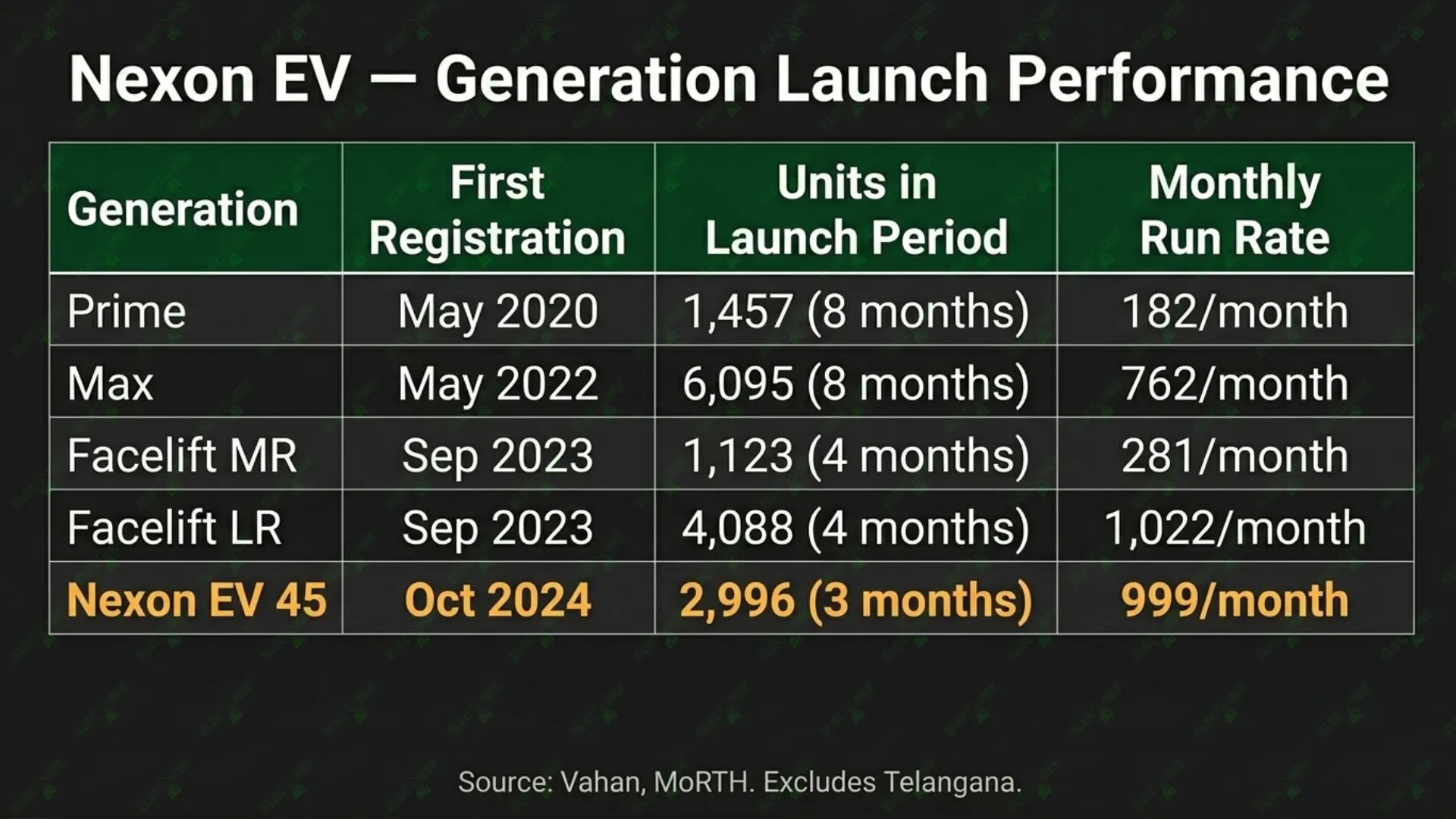
In its first eight months of availability — May to December 2020 — it registered 1,457 units. That is 182 units per month across a country of 1.4 billion people with almost no EV awareness among mainstream buyers.
Three states drove more than half of those early registrations.
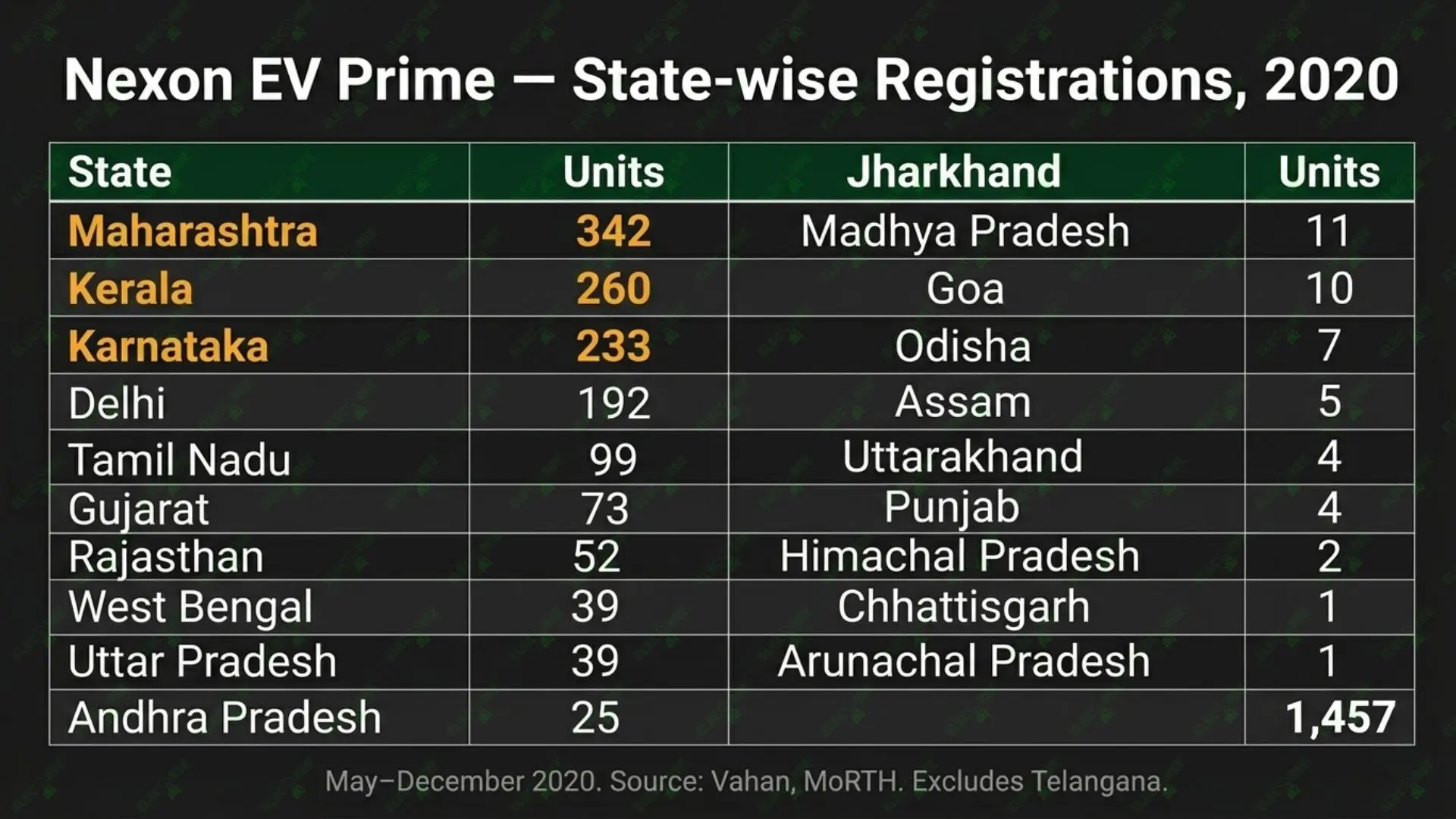
Maharashtra led with 342 units, Kerala with 260 and Karnataka with 233. These three states account for 835 of the 1,457 first-year registrations — 57% of all Prime sales in 2020. Delhi, despite being the national capital and one of India's largest vehicle markets, registered just 192 units.
This early concentration in Maharashtra, Kerala and Karnataka is not a coincidence. These states had relatively stronger EV awareness, better urban infrastructure and — in Kerala's case particularly — a culture of early technology adoption. They were the foundation on which the Nexon EV's India story was built.
The Prime Years: Building the Market
The Prime ran from May 2020 through to its gradual wind-down from 2023 onwards. Its full registration numbers by calendar year tell the story of India's EV market coming to life.
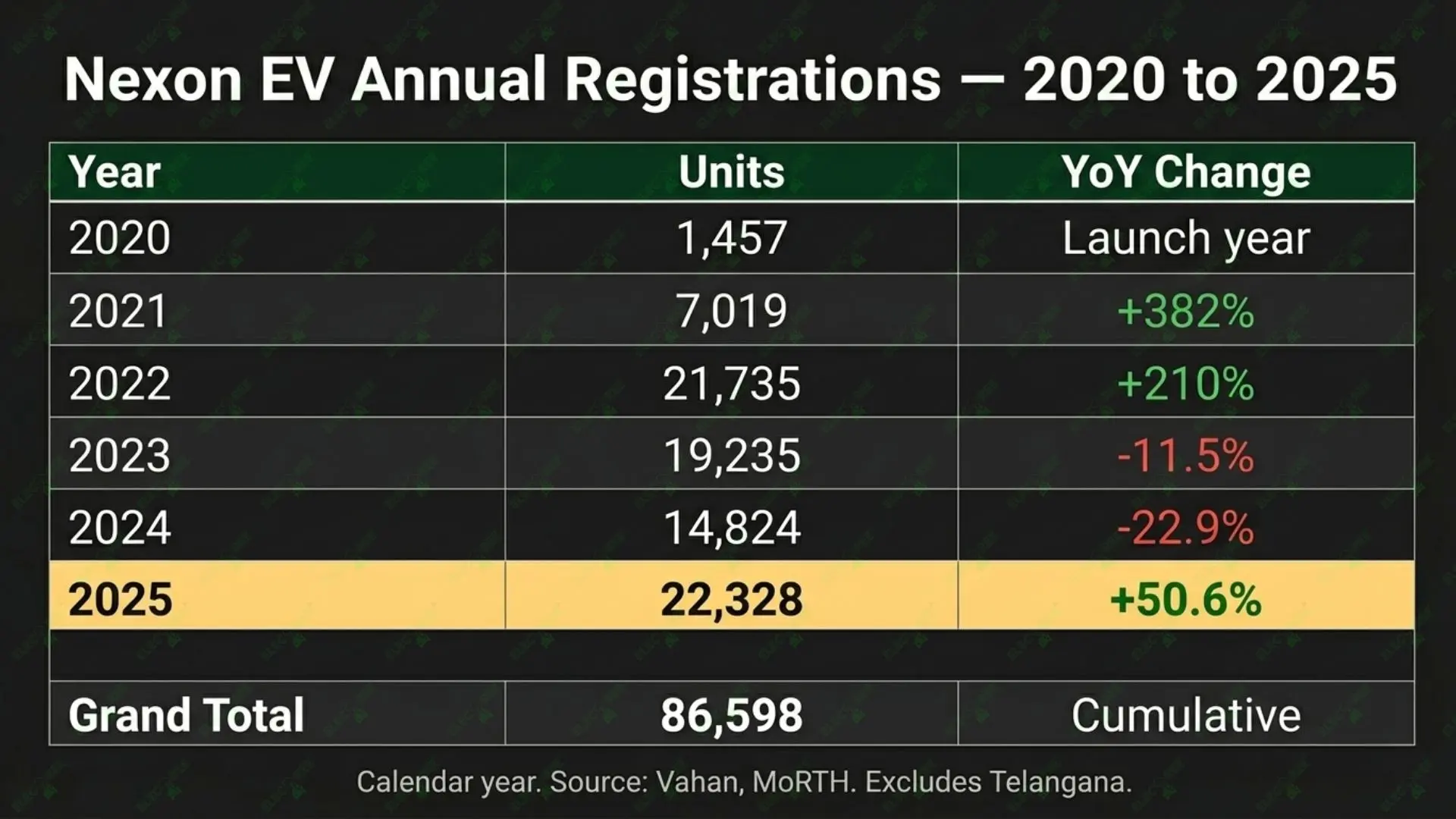
From 1,457 in 2020, the Prime drove total Nexon EV registrations to 7,019 in 2021 — a 382% increase in a single year. This was not the Prime getting better. This was India getting more comfortable with EVs, Tata building out its charging infrastructure and service network, and early owner experiences proving positive enough to generate word of mouth.
2022 saw the biggest single-year jump — 21,735 total units, a 210% increase over 2021. The Prime alone registered 15,640 units that year. But 2022 was also the year everything changed.
May 2022: The Max Arrives
In May 2022 — exactly two years after the Prime's first registrations — Tata introduced the Nexon EV Max. A larger 40.5 kWh battery, more range, higher price.
In its first eight months, the Max registered 6,095 units — a monthly run rate of 762 units. For context, the Prime had averaged 182 units per month in its first eight months two years earlier. The Max launched into a market the Prime had spent two years building, and it found buyers immediately.
The Max's first full calendar year was 2023, when it registered 8,888 units. In that same year, the Prime registered 5,136 units. The more expensive, longer-range variant was outselling the original by a ratio of 1.73:1.
This was the first clear data signal that Indian EV buyers, when given a choice between price and range, were choosing range.
September 2023: The Facelift and a New Challenge
In September 2023 Tata introduced the facelifted Nexon EV in two variants — the Facelift MR (Medium Range, 30 kWh) and the Facelift LR (Long Range, 40.5 kWh). These were the battery packs of Prime and Max but now fitted into the facelift version to give a modern look to an ageing design. In their first four months of availability, the Facelift LR registered 4,088 units against the Facelift MR's 1,123 — a ratio of 3.64:1 in favour of the longer range option.
The range preference finding from the Prime vs Max comparison had not just held — it had intensified.
But the broader Nexon EV numbers told a more difficult story. Total registrations fell to 19,235 in 2023 from 21,735 in 2022 — an 11.5% decline. For the first time since launch, the nameplate was going backwards.
2024: The Hardest Year
2024 was difficult, and much of the pressure came from within Tata's own lineup.
The Punch EV arrived on Tata's purpose-built Acti.EV platform. The Nexon EV is on Ziptron, a converted ICE platform — and as buyers became more aware of the difference, the Nexon needed a stronger reason to justify its higher price. The MG Windsor also launched in September 2024 and took some buyers away. Total registrations fell to 14,824 — the nameplate's lowest annual figure since 2021.
Tata's response was clear. The 40.5 kWh battery was discontinued. The Punch EV topped out at 35 kWh, and the new Nexon EV 45 came in at 45 kWh — creating clean separation between the two models. The 45 arrived in October 2024. What it did next is the real story.
October 2024: The 45 Changes Everything
The Nexon EV 45 — named for its 45 kWh battery pack — registered 2,996 units in its first three months of availability. A monthly run rate of 999 units, comparable to the Facelift LR's launch pace despite arriving into a far more competitive market.
What happened next is the most striking number in this entire dataset.
In 2025 — its first full calendar year — the EV registered 21,510 units. Total Nexon EV registrations for 2025 reached 22,328 — the highest annual figure in the nameplate's history, surpassing even the peak years of 2022 and 2023.
The 45 did not just rescue the Nexon “brand” from its 2024 decline. It took the nameplate to a new peak.
The Range Story: What Five Years of Data Proves
Across every generation transition, Indian buyers have consistently chosen the longer range option when given a choice at a comparable price point.
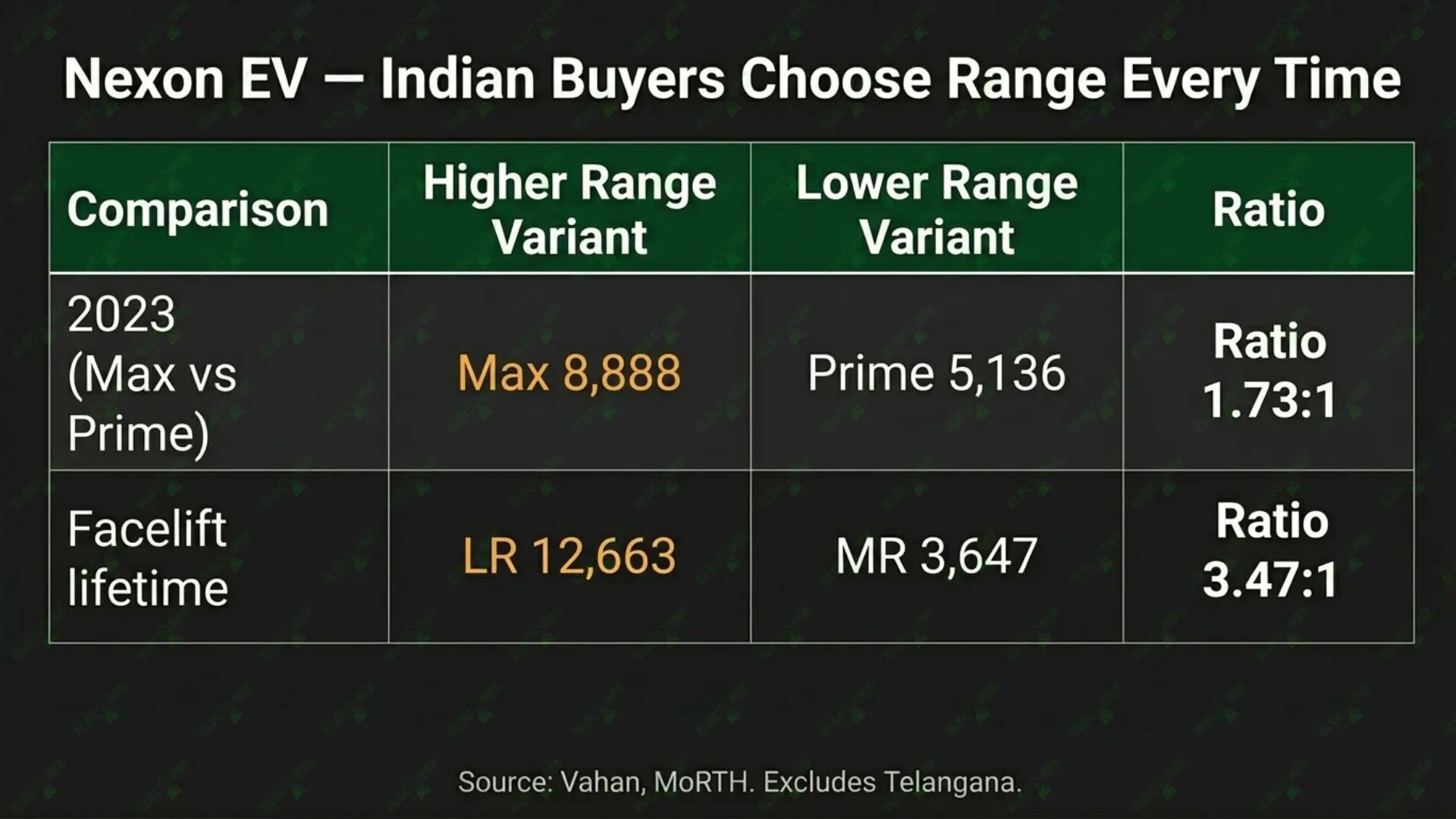
Max outsold Prime 1.73:1 in 2023. Facelift LR outsold Facelift MR 3.47:1 across their combined lifetimes. The Nexon EV 45 — the highest range Nexon EV ever offered — is now the only variant that meaningfully sells.
Five years of data makes this conclusion unavoidable: range anxiety is real among Indian EV buyers, and the Nexon EV's evolution has been driven by responding to it at every step.
The Five States That Trusted Tata
Across all generations and all six years, five states account for 70.3% of all Nexon EV registrations.
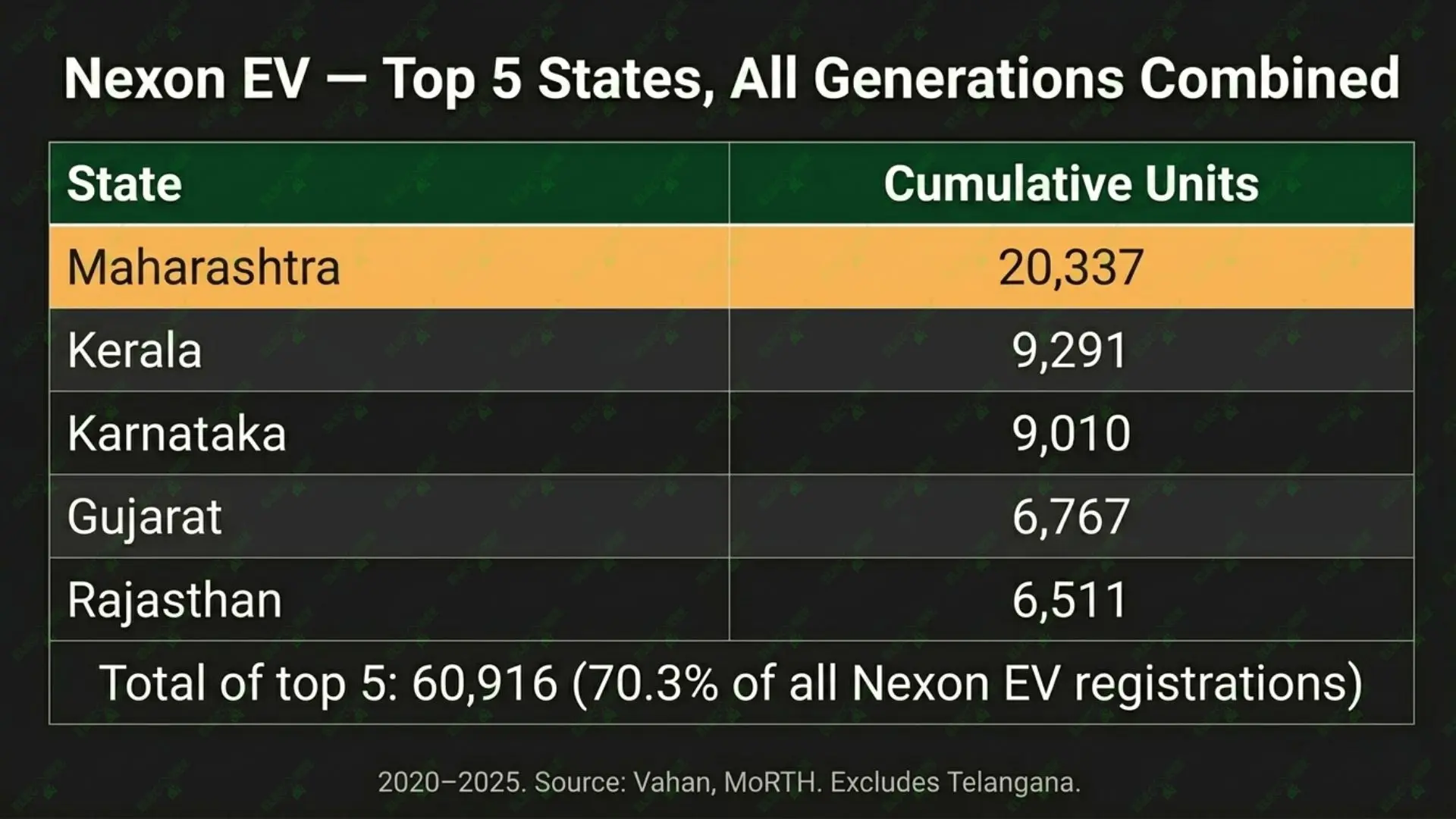
Maharashtra leads comprehensively at 20,337 units — 23.5% of all Nexon EV registrations nationally. Kerala at 9,291 and Karnataka at 9,010 follow, both states that were among the earliest adopters in 2020 and have remained loyal through every generation. Gujarat at 6,767 and Rajasthan at 6,511 complete the top five.
These five states did not just buy this EV — they built the ownership ecosystem around it. Their early adoption created the service experience, the charging infrastructure familiarity and the word-of-mouth that made this EV viable in newer markets over time.
What Comes Next
The 45 kWh version of the Nexon is currently the strongest-selling variant in the nameplate's history. But Tata is already working on what comes after.
A next-generation with a 55 kWh battery pack based on acti.ev platform — internally codenamed Garuda — is in development. If the pattern of this data holds, a larger battery will find a ready market. Every time Tata has offered more range, Indian buyers have chosen it.
86,598 registrations across five years and five generations. 37.8% of Tata's entire EV portfolio. A 2024 crisis navigated and a 2025 record set.
The Nexon EV is not just a car. It is the foundation on which India's mainstream EV market was built — and the data from the Vahan portal, state by state and variant by variant, confirms it.
Data source: Vahan portal, Ministry of Road Transport and Highways, Government of India. Excludes Telangana. Analysis by ElecTree.
Trending Articles