
Karnataka EVs Now Come With a Road Tax Bill. Here Is What Buyers Will Pay
Karnataka's zero road tax on electric vehicles ended on April 10, 2026. For the first time since 2016, buyers of mass market EVs in the state will pay a lifetime road tax at registration. Here is what changes, what does not, and what it costs.


Category:
Tag:
- Karnataka
- EV Road Tax
- EV Policy India
For nearly a decade, buying an electric car in Karnataka came with one quiet advantage that buyers rarely talked about but always appreciated — zero road tax.
That changed on April 10, 2026.
The Karnataka Motor Vehicles Taxation (Amendment) Act, 2026 received the Governor's assent on April 9 and came into effect the following day. Karnataka's 100% road tax exemption on battery-operated four-wheelers — in place since 2016 — is now gone. In its place is a lifetime tax linked to the vehicle's ex-showroom price, paid at the time of registration.
Data in this article is sourced from the Vahan portal, MoRTH.
What the New Tax Looks Like
The tax structure is straightforward:
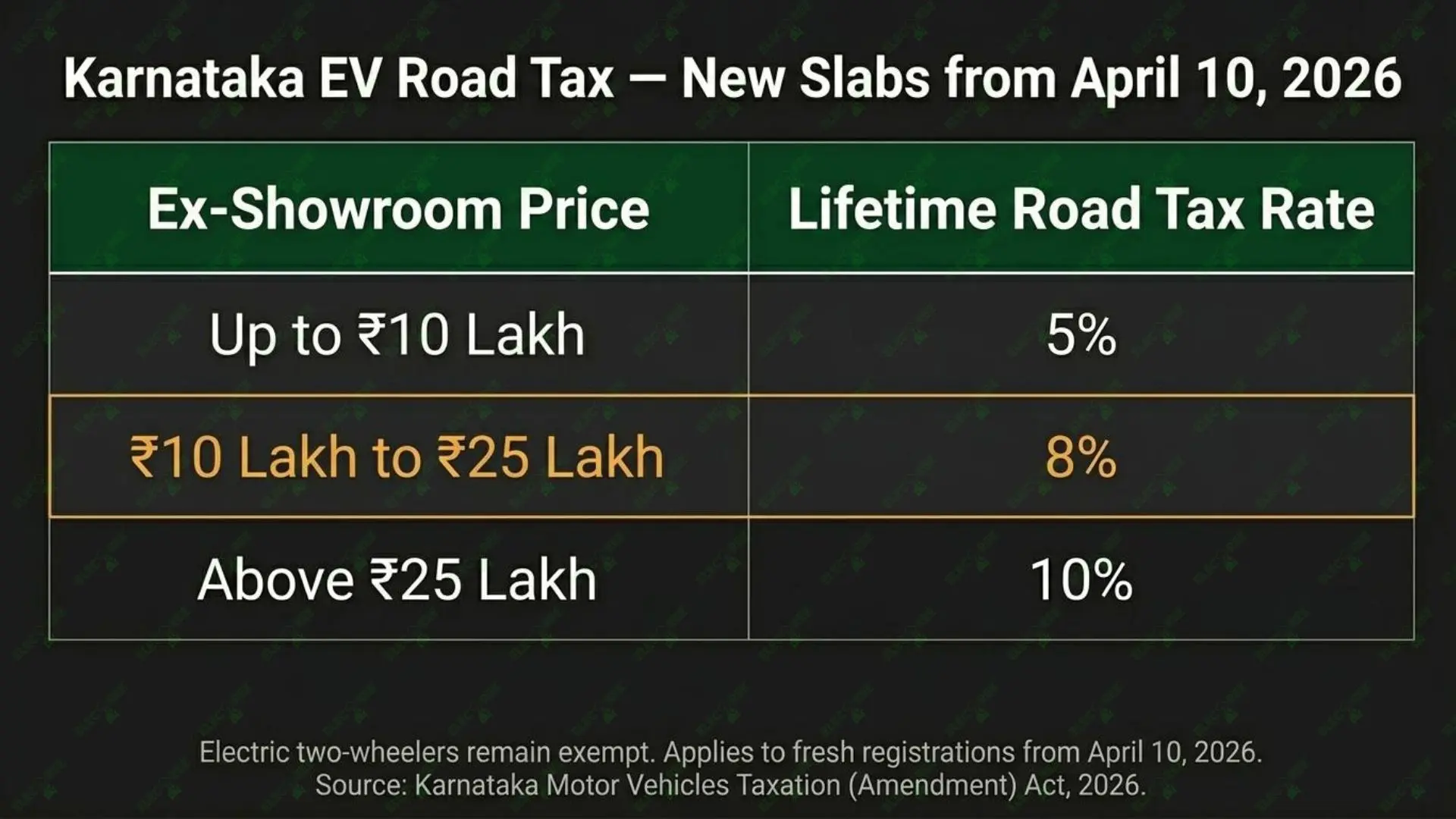
For the large majority of mass market EV buyers — those purchasing cars priced between ₹10L and ₹25L — the applicable rate is 8% of ex-showroom price. This is a one-time lifetime tax paid at registration, not an annual levy.
Electric two-wheelers continue to remain fully exempt. Existing EV owners who registered their vehicles before April 10 are not affected — the tax applies only to fresh registrations from that date onwards.
For vehicles brought into Karnataka from other states for re-registration, an age-based depreciated slab applies.
What Buyers Will Actually Pay
Two of the state's most popular mass market EVs illustrate the real rupee impact clearly.
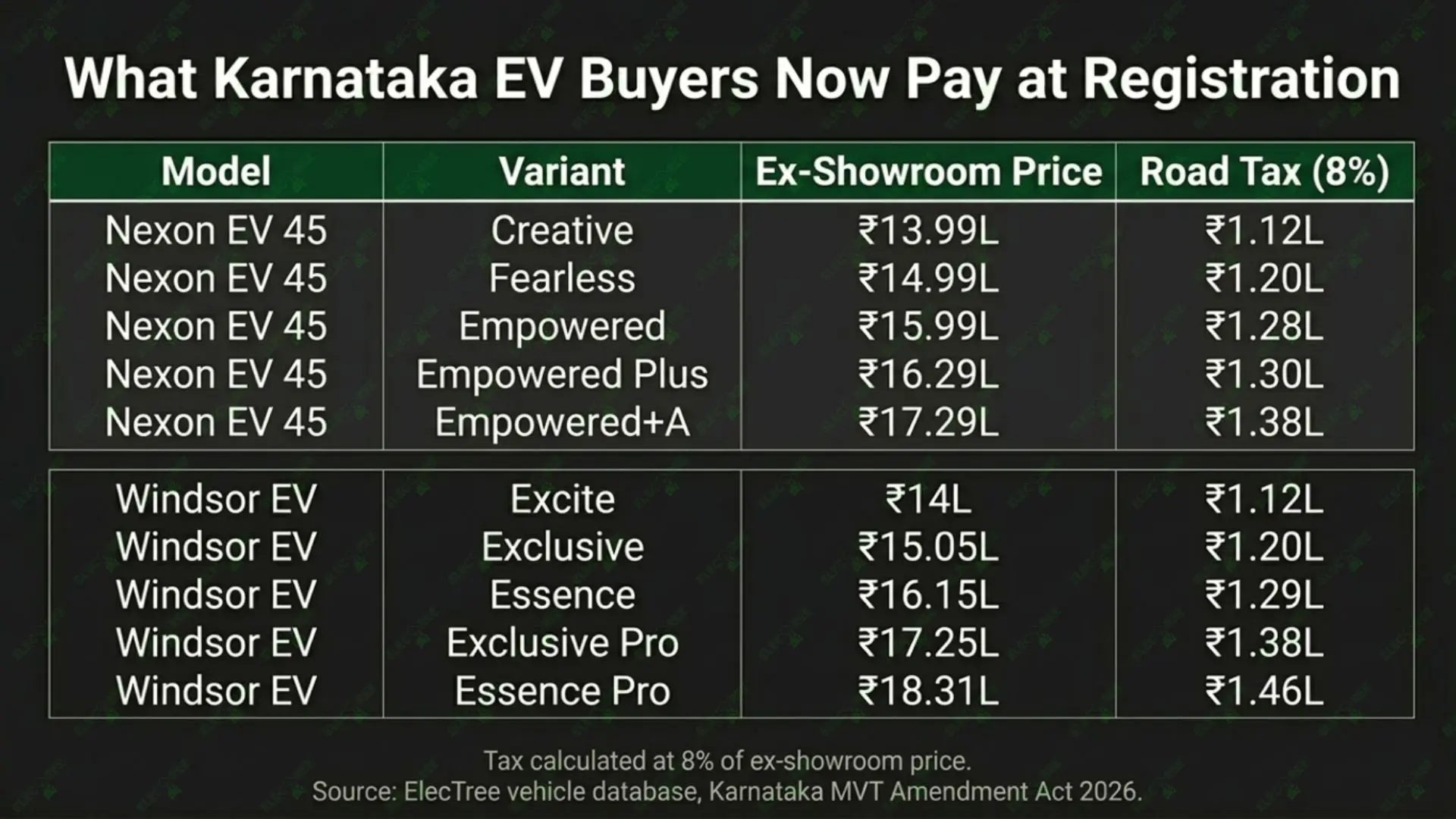
The Nexon EV 45, priced between ₹13.99L and ₹17.29L ex-showroom, now attracts road tax of ₹1.12L to ₹1.38L at registration. The Windsor EV, priced between ₹14L and ₹18.31L, attracts ₹1.12L to ₹1.46L.
Every single one of these variants paid zero road tax in Karnataka until April 9.
For context — ICE vehicles in Karnataka attract road tax of 13% to 18% of ex-showroom price. Even under the new structure, EV buyers pay significantly less than petrol or diesel car buyers at equivalent price points. A petrol car at ₹15L would attract roughly ₹2L or more in road tax. The same EV pays ₹1.2L. The advantage has narrowed, but it has not disappeared.
The ₹25 Lakh Threshold and the Pricing Game That Is Now Over
Under the old policy, EVs priced above ₹25L ex-showroom were already subject to road tax. The exemption applied specifically to vehicles below this threshold.
Over time, this created a quiet but deliberate pricing pattern. Several manufacturers kept their top variants priced at ₹24.49L or ₹24.99L — just under the threshold — to ensure Karnataka buyers could purchase a feature-loaded car with zero road tax. That pricing arbitrage is now irrelevant. The new structure taxes all EVs regardless of price, removing any incentive to stay under ₹25L for tax purposes.
Karnataka's EV Market — What the Data Shows
Karnataka has registered 53,793 four-wheeler EVs between 2020 and 2025. FY2025-26 — the financial year that ends with this tax coming into effect — recorded 24,428 registrations, the highest in the state's history.
Within this market, the Windsor EV registered 3,891 units in Karnataka between CY 2025 . The Nexon EV 1,968 units in the same time period. Windsor's faster Karnataka ramp in a fraction of the time since launch reflects both the model's broad appeal and the state's growing EV appetite. (Note: Model wise data is available till Dec'25, hence FY 25-26 is not reported here.)
The Karnataka government expects the new tax to generate approximately ₹250 crore in additional revenue annually. At current registration run rates, that is a plausible target.
A Reasonable Decision, Poorly Timed
Zero road tax forever was never a sustainable policy. At some point, EVs had to graduate from incentive-dependent products to mainstream vehicles taxed like any other. Karnataka's decision to impose road tax is not unreasonable in principle — and the rates, at 5-10%, are still well below what ICE vehicle buyers pay.
But the timing is hard to defend. The state's EV market was accelerating — FY2025-26 was its strongest year on record. The state was building momentum at precisely the moment the government chose to add a five-figure cost to every new registration.
The more difficult question is whether this signals a broader shift. Karnataka has historically been among India's more EV-forward states. If other states read this as a signal that the incentive era is ending, the impact on national EV adoption could extend well beyond Bengaluru's registration offices.
For now, the practical reality for a Karnataka buyer is simple: budget an additional ₹1.12L to ₹1.46L for a mass market EV purchase. It is not a dealbreaker. But it is no longer free.
Source: Vahan portal, MoRTH. Karnataka Motor Vehicles Taxation (Amendment) Act, 2026.
Trending Articles


Recent Articles
Renault Duster Hybrid vs Maruti Victoris Hybrid: All Variants Compared
Duster Hybrid vs Hyryder Hybrid: Prices, Powertrain and Variants Compared
Top 5 Best Selling EVs This Year: Windsor Leads with Clear Margin
Renault Duster Hybrid vs Maruti Suzuki Grand Vitara Hybrid: Base, Mid, and Top Variant Comparison