Did EVs Help BMW Scale Mt. Mercedes?
BMW outsold Mercedes in India for the first time in the last 8 years in early 2026. The margin? Just 155 cars. But the EV gap? Nearly 900 units. A data story on how the iX1 rewrote the rulebook.

Category:
Tag:
- BMW India
- Mercedes-Benz India
- BMW vs Mercedes
- Luxury Car Market India
- BMW iX1
- Electric Vehicle India
- Luxury EV India
How a massive bet on electric vehicles allowed BMW to finally close an 8-year gap with India’s undisputed luxury leader.
Mercedes vs BMW – The age-old rivalry
For the better part of a decade, the hierarchy of the Indian luxury car market was set in stone: Mercedes-Benz at the summit, and BMW trailing firmly behind.
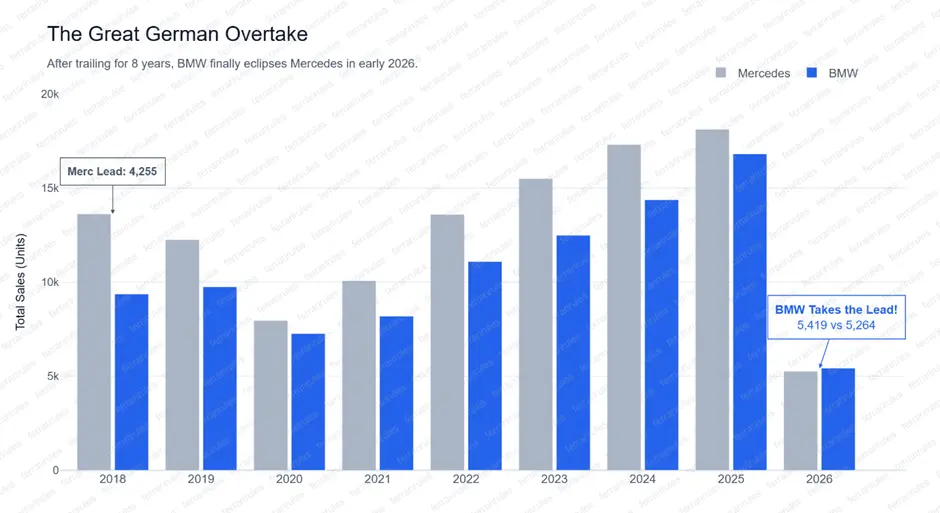
If we rewind to 2018, the gap was staggering. Mercedes-Benz sold 13,621 cars to BMW’s 9,366—a colossal lead of over 4,200 units. Year after year, Mercedes maintained its dominance, leaning heavily on its entrenched diesel portfolio, which accounted for a massive 78.5% of its sales in 2018 and 40% of its sales in 2025.
But in 2026, the unthinkable happened. By the end of Q1, BMW didn't just catch up—they overtook Mercedes, selling 5,419 units compared to the Three-Pointed Star’s 5,264.
So, how did BMW scale Mt. Mercedes? The answer isn't found in their petrol or diesel lineups. The answer is electric.
The Electric Divergence
To understand this upset, we must look at how both brands navigated the inevitable transition away from diesel. Both OEMs continued selling diesels in the BS6 era, but after 2020, the consumer preference started shifting away from Diesel cars.
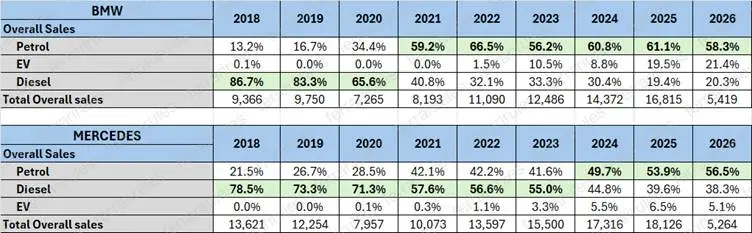
As seen in the image above, diesel is still a preference for Mercedes customers, whereas EVs have become a bigger preference for BMW customers. Let’s see how this change happened
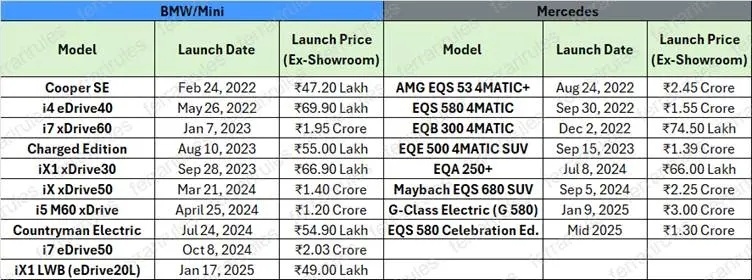
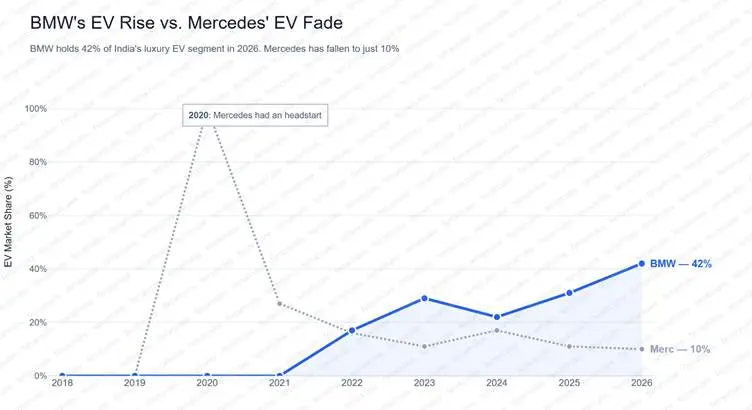
Mercedes took a head start by launching their first EV - EQC in 2020 at ₹99.3 lakh, and BMW had no EV launch until 2022
From 2022, both brands started launching multiple electric models. BMW’s EV share was a mere 1.5%, while Mercedes sat at 1.1%. But then, their strategies sharply diverged.
Mercedes took a conservative, top-down approach. They introduced highly premium, low-volume models like the EQS and EQE, treating EVs as a niche luxury segment rather than a volume driver. Their EV share crept up slowly: 3.3% in 2023, 5.5% in 2024, and peaking at just 6.5% in 2025.
BMW went all in, they recognized that while the luxury buyer was willing to transition away from diesel, they needed practical, accessible electric options. BMW’s EV share exploded to 10.5% in 2023. By 2025, while Mercedes was still hovering at 6.5%, nearly 1 in 5 cars BMW sold was electric (19.5%).
The iX1 Catalyst
If EVs were the weapon, the BMW iX1 was the silver bullet.
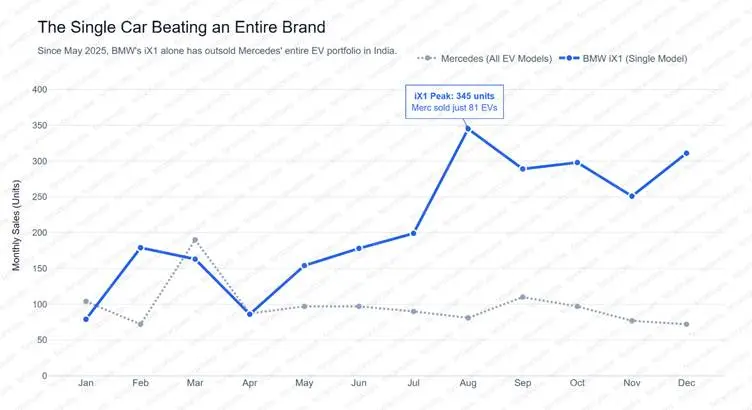
A look at the specific model sales data reveals just how heavily BMW relied on this single vehicle. Retailing as the entry point to BMW’s electric SUV lineup, the iX1 found an immediate audience among luxury buyers looking for a premium, urban-friendly EV without the flagship price tag.
Launched at the Auto Expo 2025 with an aggressive price tag of ₹49 lakhs, it became an immediate crowd favorite. In fact, the iX1 alone outsold Mercedes’ entire EV lineup for the whole of 2025
By 2026, BMW’s EV penetration has reached a staggering 21.4% of its sales volume. In real numbers, that means out of the 5,419 cars BMW sold in the first few months of 2026, over 1,150 were electric.
Compare that to Mercedes, in the same 2026 period, Mercedes' EV share contracted down to 5.1% of its sales volume. They managed only around 268 EV sales against a total volume of 5,264.
The Math is Undeniable. Let’s look at the raw math of 2026:
Total Sales Gap: BMW led by roughly 155 cars.
EV Sales Gap: BMW sold roughly 890 more EVs than Mercedes.
If you remove electric vehicles from the equation, Mercedes is still winning the traditional internal combustion race, commanding a 37% share of the petrol market and a dominant 56% share of the diesel market.
But BMW didn't win by beating Mercedes at the diesel game. They won by creating an entirely new volume pillar. By aggressively pushing models like the iX1 and making luxury EVs more accessible to the consumer. BMW captured the entry-level luxury EV market.
Summary
The data tells a clear story: BMW didn’t just scale Mt. Mercedes. They took an electric elevator to the top. Having said that, Mercedes is not sitting idle; it is responding with the CLA electric. Let’s see who comes out on top by the end of 2026 – Mercedes or BMW?
Disclaimer - Above is sourced from Vahan. The data doesn't include Telangana data
Trending Articles